
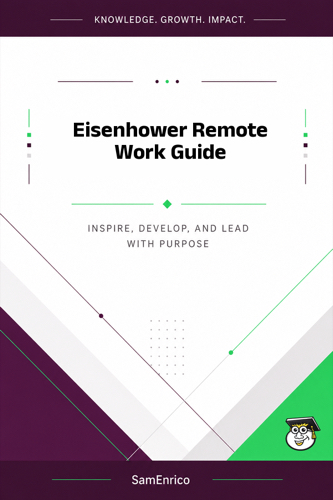
Eisenhower Remote Work Guide eBook
Prioritize asynchronously when managing distribute
by Low Tawanna
Prioritize asynchronously when managing distributed teams.
Formats
Free sample
Chapter 1: The Burnout Machine--We have a disease, and its name is urgency.Not the real kind—the server-on-fire, client-in-crisis, legal-department-on-the-phone kind. That kind of urgency is rare, legitimate, and necessary. No, the disease I am talking about is the manufactured, contagious, self-propagating urgency that has colonized every corner of modern remote work. It lives in your Slack notifications. It breathes in the back-to-back Zoom calls that fill your calendar from 9 AM to 5 PM.
It multiplies every time someone types "quick question" or "can you jump on a call?" or "just circling back on this."And it is killing your team.Not slowly, either. The data is brutal and unambiguous. Since the mass shift to distributed work models in 2020, the average knowledge worker's meeting load has increased by nearly 13%. Telephone calls—actual phone calls—have increased by a staggering 230%. Activity in customer relationship management (CRM) systems has exploded by 176%.
We are doing more. We are communicating more. We are documenting more. And yet, according to a landmark study by Microsoft's Human Factors Lab, the average employee's ability to focus without interruption has dropped by nearly 40%.We have mistaken noise for productivity. We have confused motion for progress.
We have built a Burnout Machine, and we are feeding it with every ping, every notification, and every "quick sync."This chapter diagnoses that disease. It names the enemy. And it offers the first glimpse of the antidote: the Async Mindset. But before we get to the cure, we need to understand just how sick we really are.The Great Illusion: Productivity Theater Let me paint a scene that will feel familiar to anyone reading this book.It is 4:47 PM on a Wednesday. You have been in meetings since 9 AM.
There was the 9:15 stand-up where everyone reported what they were "going to do today." Then the 10 AM client call that ran over by twenty minutes. Then the 11 AM cross-functional sync where six people debated a decision that could have been an email. Then lunch—eaten over your keyboard while responding to Slack messages. Then the 1 PM project review. Then the 2:30 one-on-one with a direct report.
Then the 3:45 "quick check-in" with the product team that turned into a full hour.You look at your to-do list. Nothing is crossed off. The strategic memo you needed to write? Still blank. The performance review you promised to complete?
Still pending. The deep analytical work that actually moves the needle? Still waiting.And yet, you are exhausted. You have been "busy" all day. Your Slack status has been green.
Your calendar is a war crime of color-coded blocks. If anyone asked, you would say you worked hard.This is what Liam Martin and Rob Rawson, authors of the Wall Street Journal bestseller Running Remote, call "productivity theater." It is the performance of work without the production of results. It is looking busy instead of being effective. And it has become the default operating mode for most distributed teams.The tragedy is that productivity theater feels real. The dopamine hit of a resolved Slack thread, the sense of accomplishment from closing a browser tab, the exhaustion that comes from a full day of back-to-back calls—these all create the sensation of progress.
But sensation is not results. Activity is not achievement.I have worked with dozens of remote teams across technology, marketing, finance, and healthcare. In almost every case, the leaders I coach initially believe they are "too busy" to implement new systems. They show me their calendars, which are indeed full. They show me their Slack analytics, which show hundreds of messages per day.
They show me their email inboxes, which are a bottomless pit of requests.And then I ask a simple question: "What did you actually accomplish this week?"The silence is deafening.The Data Doesn't Lie: We Are Drowning Let me share some numbers that should terrify every leader reading this book.According to a comprehensive study by the workforce analytics firm Asana, knowledge workers spend only 28% of their workweek on "skilled, strategic, or creative work." The remaining 72% is consumed by what the study calls "work about work"—searching for information, switching between applications, chasing approvals, attending status updates, and responding to messages.Seventy-two percent. Think about that for a moment. For every eight-hour workday, your team spends nearly six hours on activities that do not directly produce value. Only two hours go toward the work that actually matters.The cost is staggering. A separate analysis by the consulting firm Mc Kinsey & Company estimated that the average employee spends 28% of their workweek just reading and responding to email.
For a team of one hundred knowledge workers earning an average of $80,000 per year, that translates to over $2.2 million annually in lost productivity—just from email.But email is only the beginning.The disruption caused by context-switching—moving between different tasks, applications, or modes of communication—is even more expensive. Research from the University of California, Irvine, found that it takes an average of 23 minutes and 15 seconds to fully refocus after a single interruption. If you are interrupted fifteen times per day (a conservative estimate for most knowledge workers), you are losing nearly six hours of focused work every week to recovery time alone.And here is the cruelest irony: most of these interruptions are self-inflicted. We are not being interrupted by external crises. We are being interrupted by our own communication habits.
We check Slack every eleven minutes. We compulsively refresh email. We say "yes" to meetings we know we do not need to attend.We have built a Burnout Machine, and we are the ones feeding the fire.The FOMO Trap: Why We Can't Stop If the data is so clear—if constant communication is demonstrably destroying our productivity, our focus, and our mental health—why do we keep doing it?The answer lies in a psychological phenomenon that social scientists call "FOMO" : the Fear Of Missing Out. In a remote work context, FOMO manifests as the anxiety that if we are not constantly monitoring our communication channels, we will miss something critical. A decision will be made without us.
A problem will escalate because we did not respond quickly enough. An opportunity will pass us by.This anxiety is not irrational. In many organizations, the unspoken expectation is that employees will be "available" during core hours. A Slack message that goes unanswered for more than thirty minutes is noted. An email that requires a follow-up "just circling back" is implicitly a criticism.
A meeting invitation that is declined is a political risk.But here is the truth that most leaders refuse to acknowledge: the Fear Of Missing Out is a symptom of broken systems, not a requirement of remote work.When information flows through private DMs and undocumented conversations, FOMO is inevitable. When decisions are made in live meetings that are not recorded or summarized, FOMO is rational. When the only way to know what is happening is to be constantly present, FOMO is a survival mechanism.The solution is not to try harder. The solution is to change the system entirely.Introducing the Async Mindset There is an alternative to the Burnout Machine. It is called asynchronous communication—or, as it is often abbreviated, async.Async means collaboration without…
This is the end of the free sample. Get the eBook to keep going. Buy now
About this book
Details
- Author
- Low Tawanna
- Publisher
- SamEnrico
- Language
- English
- Genre
- Non-Fiction, Self-Help, Remote
- Released
- 2026-06-09
- Pages (approx.)
- 150
- Available as
- eBook, Audiobook

Read better in the ZLOADR app
Your eBooks on your phone or tablet. Sign in with your SamEnrico account and start reading.
More by Low Tawanna
 Eating Disorder Sleep RecoveryLow Tawanna$11.99
 Empathy for Eating DisordersLow Tawanna$11.99
 Step Four Inventory WorkbookLow Tawanna$11.99
 DBT for Caregiver BurnoutLow Tawanna$11.99
 Remote Work for EngineersLow Tawanna$11.99
 NVC Gratitude ExpressionLow Tawanna$11.99
 Cold Turkey Quitting PreparationLow Tawanna$11.99
 The Phantom Lovers of New Zealand: The Strange Case of the 1930s 'Alien' AbductionsLow Tawanna$11.99
 Enki’s Rise: The God Who Shattered HeavenLow Tawanna$11.99
 How to Produce Tool SocketsLow Tawanna$11.99
 A Collector's Handbook to the Hillman New Minx (1967-70)Low Tawanna$11.99
 A Beginners Guide to Motorcycle speedway (Volume 1)Low Tawanna$11.99
You may also like
 Hong Kong Handover 1997Dunn Johnnie$11.99
 Zumba For Postnatal Recovery CourseNeal Christian$11.99
 Zumba for BeginnersLadner Nikia$11.99
 YouTube Comment Mining GuideHumes Pandora$12.99
 Worry Box MeditationCarlin Rudy$11.99
 Workplace Stress MeditationNguyen Lynn$11.99
 Workplace Stress and Sleep RepairHawley Ivory$11.99
 Workplace Perfectionism CureDelaney Jeffry$11.99
 Workplace Injustice Anger GuideWallen Isabelle$11.99
 Work Addiction and Burnout LinkGreenwood Ester$11.99
 Women in Yoga and WellnessBeattie Galina$11.99
 Women in Stand Up ComedyChun Evangeline$11.99