
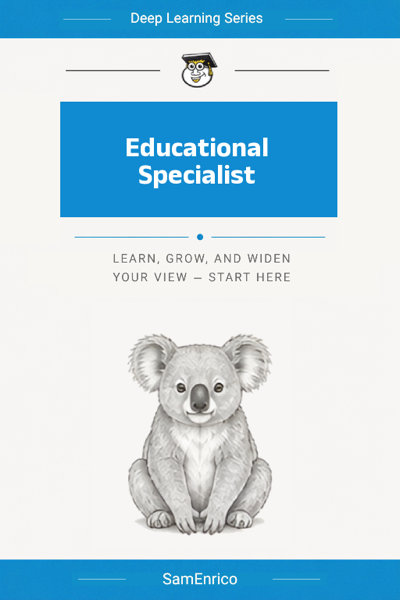
Non-FictionInformativeEducational
Educational Specialist eBook
A Coursebook on Educational Specialist
by Ho Ali
A Coursebook on Educational Specialist
Formats
Free sample
Chapter 1: The Hidden Leverage--–- Every Educational Specialist I have ever met carries a secret. Not the kind of secret that involves wrongdoing or shame, but the kind that involves exhaustion and hope held in equal measure. The secret is this: you were hired to solve problems that no one else could solve, but you were given almost no authority to make anyone do anything. You are expected to improve teaching without being anyone's boss. You are expected to fix systemic inequities without rewriting a single policy.
You are expected to reduce referrals, close gaps, and raise scores, all while being the person who says "let me see what I can do" a hundred times a day.The secret becomes heavier the longer you carry it. In your first year, you feel energized by the challenge. You stay late, arrive early, and believe that your expertise and effort will be enough. By your third year, you have learned that expertise without influence is useless and that effort without strategy is just burnout in slow motion. By your fifth year, you have either figured out where the real leverage points are, or you have left the profession entirely.
There is almost no middle ground.This chapter is about the leverage points. Not the ones you read about in graduate school—the elegant theories, the evidence-based practices, the fidelity checklists—but the real ones. The ones that exist in the messy, under-resourced, politically complicated space where schools actually operate. The ones that separate specialists who make a difference from specialists who just make themselves exhausted.We begin by clarifying something that most job descriptions get wrong: what an Educational Specialist actually is. Then we distinguish that role from the roles it is most often confused with: teacher and administrator.
Then we introduce the single most important shift in your professional identity—the move from pedagogy to andragogy—and show you why teaching adults is fundamentally different from teaching children. Finally, we give you an ethical decision-making framework for the moments when every option feels wrong and you have to choose the least bad path forward.By the end of this chapter, you will know exactly where you stand. Not because I have told you who you should be, but because you will have the tools to see your own role clearly for the first time. And clarity, in this work, is the rarest and most valuable thing of all.The Invisible Architecture of the Specialist Role Let me tell you a story that explains the entire problem with how we think about Educational Specialists. A few years ago, I watched a literacy coach walk into a first-grade classroom.
The teacher, a fifteen-year veteran, was struggling with guided reading groups. The coach sat in the back, took notes, and after the lesson, asked if she could share a few observations. The teacher said yes, but her crossed arms and tight jaw said no.The coach began with a compliment—something genuine about the teacher's rapport with students. Then she offered a single suggestion: rearrange the furniture so that the teacher could see all four groups at once. The teacher dismissed it.
Said she had tried that before. Said the kids just talked to each other. The coach nodded, thanked her for the conversation, and left.Three weeks later, the coach walked by the same classroom and noticed that the furniture had been rearranged exactly as she had suggested. The teacher saw her looking and shrugged. "I tried it," she said.
"It works better."The coach told me this story as a victory, and it was. But what interests me is not that the teacher eventually changed. What interests me is why she changed. She did not change because the coach had authority over her. The coach had none.
She did not change because the coach presented evidence. The teacher already knew the research on classroom arrangement. She changed because the coach had planted an idea in soil that was not yet ready, and then she had waited without pushing, without checking in, without demanding implementation data.That is the architecture of the specialist role. It is invisible because the most important work happens inside other people's heads, not on any checklist. It is slow because human beings do not change their practices on command.
And it is frustrating because you will rarely get credit for the seeds you plant, only for the harvests that others reap.The Educational Specialist is a hybrid role, but not in the way most people mean. It is not a mix of teaching and administration, as if you could average the two roles and land somewhere in the middle. It is something else entirely. The teacher controls the classroom. The administrator controls the building.
The specialist controls neither. What the specialist controls is access, trust, and the timing of interventions.Think of it this way. A teacher who wants to improve literacy instruction can change what happens in their own classroom starting tomorrow. An administrator who wants to improve literacy instruction can mandate a new curriculum for the entire building, though it might take a year and a lawsuit. A specialist who wants to improve literacy instruction has neither the classroom autonomy of the teacher nor the policy authority of the administrator.
What the specialist has is the ability to be in many classrooms, to see patterns that no individual teacher can see, and to build relationships that make change possible without making it mandatory.This is why the specialist role is both the most powerful and most precarious position in the school. Powerful because you see the system whole while everyone else sees only their piece of it. Precarious because your influence depends entirely on your credibility, and credibility takes years to build and seconds to destroy.The Role Spectrum: What You Actually Control Let us be precise about what you do and do not control. The table below is not theoretical. It comes from watching hundreds of specialists succeed and fail over two decades.
Use it as a diagnostic tool for your own practice, not as a prescription for what should be.Function Teacher Control Specialist Influence Administrator Control Classroom instruction Full Moderate (through coaching)Limited (through evaluation)Curriculum materials Moderate Moderate (through recommendation)Full (through adoption)Professional development Low High (through design and delivery)Full (through mandate)Student placement Low Moderate (through assessment)Full (through scheduling)Budget allocation None Low (through needs assessment)Full Personnel decisions None Low (through feedback)Full School schedule None Low (through advocacy)Full Intervention design Moderate High (through expertise)Moderate (through approval)Notice the pattern. Teachers control what happens inside their own classrooms but have almost no influence on the systems that surround those classrooms. Administrators control the systems but have limited visibility into individual classrooms. Specialists sit in the middle, seeing both the classroom and the system, and their influence comes from translating between the two.A specialist who tries to act like an administrator will fail. You cannot mandate your way to change because you have no mandate.
A specialist who tries to act like a teacher will also fail. You cannot directly instruct your way to change…
This is the end of the free sample. Get the eBook to keep going. Buy now
About this book
Details
- Author
- Ho Ali
- Publisher
- SamEnrico
- Language
- English
- Genre
- Non-Fiction, Informative, Educational
- Released
- 2026-05-04
- Pages (approx.)
- 149
- Available as
- eBook, Audiobook

Read better in the ZLOADR app
Your eBooks on your phone or tablet. Sign in with your SamEnrico account and start reading.
More by Ho Ali
 Partner Illness Self EsteemHo Ali$11.99
 Lewis Graphic Novel MemoirHo Ali$11.99
 Kigali Lean Product LaunchHo Ali$11.99
 The Retail Reward Dopamine GuideHo Ali$11.99
 Five Minute Body Scan BreaksHo Ali$11.99
 The Torso in the Suitcase: Australia's Most Baffling Dismemberment CaseHo Ali$11.99
 Understanding PseudohypoparathyroidismHo Ali$17.99
 Genetic Information GINA TrapHo Ali$12.99
 Excel Economic Forecasting ErrorsHo Ali$12.99
 How to Become a Open-developer OperatorHo Ali$11.99
You may also like
 Hong Kong Handover 1997Dunn Johnnie$11.99
 Zumba For Postnatal Recovery CourseNeal Christian$11.99
 Zumba for BeginnersLadner Nikia$11.99
 YouTube Comment Mining GuideHumes Pandora$12.99
 Worry Box MeditationCarlin Rudy$11.99
 Workplace Stress MeditationNguyen Lynn$11.99
 Workplace Stress and Sleep RepairHawley Ivory$11.99
 Workplace Perfectionism CureDelaney Jeffry$11.99
 Workplace Injustice Anger GuideWallen Isabelle$11.99
 Work Addiction and Burnout LinkGreenwood Ester$11.99
 Women in Yoga and WellnessBeattie Galina$11.99
 Women in Stand Up ComedyChun Evangeline$11.99