
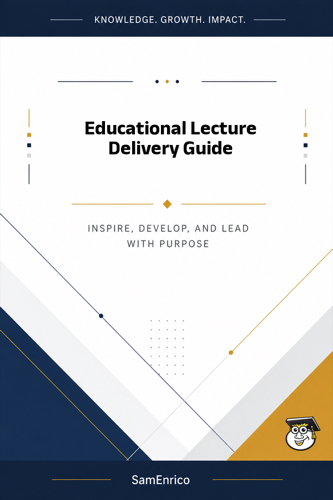
Educational Lecture Delivery Guide eBook
Teaches effectively from a podium.
Teaches effectively from a podium.
Formats
Free sample
Chapter 1: The Pivot Point--–- The overhead lights hummed. Fifty-four undergraduates sat in stadium-style rows, phones face-down on armrests, eyes fixed on a middle-aged man standing behind a wooden lectern. His slides were immaculate. His suit was pressed. His voice was steady.
And every single student in that room was silently praying for a fire alarm.This was not a failing teacher. This was a tenured professor of political science at a respected university. He had won teaching awards—years ago. He had published books. He knew the material cold.
But on this Tuesday morning, he was losing them not because he was wrong, not because he was unprepared, but because he had confused preparation with presence. He had mistaken the podium for protection rather than recognizing it as an instrument.That professor was me fifteen years ago. And this book is the manual I wish I had been given on my first day of graduate teaching assistant training.The podium is not a barrier. It is not a shield. It is not a crutch for anxious lecturers or a throne for arrogant ones.
The podium is a pivot point—the single most powerful fulcrum in educational delivery. From it, you can either bore a room into submission or ignite a chain reaction of understanding that outlasts the final exam by years. The difference is not charisma. It is not genetics. It is not the luck of being a "natural speaker." The difference is a set of teachable, repeatable, observable skills that this chapter—and this entire book—will place in your hands.But before we get to the techniques, we have to settle a more fundamental question.
One that has split faculty lounges, derailed curriculum committees, and sparked a thousand Twitter wars between pedagogy purists and old-school lecturers. The question is this: in an age of active learning, flipped classrooms, and collaborative technology, does the podium lecture still deserve a place in education?The answer, which this chapter will defend with evidence and nuance, is yes—but only if you stop defending the wrong thing.The War on Lectures (And Why Most Arguments Miss the Point)For the past two decades, educational reformers have waged a sustained campaign against the traditional lecture. The indictment is familiar: lectures are passive, teacher-centered, one-size-fits-all relics of a medieval university system. The research is often cited—Freeman et al.'s famous 2014 meta-analysis in PNAS, which found that students in active learning environments scored half a letter grade higher than those in traditional lectures. Critics have declared the lecture dead, or at least terminally ill.But here is what the critics rarely acknowledge.
The same meta-analysis that seemed to bury the lecture contained a crucial caveat: the "traditional lecture" being compared was almost always the poorly delivered lecture—the monotone recitation of bullet points, the unbroken fifty-minute stream of facts, the professor who reads slides verbatim. No serious defender of the lecture has ever advocated for that. The debate has been rigged from the start: excellent lectures were never compared to excellent active learning; bad lectures were compared to anything else, and anything else won.This book takes a different position. I am not here to defend bad lecturing. I am here to argue that the lecture format, when executed with the specific skills taught in these twelve chapters, is not merely a fallback option for large classes or underfunded departments.
It is, in specific and identifiable contexts, the most efficient and effective method of transferring conceptual frameworks, modeling expert thinking, and establishing intellectual authority.When does the podium outperform the breakout room? When you need to:Establish a shared conceptual foundation before any meaningful discussion can occur. You cannot have a productive small-group debate about constitutional law if half the room does not know what stare decisis means. The lecture builds that floor efficiently.Model expert reasoning in real time. A chemist working through a complex mechanism on a chalkboard, narrating every decision point and dead end, is doing something that no reading assignment or video can replicate.
Students are watching a mind work.Create a collective emotional and intellectual experience. A lecture on the Harlem Renaissance, delivered with vocal pacing, selected audio clips, and well-timed silence, can produce a shared moment of cultural awakening that no amount of individual worksheet completion can match.Maximize cognitive efficiency for foundational knowledge. There is a reason medical schools still use lectures for anatomy and pharmacology: when the baseline knowledge is vast and non-negotiable, the lecture is the fastest vector from expert to novice.The problem is not the lecture. The problem is that we have never systematically trained lecturers in the same way we train surgeons, orchestral conductors, or trial lawyers. We assume that a Ph D in history automatically confers the ability to perform history for a room of exhausted nineteen-year-olds.
That assumption is catastrophic. And it is the reason this book exists.The Leadership Mindset: Owning the Space Before You Open Your Mouth Steven D. Cohen, one of the most incisive voices in communication training, introduced a concept that will serve as the backbone of this first chapter and will echo throughout the book: the Leadership Mindset.The Leadership Mindset is not about dominance. It is not about volume. It is not about reminding students that you are the expert and they are the novices.
The Leadership Mindset is the internal shift from hoping the lecture goes well to knowing that you have prepared a container sturdy enough to hold the room's attention, and flexible enough to adapt when the container needs to stretch.Here is what the Leadership Mindset looks like in practice, three minutes before you walk into the classroom.Most lecturers spend those three minutes reviewing their slides, checking their notes, or worst of all, scrolling email. A lecturer with the Leadership Mindset spends those three minutes doing a psychological sound check. They ask themselves three questions:What is the single most important idea that students must leave with today?Where is the natural energy dip in my material, and what have I planned to counter it?What am I genuinely excited to share?Notice what is missing from those questions. There is no "Will they like me?" There is no "What if I forget something?" There is no "What if someone asks a question I cannot answer?" The Leadership Mindset shifts attention from self-protection to service delivery. You are not performing for approval.
You are building a bridge from your expertise to their curiosity. The bridge may wobble. It may need repair mid-lecture. But you are the engineer, not the supplicant.This mindset is not innate. I have coached Nobel laureates who trembled before undergraduate classes and first-year teaching assistants who walked into a lecture hall with the quiet confidence of a concert pianist.
The difference was never talent. The difference was whether they had internalized the belief that their role was to lead attention, not to perform for approval.The Pivot Point: Why This Metaphor Matters Let me dwell on the title of this chapter for a moment: The Pivot Point.In biomechanics, a pivot point is the fixed anchor around which movement organizes. A lever cannot lift a load…
This is the end of the free sample. Get the eBook to keep going. Buy now
About this book
Details
- Author
- Metz Emmaline
- Publisher
- SamEnrico
- Language
- English
- Genre
- Non-Fiction, Self-Help, Lecturing
- Released
- 2026-06-08
- Pages (approx.)
- 124
- Available as
- eBook, Audiobook

Read better in the ZLOADR app
Your eBooks on your phone or tablet. Sign in with your SamEnrico account and start reading.
More by Metz Emmaline
 Menstrual Health for TravelersMetz Emmaline$11.99
 Smartphone Addiction Breakup PlanMetz Emmaline$11.99
 Hypnotic Arm Rising InductionMetz Emmaline$11.99
 Personal Ing For Success Job SearchMetz Emmaline$11.99
 The Silent Navigators: How Ancient Polynesian Wayfinding Inspired the Internet AgeMetz Emmaline$11.99
 Blood Moon: The Wolf King of the CarpathiansMetz Emmaline$11.99
 Understanding Echovirus InfectionMetz Emmaline$17.99
 Voiceover Sample LibraryMetz Emmaline$12.99
 HIPAA Breach Notification RuleMetz Emmaline$12.99
 How to Become a Automobile TesterMetz Emmaline$11.99
 Data Engineering ConsultantMetz Emmaline$11.99
You may also like
 Hong Kong Handover 1997Dunn Johnnie$11.99
 Zumba For Postnatal Recovery CourseNeal Christian$11.99
 Zumba for BeginnersLadner Nikia$11.99
 YouTube Comment Mining GuideHumes Pandora$12.99
 Worry Box MeditationCarlin Rudy$11.99
 Workplace Stress MeditationNguyen Lynn$11.99
 Workplace Stress and Sleep RepairHawley Ivory$11.99
 Workplace Perfectionism CureDelaney Jeffry$11.99
 Workplace Injustice Anger GuideWallen Isabelle$11.99
 Work Addiction and Burnout LinkGreenwood Ester$11.99
 Women in Yoga and WellnessBeattie Galina$11.99
 Women in Stand Up ComedyChun Evangeline$11.99