
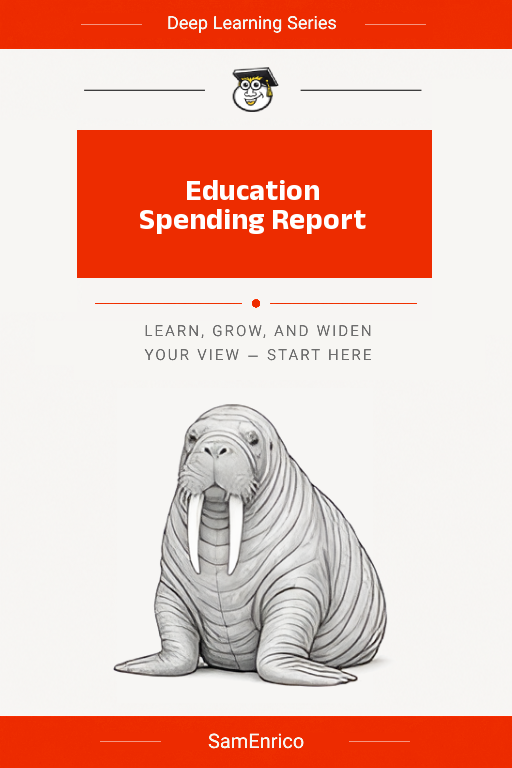
Non-FictionConsumer Mind ReportEdTech Strategy
Education Spending Report Audiobook
Analyzes tuition, online learning, and continuing
Analyzes tuition, online learning, and continuing education expenditure differences for edtech marketing.
Formats
Free sample
Chapter 1: The Sticker Price Hoax--In the spring of 2019, I sat across from the president of a mid-sized private university who was proud of a recent achievement. His marketing team had just driven record applications—up 22 percent year over year. The admissions funnel was full. The president beamed. Then I asked a question that drained the color from his face: “What’s your net tuition revenue per student?”He didn’t know.
Neither did his CFO. Neither did the vice president of enrollment.What they did know was their published tuition: 48,000peryear.Whattheydiscoveredoverthenextfourhoursofdiggingwasthattheiraveragestudentpaidjust48,000 per year. What they discovered over the next four hours of digging was that their average student paid just 48,000peryear.Whattheydiscoveredoverthenextfourhoursofdiggingwasthattheiraveragestudentpaidjust19,000 after institutional discounts, scholarships, and financial aid. The sticker price was a fiction. The marketing team had been running campaigns bragging about a $48,000 education that almost no one actually paid.
Worse, the discount rate had climbed from 35 percent to 62 percent over seven years, and no one in leadership had connected that trend to their marketing spend.That university is not unique. It is not an outlier. It is the rule.Welcome to the sticker price hoax.The Great Unraveling of Published Tuition For decades, higher education operated on a simple pricing model. Institutions published a tuition price. Students paid that price—or something very close to it—because there were few alternatives and little price transparency.
That world is dead. In its place is a chaotic, discount-driven marketplace where the published price has become a marketing fiction that harms both institutions and the students they serve.The numbers are staggering. According to the National Association of College and University Business Officers, the average institutional discount rate for first-time, full-time freshmen at private nonprofit colleges reached 54 percent in 2023. For some institutions, discount rates now exceed 70 percent. A decade ago, the average discount rate hovered around 35 percent.
The trend line is clear, and it points in only one direction.Let me translate that into plain English. When a university publishes a tuition of 50,000butgivestheaveragestudent50,000 but gives the average student 50,000butgivestheaveragestudent27,000 in discounts and aid, the net price is 23,000.Yetthemarketingdepartmentrunsadstoutinga23,000. Yet the marketing department runs ads touting a 23,000.Yetthemarketingdepartmentrunsadstoutinga50,000 education. The financial aid office processes the discounts. The CFO reports the net revenue.
And somewhere in the middle, no one is accountable for the gap between what is advertised and what is paid.This disconnect creates three specific problems for Ed…
This is the end of the free sample. Get the Audiobook to keep going. Buy now
About this book
Details
- Author
- Dumas Katheleen
- Publisher
- SamEnrico
- Language
- English
- Genre
- Non-Fiction, Consumer Mind Report, EdTech Strategy
- Released
- 2026-06-01
- Pages (approx.)
- 151
- Available as
- eBook, Audiobook

Listen in the VoxFlicks app
Audiobooks and audio dramas wherever you go. Sign in with your SamEnrico account and press play.
More by Dumas Katheleen
 Child Star Sibling RivalryDumas Katheleen$11.99
 Senior Technology Confidence CourseDumas Katheleen$11.99
 The Whole Breath BodyDumas Katheleen$11.99
 Mirroring Technique De escalationDumas Katheleen$11.99
 Stress and Relationship Physical AffectionDumas Katheleen$11.99
 The Tsar's Falcon: Imperial Russia's Feathered AmbassadorsDumas Katheleen$11.99
 Financial Planning and Analysis AnalystDumas Katheleen$11.99
 Non Resident LLC Certificate Of Good StandingDumas Katheleen$12.99
 Understanding Lopes–gorlin SyndromeDumas Katheleen$17.99
 How to Become a Drawing-kiln OperatorDumas Katheleen$11.99
You may also like
 Hong Kong Handover 1997Dunn Johnnie$11.99
 Zumba For Postnatal Recovery CourseNeal Christian$11.99
 Zumba for BeginnersLadner Nikia$11.99
 YouTube Comment Mining GuideHumes Pandora$12.99
 Worry Box MeditationCarlin Rudy$11.99
 Workplace Stress MeditationNguyen Lynn$11.99
 Workplace Stress and Sleep RepairHawley Ivory$11.99
 Workplace Perfectionism CureDelaney Jeffry$11.99
 Workplace Injustice Anger GuideWallen Isabelle$11.99
 Work Addiction and Burnout LinkGreenwood Ester$11.99
 Women in Yoga and WellnessBeattie Galina$11.99
 Women in Stand Up ComedyChun Evangeline$11.99