
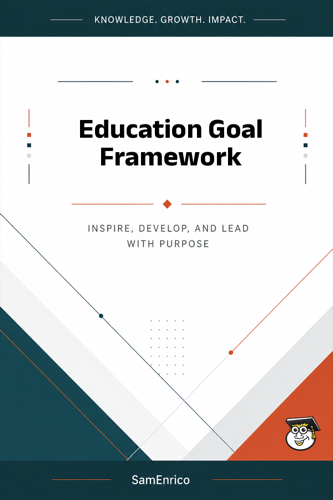
Non-FictionSelf-HelpEducation Goals
Education Goal Framework eBook
Use SMART and OKRs for schools and students.
by Todd Julia
Use SMART and OKRs for schools and students.
Formats
Free sample
Chapter 1: The Great Drift--–- Maria sat in the back row of her eighth-grade math class, staring at a worksheet covered in half-finished problems. She had been sitting there for forty-five minutes. Her pencil moved occasionally, but the answers never came. She wanted to succeed. She really did.
Last night, she told her mother, “I’m going to study harder for the next test.” She meant it. But when she got home, she scrolled through her phone for two hours, then copied homework from a friend, then went to bed feeling guilty and exhausted. Maria is not lazy. Maria is not unintelligent. Maria is drifting.Every classroom in every school contains dozens of Marias.
They are students who genuinely want to do well. They say the right things: “I’ll try harder,” “I need to focus more,” “I want to get better at this.” They make promises to themselves, to their parents, to their teachers. And then, without any clear reason, they don’t follow through. Teachers call this laziness. Parents call it carelessness.
Students call it something else: “I don’t know why I can’t just do it.”The gap between wanting something and actually doing it is the single greatest failure point in education. It is not a gap in intelligence. It is not a gap in effort. It is a gap in structure.This book exists to close that gap.What you are about to read is not a collection of motivational platitudes. It is not a list of tips and tricks to “get more done.” It is a complete framework for transforming how students set, track, and achieve goals.
It is built on two proven systems: SMART goals, which ensure clarity and testability, and OKRs (Objectives and Key Results), which provide rhythm, alignment, and stretch. Together, they form a feedback loop that has driven success at Intel, Google, and Linked In. And they work just as powerfully in a middle school classroom, a high school study group, or a college dorm room.But before we get to the framework, we have to understand the problem. Because you cannot fix what you refuse to see.The 92 Percent Problem Let’s start with a number that should disturb every educator, parent, and student in the world.Ninety-two percent of people who set personal goals fail to achieve them. That statistic comes from decades of research on New Year’s resolutions, personal development plans, and self-initiated change efforts.
It holds steady across age groups, income levels, and educational backgrounds. Ninety-two percent. Fewer than one in ten people successfully follow through on what they say they want to accomplish.Now apply that number to a classroom of thirty students. Statistically, only two or three of them will achieve the goals they set for themselves at the beginning of the semester. The other twenty-seven will drift.
They will want to succeed. They will intend to succeed. And then they will not.This is not a theory. It is a measurable, repeatable, predictable phenomenon.The most common explanation for this failure rate is laziness. “People don’t want it badly enough.” “They lack discipline.” “They’re making excuses.” But research from behavioral psychology and neuroscience tells a different story.
The problem is not a lack of desire. The problem is a lack of specificity.Consider how most students talk about their goals. “I want to get better at math.” “I need to study more.” “I’m going to try harder on the next essay.” These are not goals. They are aspirations. They sound good.
They feel good to say. And they produce almost nothing.When a student says, “I want to get better at math,” her brain receives no clear instruction. What does “better” mean? By how much? By when?
What actions count as “studying”? How will she know when she has succeeded? The vagueness of the statement makes it impossible to execute. The brain, confronted with ambiguity, defaults to the path of least resistance. That path is almost always immediate gratification: social media, video games, passive entertainment, anything that does not require sustained cognitive effort.This is not a character flaw.
It is neuroscience.The Neuroscience of Written Goals The human brain evolved to prioritize short-term rewards over long-term gains. This is called temporal discounting, and it is one of the most well-replicated findings in cognitive science. A reward that is available now feels more valuable than an identical reward available in the future. This is why a student will choose to watch a thirty-minute video right now instead of studying for a test that is two weeks away. The video’s reward is immediate.
The test’s reward is distant and abstract.But here is where it gets interesting. Written, structured goals change how the brain processes future rewards.When a person writes down a specific goal with a clear deadline, the prefrontal cortex—the part of the brain responsible for planning, impulse control, and executive function—activates in a unique way. The goal becomes a cognitive anchor. It shifts the brain’s valuation of future rewards, making them feel more immediate and more tangible. Studies have shown that written goals increase persistence by up to 50 percent.
People who write down their goals are significantly more likely to achieve them than people who merely think about them.Why does writing make such a difference? Because writing forces specificity. You cannot write down a vague hope. You have to commit to something measurable. You have to choose a deadline.
You have to make the abstract concrete. And in that process, you recruit the brain’s planning systems in a way that thinking alone cannot achieve.This is not mysticism. This is cognitive engineering.Every time a student writes, “By Friday, I will complete twenty algebra problems with 85 percent accuracy,” they are not just making a plan. They are rewiring their own attention. They are telling their brain, “This specific outcome matters at this specific time.” And the brain responds by prioritizing that outcome over competing distractions.The Gap Between Aspiration and Action If written goals are so powerful, why don’t more students use them?
The answer is simple: they have never been taught how.Most students receive zero formal instruction in goal-setting. They are told to “work harder” and “stay focused,” but no one explains the mechanics of how to translate an intention into a daily action. It is like telling someone to build a house without giving them a hammer, a saw, or a blueprint. The desire is there. The tools are not.This gap between aspiration and action is where the education system fails most dramatically.
Schools spend enormous resources on content—math, history, science, literature—but almost nothing on the meta-skill of learning how to learn. Students graduate knowing how to solve for x but not how to set a weekly goal and actually achieve it. They can identify the causes of World War I but cannot explain why they spent three hours on their phone instead of studying for yesterday’s exam.This is not a minor oversight. It is a catastrophic blind spot.The ability to set, track, and achieve goals is the single most transferable skill a student…
This is the end of the free sample. Get the eBook to keep going. Buy now
About this book
Details
- Author
- Todd Julia
- Publisher
- SamEnrico
- Language
- English
- Genre
- Non-Fiction, Self-Help, Education Goals
- Released
- 2026-06-09
- Pages (approx.)
- 147
- Available as
- eBook, Audiobook

Read better in the ZLOADR app
Your eBooks on your phone or tablet. Sign in with your SamEnrico account and start reading.
More by Todd Julia
 Notion Template Button LibraryTodd Julia$11.99
 Remote Task PrioritizationTodd Julia$11.99
 Netflix Top Ten Social PressureTodd Julia$11.99
 Hoffa Murder Theory Charles O Brien ConnectionTodd Julia$11.99
 Burnout Recovery For Personal TrainersTodd Julia$11.99
 Rotator Cuff GuideTodd Julia$11.99
 Cryptocurrency Volatility StressTodd Julia$11.99
 Plastic Empire: The Rise and Fall of the Rubber BanditTodd Julia$11.99
 Silk Roads to Stitches: The Ancient Textile Trade That Wove America’s Fashion FutureTodd Julia$11.99
 A Collector's Handbook to the Rover 2-litre (1929-30)Todd Julia$11.99
 How to Produce Music Benches and StoolsTodd Julia$11.99
 UAE VAT on Real Estate GuideTodd Julia$12.99
You may also like
 Hong Kong Handover 1997Dunn Johnnie$11.99
 Zumba For Postnatal Recovery CourseNeal Christian$11.99
 Zumba for BeginnersLadner Nikia$11.99
 YouTube Comment Mining GuideHumes Pandora$12.99
 Worry Box MeditationCarlin Rudy$11.99
 Workplace Stress MeditationNguyen Lynn$11.99
 Workplace Stress and Sleep RepairHawley Ivory$11.99
 Workplace Perfectionism CureDelaney Jeffry$11.99
 Workplace Injustice Anger GuideWallen Isabelle$11.99
 Work Addiction and Burnout LinkGreenwood Ester$11.99
 Women in Yoga and WellnessBeattie Galina$11.99
 Women in Stand Up ComedyChun Evangeline$11.99