
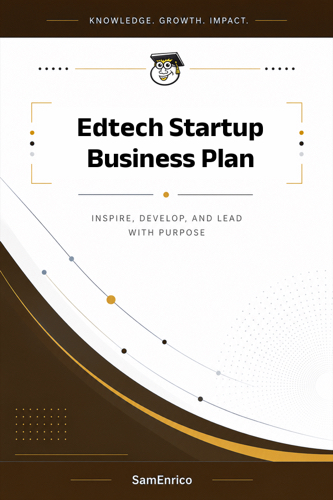
Non-FictionStartup GuideEducation Technology
Edtech Startup Business Plan eBook
Plan curriculum development, student acquisition,
by Leaman Cara
Plan curriculum development, student acquisition, and learning outcomes.
Formats
Free sample
Chapter 1: The Pedagogy Trap--Most edtech founders discover the hard way that building a learning product is nothing like building a social network or a marketplace. You can optimize your signup flow until it converts at forty percent. You can raise millions for a beautiful video library with celebrity instructors. You can deploy AI chatbots that answer student questions in milliseconds. And still, none of it matters if the student closes the laptop having learned nothing.This is the Pedagogy Trap.
It is the single most common reason edtech startups fail, and it has nothing to do with technology, marketing, or fundraising. The trap is simple: founders mistake activity for learning. They celebrate minutes watched, problems attempted, and lessons started, mistaking these outputs for the only outcome that actually matters—durable, transferable knowledge. Meanwhile, students quietly churn, parents demand refunds, and schools decline renewal contracts, all because the product never delivered on its fundamental promise.I have watched this happen more than fifty times. A founder with impeccable credentials—perhaps a former teacher turned programmer, or a product manager from a high-growth consumer app—builds something beautiful.
The curriculum is aligned to standards. The videos are professionally produced. The interface is delightful. And yet, six months after launch, usage has collapsed. When I ask to see the learning outcome data, there is none.
When I ask how they defined success before writing a line of code, they show me a feature list. When I ask what pedagogical philosophy drives their decisions, they stare blankly.This chapter exists to ensure that does not happen to you. Before you design a single lesson, record a single video, or write a single line of assessment logic, you must choose your Pedagogical North Star. This is not an abstract exercise for academics. It is a practical business decision that will determine your acquisition strategy, your pricing model, your technology stack, and your ability to prove outcomes.
Get it right, and every subsequent decision becomes easier. Get it wrong, and you will spend millions optimizing a product that cannot deliver what it promises.The Two Philosophies That Dominate Ed Tech Every effective learning product, whether it knows it or not, is built on one of two foundational pedagogical philosophies. The first is Direct Instruction. The second is Constructivism. These are not merely academic categories; they are operating systems for your entire business.
They dictate how long your lessons should be, how much agency the student has, what kind of data you collect, and even how you price your product.Let me be precise about what each philosophy actually means, because both terms have been abused by marketers.Direct Instruction is explicit, sequential, and teacher-led. The curriculum is broken into small, carefully sequenced steps. Each step is demonstrated, then practiced, then assessed before moving to the next. The student knows exactly what to do and when to do it. There is minimal ambiguity.
The goal is efficiency: move the student from not knowing to knowing in the shortest possible time. This approach excels at teaching well-defined skills—algebra, grammar rules, coding syntax, historical dates, scientific nomenclature. Think of Khan Academy, Duolingo, or any structured test-prep platform. The student progresses through a predetermined path, mastery at each gate.Constructivism is exploratory, student-led, and problem-oriented. The curriculum presents a rich problem or project and provides tools, resources, and guidance, but the student constructs their own understanding through active inquiry.
There is intentional ambiguity. The goal is not efficient transmission but deep, transferable understanding—the ability to apply knowledge to novel situations. This approach excels at teaching complex, ill-defined domains—design thinking, scientific inquiry, historical analysis, creative writing, entrepreneurial problem-solving. Think of Scratch (the MIT programming environment), project-based learning platforms, or virtual labs where students design their own experiments.Neither philosophy is inherently superior. They are appropriate for different learning goals, different student populations, and different market contexts.
The fatal mistake is not choosing one. It is building a product that tries to do both simultaneously, resulting in a confused experience that satisfies no one. Or worse, it is building a product that has no philosophical foundation at all, just a collection of features that seemed like good ideas at the time.How to Choose Your Pedagogical North Star Choosing between Direct Instruction and Constructivism requires answering four specific questions about your market, your content domain, and your business model. Do not guess at these answers. Gather real data from potential customers.Question One: What is the core skill you are teaching?
If the skill is well-defined, with clear right and wrong answers, and exists within an established knowledge hierarchy (you must learn addition before multiplication, nouns before clauses), Direct Instruction is your friend. If the skill is open-ended, with multiple valid approaches and no single correct path, Constructivism is more appropriate. A third-grade fractions app should be Direct Instruction. A high school social justice debate club should be Constructivist. Neither is wrong.
But they are not interchangeable.Question Two: Who is paying, and what do they want? Institutional buyers—school districts, corporate training departments, test-prep centers—typically want predictable outcomes and standardized measurement. They need to show that Student A achieved Proficiency Level 3 by the end of the semester. This favors Direct Instruction, which generates clean, comparable data. Consumer parents paying out of pocket often want deeper engagement and love of learning, which may favor Constructivism.
However, beware: parents also want to see progress. A purely exploratory Constructivist product with no clear milestones will generate refund requests.Question Three: What is your go-to-market motion? If you plan to sell through teachers who need to justify every minute of classroom time, Direct Instruction's clear lesson objectives and measurable outcomes are an easier sell. If you plan to sell directly to parents through social media virality, Constructivism's engaging projects and shareable student creations (look what my daughter built!) provide better organic marketing.Question Four: What is your tolerance for assessment complexity? Direct Instruction assessment is straightforward: multiple choice, fill-in-the-blank, short answer.
Computers can grade these instantly. Constructivism assessment requires portfolios, rubrics, and human judgment. If you are a lean startup without a team of graders, Constructivism will be operationally expensive. The 70/30 rule introduced later in this book applies here: automate what is repetitive, but be prepared to invest in human evaluation for complex learning.Once you have answered these four questions, you will know your North Star. Write it down.
Share it with every employee and contractor. Post it on your wall. Every product decision—from lesson length to feedback design to pricing tier—will be tested against this statement. Without it, you will drift.The Job to Be Done Framework for Edtech Choosing a pedagogical philosophy is necessary but not sufficient. You must also understand the specific job your customer is hiring your product to do.
This is Clayton Christensen's Jobs to Be Done framework, and it is ruthlessly clarifying for edtech founders because it cuts through the noise of features and benefits to focus on causation.A job is not a demographic category. "High school juniors" is not a job. "Parents of struggling readers" is not a job. A job is the progress a person seeks in a particular circumstance.…
This is the end of the free sample. Get the eBook to keep going. Buy now
About this book
Details
- Author
- Leaman Cara
- Publisher
- SamEnrico
- Language
- English
- Genre
- Non-Fiction, Startup Guide, Education Technology
- Released
- 2026-06-11
- Pages (approx.)
- 145
- Available as
- eBook, Audiobook

Read better in the ZLOADR app
Your eBooks on your phone or tablet. Sign in with your SamEnrico account and start reading.
More by Leaman Cara
 Complementary Goods GuideLeaman Cara$11.99
 Grooming Influence GuideLeaman Cara$11.99
 Loot Box and Skin Gambling RecoveryLeaman Cara$11.99
 Breaking Barriers: How Title IX Inspired Asia's Golden Age of Women's SportsLeaman Cara$11.99
 Mobile Back EndLeaman Cara$11.99
 Learn to Play the MarovanyLeaman Cara$11.99
 Mentoring Low Context CulturesLeaman Cara$12.99
 Ultimate Handbook Guide to Daqing : (China) Travel GuideLeaman Cara$11.99
You may also like
 Hong Kong Handover 1997Dunn Johnnie$11.99
 Zumba For Postnatal Recovery CourseNeal Christian$11.99
 Zumba for BeginnersLadner Nikia$11.99
 YouTube Comment Mining GuideHumes Pandora$12.99
 Worry Box MeditationCarlin Rudy$11.99
 Workplace Stress MeditationNguyen Lynn$11.99
 Workplace Stress and Sleep RepairHawley Ivory$11.99
 Workplace Perfectionism CureDelaney Jeffry$11.99
 Workplace Injustice Anger GuideWallen Isabelle$11.99
 Work Addiction and Burnout LinkGreenwood Ester$11.99
 Women in Yoga and WellnessBeattie Galina$11.99
 Women in Stand Up ComedyChun Evangeline$11.99