
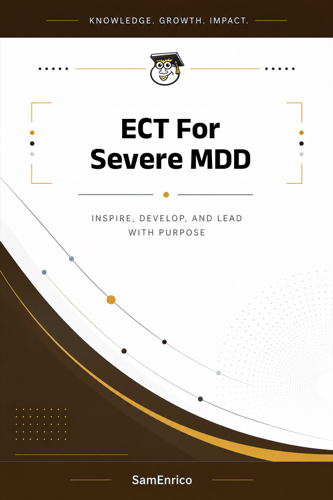
Non-FictionHealth & WellnessBrain Stimulation
ECT For Severe MDD eBook
Explains electroconvulsive therapy for life threat
by Archer Yvone
Explains electroconvulsive therapy for life threatening depression.
Formats
Free sample
Chapter 1: The Grey Tsunami...–- The call came on a Tuesday, though the days had long since stopped meaning anything. The woman on the phone—a referral coordinator from a university hospital—used words like "seventy-two-hour hold" and "involuntary admission" and "risk to self." But what the father heard was simpler: his daughter had tried to die again. This time she had succeeded in swallowing enough pills to stop a heart, and only a roommate's forgotten errand had saved her. She was twenty-four years old, had tried seven antidepressants, two mood stabilizers, and one round of transcranial magnetic stimulation. She had sat in three therapists' offices and confessed things that made grown adults cry.
And now she lay in a medical ICU, stomach pumped, wrists bandaged from a previous attempt, staring at a ceiling tile with the dead-eyed stillness of someone who had already left.The psychiatrist who consulted on the case was not the girl's regular doctor. He was an ECT specialist, a rare breed even in academic medicine, and he walked into the ICU room with a clipboard and a calm that the father later described as "almost offensive." The specialist asked four questions: "How long since you've eaten a full meal? Do you hear or believe things others tell you aren't real? Have you stopped bathing or changing clothes? On a scale of one to ten, with ten being certain, how sure are you that you want to die?" The girl did not answer the first three.
To the fourth, she whispered, "Eleven."The father expected the psychiatrist to recommend a new medication, a clinical trial, perhaps a longer hospitalization. Instead, the doctor said something the father had only ever heard in movies: "I think we should consider electroconvulsive therapy. And I think we should consider it today."The father said no. He said no because he had seen One Flew Over the Cuckoo's Nest in college. He said no because his mother had once told him about a cousin who received "shock treatments" in the 1960s and came back "not quite right." He said no because the word "seizure" sounded like brain damage, and the word "electrode" sounded like torture, and the word "anesthesia" sounded like one more risk for a daughter who had already survived so much.
He said no because he loved her, and love, in that moment, looked exactly like fear dressed in protective clothing.The specialist did not argue. He handed the father a single sheet of paper—not a consent form, but a study from a leading medical journal. The study compared ECT to the best available medications for severe, life-threatening depression. The medication group had a response rate of around thirty-five percent. The ECT group had a response rate of nearly eighty percent.
At the bottom of the page, someone had handwritten a note: "Your daughter has a 15-20% lifetime risk of dying by suicide if we continue as we have been. ECT carries a mortality risk of approximately 2 deaths per 100,000 treatments. I will wait in the hallway."The father read the numbers seven times. Then he opened the door and said, "Tell me everything."The Problem With the Word "Depression"The English language has failed us. We use the same word—depression—to describe two radically different conditions.
The first is the sadness that follows a breakup, a job loss, a death. It is real, it hurts, and it usually responds to time, talk, or medication. The second is a neurobiological emergency in which the brain's mood-regulating circuits simply stop working, often without warning, often without any obvious trigger. This second kind of depression does not feel like sadness. It feels like a grey tsunami—a slow, crushing wave that flattens everything in its path.
It erases appetite, sleep, pleasure, memory, and eventually the will to live. It is not a mood disorder in the way a cold is not a respiratory disorder. It is organ failure of the mind.In this book, we are not talking about the first kind. If you have experienced mild or moderate depression that responded to an SSRI or a few months of therapy, you likely do not need electroconvulsive therapy. You may not even need this book.
But if you are reading these words because you or someone you love has stopped eating, stopped speaking, stopped believing that tomorrow could be different—if you have tried medication after medication and felt nothing but side effects—if you have made a plan to die and come frighteningly close to carrying it out—then you are in the territory this book was written for.The medical term for this territory is life-threatening Major Depressive Disorder (MDD) . It is not a metaphor. It is a clinical emergency with specific, observable features. And it requires a different playbook than ordinary depression.The Four Horsemen of Life-Threatening MDDBefore we can talk about ECT, we have to know who needs it. Not every case of depression that fails a few medications is a candidate.
The decision to recommend ECT rests on four specific danger signs, which I call the Four Horsemen of life-threatening MDD. If you or your loved one has even one of these, waiting for another medication to work is not prudent—it is dangerous.The First Horseman: Psychotic Features About twenty percent of people with severe MDD develop psychotic features. This does not mean they hear voices commanding them to hurt others (that is more typical of schizophrenia). Instead, the psychosis of depression is almost always mood-congruent—it fits with the theme of worthlessness and doom. A patient might believe they have committed an unforgivable sin, that their body is rotting from the inside, that they have caused a natural disaster, or that they are already dead.
These are called nihilistic or guilty delusions, and they are horrifying to experience. The person is not "out of touch with reality" in a florid, screaming way. They are quietly, absolutely convinced that they are the worst person who has ever lived.Here is what every family member needs to know: psychotic depression does not respond well to antidepressants alone. The psychosis requires an antipsychotic medication, and even then, the response rate is modest and slow. ECT, by contrast, works in roughly eighty to ninety percent of psychotic depression cases, often within the first week of treatment.
If your loved one is saying things like "I've ruined everything" or "I don't deserve to eat" or "The world would be better without me," and those statements have a fixed, delusional quality that cannot be reasoned away, ask the psychiatrist specifically about ECT.The Second Horseman: Catatonia Catatonia is one of the most misunderstood and underdiagnosed conditions in psychiatry. In the public imagination, catatonia means standing frozen like a statue, unresponsive, staring into space. That is one form—called stuporous catatonia. But catatonia can also look like purposeless, repetitive agitation: pacing for hours, rocking, repeating the same phrase over and over, resisting all attempts at care. Both forms share a common feature: the person cannot initiate or stop movements voluntarily.
The brain's motor circuits have been hijacked by the same inflammatory or neurochemical processes that cause the mood disturbance.The tragedy…
This is the end of the free sample. Get the eBook to keep going. Buy now
About this book
Details
- Author
- Archer Yvone
- Publisher
- SamEnrico
- Language
- English
- Genre
- Non-Fiction, Health & Wellness, Brain Stimulation
- Released
- 2026-06-06
- Pages (approx.)
- 149
- Available as
- eBook, Audiobook

Read better in the ZLOADR app
Your eBooks on your phone or tablet. Sign in with your SamEnrico account and start reading.
More by Archer Yvone
 Squarespace Aesthetic CompareArcher Yvone$11.99
 Mindfulness for Athletes GuideArcher Yvone$11.99
 ABC Method for Small Business OwnersArcher Yvone$11.99
 Tech Hub Rental GuideArcher Yvone$11.99
 Parenting Stress and Perfectionism CureArcher Yvone$11.99
 LLC Tax GuideArcher Yvone$11.99
 The Damascus Shadows: How Syria’s Secret Police Orchestrated a Cult of FearArcher Yvone$11.99
 Design Thinking For AccountingArcher Yvone$11.99
 The Edison Heist: Illuminating the WorldArcher Yvone$11.99
 Mastering The Art of Northern Shaolin (北少林) Bei ShaolinArcher Yvone$11.99
 How to Produce Surgical LubricantsArcher Yvone$11.99
 How to Produce Hardware TorchesArcher Yvone$11.99
You may also like
 Hong Kong Handover 1997Dunn Johnnie$11.99
 Zumba For Postnatal Recovery CourseNeal Christian$11.99
 Zumba for BeginnersLadner Nikia$11.99
 YouTube Comment Mining GuideHumes Pandora$12.99
 Worry Box MeditationCarlin Rudy$11.99
 Workplace Stress MeditationNguyen Lynn$11.99
 Workplace Stress and Sleep RepairHawley Ivory$11.99
 Workplace Perfectionism CureDelaney Jeffry$11.99
 Workplace Injustice Anger GuideWallen Isabelle$11.99
 Work Addiction and Burnout LinkGreenwood Ester$11.99
 Women in Yoga and WellnessBeattie Galina$11.99
 Women in Stand Up ComedyChun Evangeline$11.99