
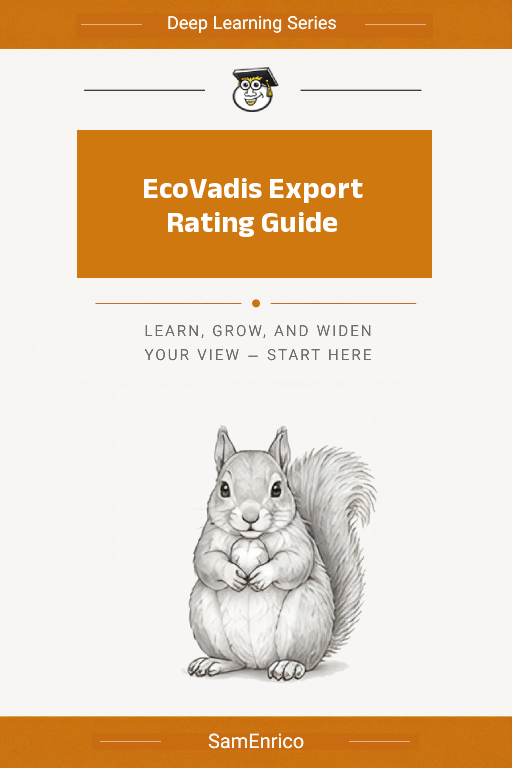
EcoVadis Export Rating Guide eBook
Achieve Gold or Platinum EcoVadis rating for expor
by Baugh Anissa
Achieve Gold or Platinum EcoVadis rating for export supply chains, meeting corporate sustainability scorecard requirements for LVMH, Nestle, and P&G.
Formats
Free sample
Chapter 1: The Green Passport--The export manager for a mid-sized Vietnamese garment factory had done everything right. She had ISO 9001 for quality, ISO 14001 for environment, SA8000 for social accountability, and a decade of flawless delivery records for a French luxury brand. When the procurement email arrived requesting an Eco Vadis assessment, she shrugged and assigned it to an intern. Two months later, her factory was removed from LVMH’s approved supplier list. Not because of quality.
Not because of price. Not because of delivery. Because her Eco Vadis score came back at 48 out of 100 – Silver in most industries, but for LVMH, a score below Gold is treated as a reputational liability. The contract worth $4 million annually moved to a competitor in Bangladesh that had never worked with luxury brands before but had a Platinum Eco Vadis rating.This story is not an exception. It is the new normal.Across every major export sector – apparel, chemicals, electronics, automotive parts, packaging, and consumer goods – the rules of global trade have changed.
For decades, the gatekeepers of international supply chains were quality certificates, price negotiations, and delivery reliability. Those remain important, but they are no longer sufficient. A new document has joined the ranks of mandatory trade credentials: the Eco Vadis scorecard. Call it the Green Passport. Without it, your invoices sit unpaid.
With a low score, your contracts go to competitors. With a Gold or Platinum rating, you leapfrog decades-old suppliers who failed to adapt.This chapter is not an introduction to Eco Vadis. You can find basic definitions on their website. This chapter is a wake-up call for export supply chains targeting the world’s most demanding buyers: LVMH, Nestlé, and Procter & Gamble. By the time you finish reading, you will understand why your existing quality certificates no longer open doors, how a single news article from three years ago can destroy your rating regardless of your paperwork, and why the companies that treat ESG as a compliance exercise are already losing to those who treat it as a competitive weapon.The Death of the Quality Certificate Era For the past thirty years, export supply chains operated on a simple logic.
If you could prove that your factory produced goods that met specifications – through ISO 9001, FDA registration, GMP certification, or industry-specific standards like IATF 16949 for automotive – you could sell to almost any buyer in the world. Quality certificates were your passport. They signaled that you had documented processes, trained staff, and audit trails. They were expensive to obtain and maintain, which created a barrier to entry that protected established suppliers.That era ended between 2020 and 2024. The trigger was not a single regulation but a convergence of forces: climate disclosure laws in the European Union, shareholder activism targeting consumer goods companies, and a generational shift in procurement leadership.
Buyers who once asked “Can you make this product?” now ask “What is the carbon footprint of making this product?” Buyers who once audited only their direct suppliers now demand visibility into their suppliers’ suppliers, and their suppliers’ suppliers’ suppliers. The quality certificate that proved your factory is well-managed says nothing about whether your raw materials come from deforested land, whether your subcontractors employ underage workers, or whether your wastewater contains heavy metals.LVMH learned this lesson publicly in 2021 when an investigation revealed that raw materials for a luxury brand had been sourced from a supply chain linked to forced labor. Nestlé has faced decades of criticism over cocoa and seafood supply chains. P&G has been targeted by shareholder resolutions demanding transparency on deforestation for palm oil and wood pulp. These companies did not respond by asking for more quality certificates.
They responded by demanding that every supplier – direct and indirect – undergo a standardized, comparable, and publicly credible sustainability assessment. They chose Eco Vadis because it already assessed over 100,000 companies across 200 industries using a methodology aligned with UN Global Compact principles, GRI standards, and ISO 26000.Here is what this means for you as an exporter. Your ISO 9001 certificate is still necessary for operational quality. But it is no longer sufficient for commercial access. If you submit only your quality certificates to LVMH, Nestlé, or P&G, you will be told to complete an Eco Vadis assessment.
If you delay, your contracts will be put on hold. If you score below the buyer’s threshold, you will be replaced. There is no negotiation. There is no appeal to a relationship manager. The score is the score.The Three Buyers That Define the New Standard Not all Eco Vadis buyers are equal.
A regional retailer in a less regulated market might accept a Bronze medal. A small European brand might waive the requirement for a trusted long-term partner. But LVMH, Nestlé, and P&G represent the high watermark of supply chain ESG requirements. If you can satisfy them, you can satisfy almost any buyer in the world. Conversely, if you cannot satisfy them, you will find yourself increasingly excluded from the premium segments of global trade.LVMH Moët Hennessy Louis Vuitton is the world’s largest luxury goods conglomerate, owning 75 houses including Louis Vuitton, Christian Dior, Givenchy, Bulgari, and Sephora.
Its procurement mandate is called LIFE 360 – an acronym for LVMH Initiatives For the Environment. The 360 refers to a 360-degree view of environmental and social impact across the entire value chain. For suppliers, LIFE 360 means four non-negotiable demands. First, biodiversity: raw materials must come from sources that do not contribute to deforestation or habitat destruction. Leather, cotton, wool, cashmere, and exotic skins are under particular scrutiny.
Second, circular economy: packaging must be designed for reuse or recycling, and single-use plastics are being phased out entirely. Third, climate: suppliers must report Scope 1, 2, and 3 emissions and demonstrate year-over-year reduction. Fourth, transparency: all subcontractors and raw material sources must be disclosed and assessed.For an exporter selling to LVMH, the practical implication is brutal and clear. A Silver Eco Vadis rating – which might be perfectly acceptable for a mass-market retailer – is treated as a reputational risk. LVMH’s procurement team will not sign a multi-year contract with a Silver-rated supplier.
They might offer a one-year trial contract with strict conditions and quarterly reviews. But their preference is unambiguous: Gold minimum, Platinum preferred. And they have enough suppliers competing for their business that they can afford to be selective.Nestlé is the world’s largest food and beverage company, with over 2,000 brands including Nescafé, Purina, Gerber, and Kit Kat. Its ESG scorecard is not a single document but a framework that applies differently depending on whether you supply raw ingredients (Tier 1), packaging (Tier 2), or logistics (Tier 3). For raw ingredient suppliers – cocoa, coffee, palm oil, dairy, meat, soy – Nestlé requires Platinum Eco Vadis plus additional certification (Rainforest Alliance, Fairtrade, Roundtable on Sustainable Palm Oil).
The reason is simple: these supply chains have historically contained the highest risks of deforestation, child labor, and land rights violations. Nestlé has been sued, investigated, and boycotted over these issues. They will not accept anything less than Platinum from the sources of their core raw materials.For packaging suppliers – bottles, labels, boxes, films – Nestlé’s requirement is Gold minimum. Packaging represents a significant portion of Nestlé’s plastic footprint and Scope 3 emissions. They need suppliers who…
This is the end of the free sample. Get the eBook to keep going. Buy now
About this book
Details
- Author
- Baugh Anissa
- Publisher
- SamEnrico
- Language
- English
- Genre
- Non-Fiction, Business Brief
- Released
- 2026-05-30
- Pages (approx.)
- 146
- Available as
- eBook, Audiobook

Read better in the ZLOADR app
Your eBooks on your phone or tablet. Sign in with your SamEnrico account and start reading.
More by Baugh Anissa
 Alcohol Nutrition RecoveryBaugh Anissa$11.99
 Sattvic Diet for ClarityBaugh Anissa$11.99
 Elderly Witness Memory DegradationBaugh Anissa$11.99
 Aerospace and Defense Deals GuideBaugh Anissa$11.99
 Binge Eating Recovery for Night NursesBaugh Anissa$11.99
 Germany Freelance Visa GuideBaugh Anissa$11.99
 The Nursing Home SurvivorBaugh Anissa$11.99
 SAD Master GuideBaugh Anissa$11.99
 Nefertiti: The Lost Queen’s Last MessageBaugh Anissa$11.99
 Dancing Through the Colonies: The Birth of Pacific Ballet in the 18th CenturyBaugh Anissa$11.99
 Service Providers Guide to Hardware & Home Improvement StoresBaugh Anissa$11.99
 How to Produce a TextureBaugh Anissa$11.99
You may also like
 Hong Kong Handover 1997Dunn Johnnie$11.99
 Zumba For Postnatal Recovery CourseNeal Christian$11.99
 Zumba for BeginnersLadner Nikia$11.99
 YouTube Comment Mining GuideHumes Pandora$12.99
 Worry Box MeditationCarlin Rudy$11.99
 Workplace Stress MeditationNguyen Lynn$11.99
 Workplace Stress and Sleep RepairHawley Ivory$11.99
 Workplace Perfectionism CureDelaney Jeffry$11.99
 Workplace Injustice Anger GuideWallen Isabelle$11.99
 Work Addiction and Burnout LinkGreenwood Ester$11.99
 Women in Yoga and WellnessBeattie Galina$11.99
 Women in Stand Up ComedyChun Evangeline$11.99