
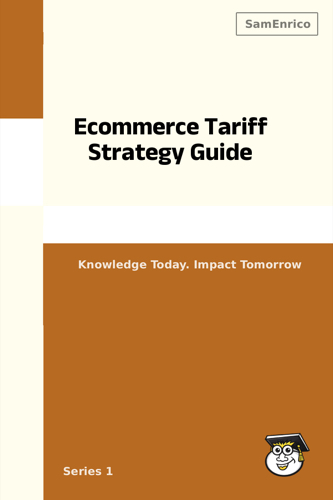
Non-FictionBusiness Brief / Ecommerce
Ecommerce Tariff Strategy Guide eBook
Optimizes cross-border online sales with de minimi
Optimizes cross-border online sales with de minimis thresholds and fulfillment tactics.
Formats
Free sample
Chapter 1: The $800 Drug...--Every successful ecommerce founder I've met over the past decade has been an accidental smuggler. They didn't sneak goods across borders in the dead of night. They didn't falsify invoices or bribe customs officials. They simply used a legal loophole so generous, so frictionless, that it felt like cheating—because it was. The de minimis threshold, which allowed any shipment valued under $800 to enter the United States completely duty-free, was not designed for the age of dropshipping.
It was a clerical convenience, a way to avoid processing small-value packages that weren't worth the government's time. But like a forgotten backdoor in a fortress, it became the foundation upon which a multi-billion dollar ecommerce revolution was built.And now, that door is slamming shut.If you are reading this book, you have likely already felt the pain. Perhaps you logged into your shipping platform last month and saw a new line item on your customs bill: "Formal Entry Fee – $32.71." Perhaps you received a letter from your freight forwarder stating that your $49 widget now requires a 10-digit tariff code, a bond, and a customs broker's signature. Perhaps you watched your profit margin evaporate from a comfortable 28% to a terrifying 3% overnight, with no change in your sales volume or customer behavior. You are not alone.
You are not doing anything wrong. You are simply living through the end of the most generous trade loophole in modern history.This chapter is an autopsy of that loophole and a warning about what comes next. We will trace the rise of the de minimis empire, from the early days of e Bay power sellers to the explosive growth of Temu and Shein. We will document the precise timeline of the 2025 policy phase-out, making a critical distinction that most news articles get wrong: the exemption is ending for China and Hong Kong-origin goods, while USMCA-qualifying shipments from Mexico and Canada retain access. And we will shatter the myth that "split shipments"—breaking a $5,000 order into ten $500 parcels—remains a viable tactic.
It is not. The compliance burden has shifted entirely. The era of accidental smuggling is over.The Loophole That Built an Empire To understand how deeply the de minimis threshold shaped modern ecommerce, you must first understand its origins. The Customs modernization Act of 1993 established a de minimis level of $200 for duty-free entry. This was not a gift to foreign manufacturers.
It was an administrative efficiency. The US customs service did not want to process paperwork for a box of $150 sneakers when the cost of processing exceeded the duty collected. In 2016, the Trade Facilitation and Trade Enforcement Act raised that threshold to $800—a fourfold increase that was barely noticed by mainstream retailers but would prove cataclysmic for global trade.Consider the math of the old world. A typical Chinese factory could produce a high-quality backpack for $8. Shipping via e Packet from Shenzhen to a customer in Ohio cost another $5.
The seller listed the backpack for $29.97. Under the de minimis rule, that backpack entered the US with zero duties, zero customs entry fees, and zero paperwork beyond a simple commercial invoice. The seller's landed cost was $13. Their gross margin was $16.97—a staggering 56% profit on a product they never touched, never warehoused, and never financed beyond the cost of the goods themselves.This math spawned an entire ecosystem. Dropshipping giants like Wish, Ali Express, and later Temu and Shein built their business models on the assumption that sub-$800 shipments would always be free.
They optimized for volume, not value. They learned that if a customer ordered a $799 couch and a $2 phone case together, it was cheaper to split the shipment into two boxes than to pay duties on the combined value. Split shipments became the industry's dirty secret—a tactic so effective that logistics providers built automated systems to detect and split orders at the warehouse level.The numbers are staggering. In 2015, less than 140 million shipments entered the US under the de minimis exemption. By 2023, that number had exploded to over 1.3 billion packages per year.
That is nearly four packages for every man, woman, and child in America—all entering duty-free. The US Postal Service and private carriers like Fed Ex and UPS were processing more small parcels than they had ever imagined, and customs was essentially asleep at the wheel.But the party could not last. Domestic retailers noticed. The National Retail Federation lobbied Congress, arguing that foreign sellers had an unfair 20-30% price advantage simply by avoiding duties that American companies paid. Lawmakers noticed the volume, too.
The idea that 1.3 billion packages were entering the country each year with zero government oversight became a national security concern. Counterfeit goods, unsafe children's products, and undeclared hazardous materials were flowing through the de minimis loophole with impunity. Something had to give.The 2025 Phase-Out: What Actually Changed On March 15, 2024, the US government announced that the de minimis exemption for goods originating in China and Hong Kong would be phased out entirely by early 2025. This was not a rumor. It was not a proposal.
It was published in the Federal Register with a binding timeline. The phase-out followed a three-stage schedule:Stage One (Effective July 1, 2024): All shipments from China and Hong Kong valued over $200 became subject to formal entry requirements, including the filing of a 10-digit HTS code and payment of applicable duties. The previous $800 threshold was cut by 75% for these countries only.Stage Two (Effective January 1, 2025): The threshold dropped further to $100. Additionally, a new per-parcel processing fee of $2.50 was applied to all shipments from China and Hong Kong, regardless of value. This fee was designed to offset the administrative cost of processing millions of small packages.Stage Three (Effective June 1, 2025): The de minimis exemption for China and Hong Kong was eliminated entirely.
Every shipment, regardless of value, now requires a formal customs entry, a 10-digit HTS code, payment of applicable duties, and a per-parcel fee that varies by carrier (currently $2.50 for postal shipments and $3.80 for private carriers).It is critical to understand what did NOT change. The de minimis exemption for goods originating in Mexico and Canada, under the USMCA agreement, remains fully intact at $800. Goods from other countries (Vietnam, India, Turkey, the EU, etc.) still enjoy the $800 exemption for now, though the book's later chapters will discuss the "global sunset" that is expected by late 2026. This distinction is the single most important fact in this entire chapter. Many sellers have panicked and abandoned cross-border ecommerce entirely, assuming the loophole is dead for everyone.
That is false. It is dead for China and Hong Kong. It remains very much alive for USMCA-qualifying goods—a point we will exploit extensively in Chapter 5.Why "Split Shipments" Will Now Get You Flagged Before the phase-out, split shipments were the ultimate arbitrage tactic. A seller would receive an order for $1,500 worth of goods. Their warehouse software would automatically split the order into two shipments: one valued at $799, another at $701.
Both cleared customs duty-free. The customer received two boxes, often arriving on different days, and rarely complained. The seller saved hundreds of dollars in duties that would have been owed on the combined value.This tactic is now not only ineffective but actively dangerous.The customs enforcement systems have been upgraded. Beginning in…
This is the end of the free sample. Get the eBook to keep going. Buy now
About this book
Details
- Author
- Coolidge Tommye
- Publisher
- SamEnrico
- Language
- English
- Genre
- Non-Fiction, Business Brief / Ecommerce
- Released
- 2026-06-06
- Pages (approx.)
- 151
- Available as
- eBook, Audiobook

Read better in the ZLOADR app
Your eBooks on your phone or tablet. Sign in with your SamEnrico account and start reading.
More by Coolidge Tommye
 Mindless Snacking Interruption ManualCoolidge Tommye$11.99
 Compulsive Spending for DentistsCoolidge Tommye$11.99
 IBS Restaurant Dining GuideCoolidge Tommye$11.99
 Tom Wills: The Man Who Invented Australian Rules FootballCoolidge Tommye$11.99
 Skilled Employment Reference GuideCoolidge Tommye$12.99
 Umbrella Stand CraftCoolidge Tommye$11.99
 Ultimate Handbook Guide to Duque De Caxias : (Brazil) Travel GuideCoolidge Tommye$11.99
You may also like
 Hong Kong Handover 1997Dunn Johnnie$11.99
 Zumba For Postnatal Recovery CourseNeal Christian$11.99
 Zumba for BeginnersLadner Nikia$11.99
 YouTube Comment Mining GuideHumes Pandora$12.99
 Worry Box MeditationCarlin Rudy$11.99
 Workplace Stress MeditationNguyen Lynn$11.99
 Workplace Stress and Sleep RepairHawley Ivory$11.99
 Workplace Perfectionism CureDelaney Jeffry$11.99
 Workplace Injustice Anger GuideWallen Isabelle$11.99
 Work Addiction and Burnout LinkGreenwood Ester$11.99
 Women in Yoga and WellnessBeattie Galina$11.99
 Women in Stand Up ComedyChun Evangeline$11.99