
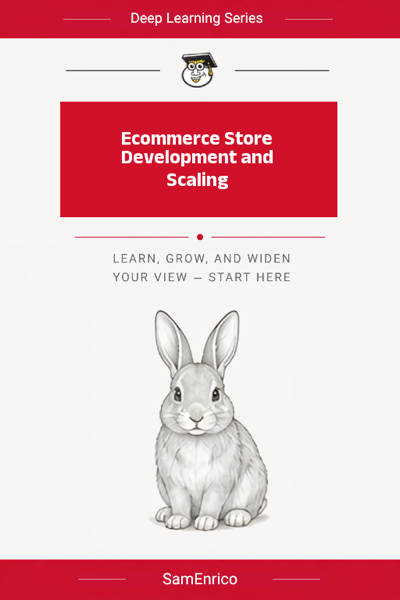
Non-FictionInformativeEducational
Ecommerce Store Development and Scaling eBook
A Coursebook on Ecommerce Store Development and Sc
by Hearn Joline
A Coursebook on Ecommerce Store Development and Scaling
Formats
Free sample
Chapter 1: The Zero to One Audit--The most common question I hear from aspiring ecommerce founders is not “How do I scale?” but “Which platform should I use?” or “How do I run Facebook ads?” These are the wrong first questions. They are tactical questions that assume you have already solved the strategic problem — the problem of what to sell, to whom, and why anyone should care.Here is the harsh truth that most ecommerce courses will not tell you: the vast majority of ecommerce stores fail not because of poor execution on ads or a slow checkout page. They fail because they enter a crowded market where the only possible differentiator is price. They launch a store selling “men’s grooming products” or “women’s fashion accessories” or “home fitness equipment” — categories so broad and so saturated that no amount of advertising skill can overcome the fundamental lack of a defensible position.This chapter is not about how to launch a store. It is about whether you should launch a store at all, and if so, in what specific direction.
It is an audit — a rigorous, unforgiving audit — of your niche, your product, and your advantage. By the end of this chapter, you will have either identified a monopoly niche worth pursuing or realized that you need to go back to the drawing board. Both outcomes are valuable. The second outcome saves you from wasting years of your life and hundreds of thousands of dollars on a business that was doomed before it launched.The Zero to One Philosophy Applied to Ecommerce In his book Zero to One, Peter Thiel makes a distinction that every ecommerce founder should memorize: going from 0 to 1 is creating something new; going from 1 to n is copying something that already exists. The former creates a monopoly.
The latter creates competition. And competition, in ecommerce, is a race to the bottom.When you launch a store selling “organic skincare,” you are not going from 0 to 1. You are entering a space with thousands of competitors, many of whom have deeper pockets, better supplier relationships, and more established brand recognition. You are competing on the margins — literally. Your only levers are price (discounts), customer acquisition cost (ads), and conversion rate optimization (CRO).
These are important skills, but they are not sustainable advantages. Any competitor can lower their price. Any competitor can copy your ad creative. Any competitor can optimize their checkout.The only sustainable advantage in ecommerce is a monopoly in a small niche. Not a monopoly enforced by law or patents (though those help), but a monopoly created by solving a specific problem for a specific group of people in a way that no one else does as well.
This is what Thiel means by going from 0 to 1: you create a market that did not exist before, or you dominate a market so small that larger competitors ignore it.Consider the difference between two hypothetical stores. Store A sells “yoga mats.” The market is enormous, competitive, and price-sensitive. Store B sells “yoga mats for tall people — extra length (84 inches) with alignment guides printed on the surface for proper foot placement.” The market is smaller, but the need is real and underserved. Tall yoga practitioners struggle with standard 68-inch mats that leave their hands or feet off the mat. Most yoga mat brands ignore this problem because it is a niche within a niche.
That is precisely why Store B can charge a premium, build a loyal following, and achieve something close to a monopoly.The Zero to One audit is about finding your version of the tall-person yoga mat. It is about identifying a specific, painful problem and designing a solution that the market has overlooked.The Three-Prong Test: Your Pre-Flight Checklist Before you spend a dollar on inventory, a domain name, or a Shopify subscription, you must pass what I call the Three-Prong Test. This is a self-audit tool that forces you to answer three questions honestly. If you cannot answer “yes” to at least two of these three prongs, you do not have a viable ecommerce business. You have a hobby that will cost you money.Prong One: Solving a Specific, Underserved Problem The first prong asks: does your product address a painful, specific problem that a defined group of people actively want to solve?
This is not about a broad category like “fitness” or “home decor.” It is about a narrow, identifiable pain point.A broad problem is “I want to be healthier.” A specific problem is “I am a remote worker who experiences lower back pain after eight hours of sitting in an ergonomic chair that is not quite right for my height.” A broad problem has a million solutions. A specific problem has few solutions, and the people who have that problem are actively searching for an answer.How do you know if a problem is specific enough? Use the “stranger test.” If you can describe the problem to a stranger in one sentence and they immediately nod in recognition or share their own frustration, the problem is likely specific and real. If they look confused or give a generic “oh, that’s nice,” you are probably describing a broad problem that does not feel urgent to anyone.The best problems for ecommerce have three characteristics. First, they are recurring — the customer will need to solve the problem repeatedly, creating repeat purchases and subscription potential.
Second, they are emotionally charged — the customer feels frustration, embarrassment, pain, or anxiety around the problem, which makes them willing to pay for a solution. Third, they are visible — the customer can articulate the problem clearly, which means they can search for it on Google, ask about it on social media, and recognize your solution when they see it.Consider the difference between “dog food” (broad) and “dog food for senior golden retrievers with hip dysplasia who are allergic to chicken” (specific). The second problem is painful (watching an aging dog struggle to move), recurring (daily feeding), emotionally charged (pet owners are highly motivated), and visible (owners of senior golden retrievers know exactly what they are looking for). That is a viable niche.Prong Two: A Unique Channel Advantage The second prong asks: do you have a distribution advantage that competitors cannot easily replicate? Many ecommerce founders believe that product is everything.
They spend months perfecting formulations, packaging, and design, only to launch and discover that no one can find them. Product is important, but distribution is equally important. A mediocre product with excellent distribution will outsell an excellent product with mediocre distribution every time.A unique channel advantage means that you have access to a customer acquisition channel that is either exclusive to you or significantly cheaper for you than for your competitors. This could take many forms. You might have an existing audience — a You Tube channel, an Instagram following, an email list — that is already interested in your niche.
You might have a partnership with a complementary brand that can cross-promote you to their audience. You might have expertise in a specific advertising platform that your competitors have not mastered. You might have a physical retail relationship that gives you shelf space in a…
This is the end of the free sample. Get the eBook to keep going. Buy now
About this book
Details
- Author
- Hearn Joline
- Publisher
- SamEnrico
- Language
- English
- Genre
- Non-Fiction, Informative, Educational
- Released
- 2026-06-02
- Pages (approx.)
- 124
- Available as
- eBook, Audiobook

Read better in the ZLOADR app
Your eBooks on your phone or tablet. Sign in with your SamEnrico account and start reading.
More by Hearn Joline
 Tenancy in Common 1031 ExchangeHearn Joline$11.99
 Prolonged Grief Disorder HandbookHearn Joline$11.99
 Painting Dream SymbolHearn Joline$11.99
 Learning Block SchedulingHearn Joline$11.99
 Vitamin D Essential GuideHearn Joline$11.99
 NVC For Sales NegotiationHearn Joline$11.99
 Memory PodcastsHearn Joline$11.99
 Loving Kindness for a Partner with AnxietyHearn Joline$11.99
 Immigrant Senior Care Home EmpireHearn Joline$11.99
 The Shifting Sands: Ancient Seers and the Birth of a ContinentHearn Joline$11.99
 Echoes of the Eternal: The Time-Looping Mystery of the Bermuda TriangleHearn Joline$11.99
 The Scythian Queen: Love and War on the SteppeHearn Joline$11.99
You may also like
 Hong Kong Handover 1997Dunn Johnnie$11.99
 Zumba For Postnatal Recovery CourseNeal Christian$11.99
 Zumba for BeginnersLadner Nikia$11.99
 YouTube Comment Mining GuideHumes Pandora$12.99
 Worry Box MeditationCarlin Rudy$11.99
 Workplace Stress MeditationNguyen Lynn$11.99
 Workplace Stress and Sleep RepairHawley Ivory$11.99
 Workplace Perfectionism CureDelaney Jeffry$11.99
 Workplace Injustice Anger GuideWallen Isabelle$11.99
 Work Addiction and Burnout LinkGreenwood Ester$11.99
 Women in Yoga and WellnessBeattie Galina$11.99
 Women in Stand Up ComedyChun Evangeline$11.99