
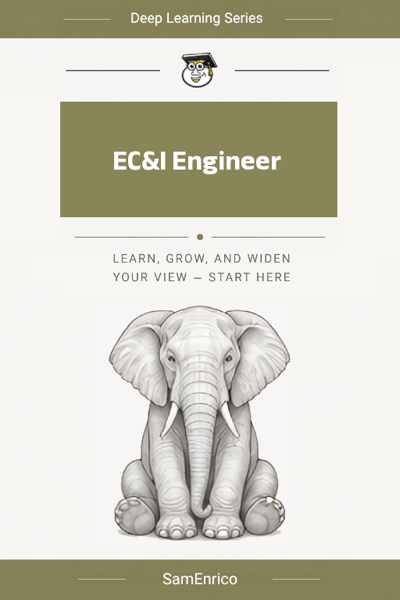
EC&I Engineer eBook
A Coursebook on EC&I Engineer
by Shin Lasonya
A Coursebook on EC&I Engineer
Formats
Free sample
Chapter 1: The Dangerous Gap...–- The control room was silent except for the rhythmic clicking of a keyboard. On the screens, a chemical reactor was approaching its maximum rated pressure. The operator watched the numbers climb: 87%... 91%... 94%.
He reached for the emergency shutdown button, then hesitated. The pressure transmitter had been drifting for weeks. Was this a real alarm or another false positive?Three seconds later, the relief valve lifted. Steam and vapor vented to atmosphere. No one was hurt.
But the plant lost 47,000inproductandanother47,000 in product and another 47,000inproductandanother120,000 in lost production while they investigated.The root cause? A mis-specified instrument. The pressure transmitter was SIL 2 rated, properly calibrated, and correctly programmed into the PLC. But it was a standard model rated for IP54 (splash-proof) installed outdoors in a coastal environment. Salt spray had corroded the vent port.
The transmitter was technically working—but its readings had drifted outside acceptable limits.The EC&I engineer who specified that transmitter had done everything by the book. Except one thing: they had not asked, "Will this device survive the real environment?" They had assumed that a SIL rating meant robustness. It does not.This book exists because that engineer's mistake—and hundreds like it—happen every day. Not because EC&I engineers are careless. Because no single resource teaches the integration of electrical, control, and instrumentation engineering with practical safety assurance.
Until now.1.1 Who Is the EC&I Engineer and Why Do You Need This Book?If you have picked up this book, you are likely one of three people. First, you might be a graduate or junior engineer who has been given the title "EC&I Engineer" and told to get on with it—without anyone explaining what that actually means. Second, you could be an experienced electrician or instrument technician moving into an engineering role, discovering that site knowledge does not automatically translate into design competence. Third, you might be a mechanical or process engineer who keeps hearing the words "SIL," "Ex d," and "loop diagram" and realizes you need to understand what your EC&I colleagues are actually doing.Regardless of which category fits, you have discovered a fundamental truth: EC&I engineering is not a single discipline. It is a marriage of three distinct fields that are rarely taught together.Electrical engineering in this context means low-voltage (LV) and medium-voltage (MV) power distribution for control systems—not building wiring.
You will size cables for long instrument runs, specify motor control centers (MCCs), and design earthing systems that do not create ground loops.Control engineering means understanding PLCs, DCS, SCADA, HMI design, and industrial communications—not becoming a full-time programmer. You need to specify I/O counts, read ladder logic, and know why a 150ms scan time might kill a safety function.Instrumentation engineering means selecting pressure, temperature, level, and flow instruments for specific fluids and environments—not just picking a part number from a catalog. You need to know why a Coriolis flow meter is overkill for water but essential for peanut butter, and why an RTD is better than a thermocouple for precise temperature control.And woven through all three is safety assurance—the thread that separates a functional plant from a deadly one.This book is called a "coursebook" because it is designed to be read sequentially, with each chapter building on the previous ones. You will not find a random collection of standalone articles. You will find a structured journey from "What is an EC&I engineer?" to "How do I commission a plant and maintain my competence for the next thirty years?"1.2 The T-Shaped Professional: Depth and Breadth There is a concept in engineering that describes what makes an EC&I engineer valuable.
It is called the "T-shaped" professional. The vertical bar of the T represents deep expertise in one area. The horizontal bar represents broad knowledge across related areas.For an EC&I engineer, the vertical bar is safety assurance—specifically, the ability to design systems that fail safely, to understand hazardous area classification, and to apply functional safety standards (IEC 61508/61511) correctly. This is what distinguishes you from an electrician or a PLC programmer. An electrician knows how to wire a panel.
A PLC programmer knows how to make a conveyor move. An EC&I engineer knows how to make sure the conveyor stops safely when someone opens a guard door—and how to prove that the stop system is reliable.The horizontal bar of the T includes:Electrical design – cable sizing, voltage drop, earthing, MCCs, VFDs, protection devices Instrumentation – sensor selection, control valves, loop diagrams, instrument indexes Control systems – PLC/DCS architecture, I/O, basic programming literacy, industrial protocols Standards – IEC 61508, IEC 61511, IEC 60079, BS 7671, ISA-101, ISA-18.2Documentation – block diagrams, single lines, schematics, loop diagrams, work packs, MTOs Commissioning – FAT, SAT, loop checking, as-built markups, handover packages You will notice that "programming" is not on that list. You do not need to be an expert coder. You need to be literate enough to read ladder logic and spot a missing interlock. The companies that hire EC&I engineers have dedicated controls engineers or system integrators for heavy programming.
Your value is in the integration—making sure the electrical, instrument, and control domains work together safely.A quick note on job titles before we proceed. Some companies advertise for "E&I Engineers" (electrical and instrumentation, leaving control to a separate role). Others advertise for "Controls Engineers" (heavy on PLC/DCS, lighter on field instruments). "EC&I Engineer" is the most comprehensive title, and it is the one this book uses. When you read job descriptions, look for the keywords that tell you which version they want.
If they ask for "loop diagrams," "instrument indexes," and "hazardous area classification," you are in the right place. If they ask for "C++," "Python," and "agile development," that is a different role entirely.1.3 The Industries That Need You EC&I engineers do not work everywhere. You will not find many of us in software startups or civil engineering firms. But in heavy industries where safety and reliability are paramount, you are essential.1.3.1 Oil and Gas (Upstream, Midstream, Downstream)This is the largest employer of EC&I engineers globally. The work spans offshore platforms, onshore processing plants, refineries, pipelines, and storage terminals.
The governing standard is IEC 61511 (functional safety for the process industry). Safety Instrumented Systems (SIS) are everywhere—emergency shutdown systems (ESD), fire and gas detection (F&G), high-integrity pressure protection systems (HIPPS).What makes oil and gas unique is the combination of high consequence (explosion, fire, toxic release) and harsh environment (corrosion, vibration, extreme temperatures, offshore logistics). You will specify instruments certified for Zone 1 or Zone 2 hazardous areas (more on that in Chapter 8). You will design SIS loops with SIL 2 or SIL 3 targets. You will learn to love the phrase "proof test interval."1.3.2 Nuclear Power (and Other Regulated Energy)Nuclear is a different beast entirely.
The governing standard is IEC 61513 (nuclear power plants – instrumentation and control systems important to safety). The philosophy is "defense in depth"—multiple independent layers of protection, each capable of fulfilling the safety function on its own.What makes nuclear unique is the regulatory oversight. You cannot change a single wire without a…
This is the end of the free sample. Get the eBook to keep going. Buy now
About this book
Details
- Author
- Shin Lasonya
- Publisher
- SamEnrico
- Language
- English
- Genre
- Non-Fiction, Informative, Educational
- Released
- 2026-05-18
- Pages (approx.)
- 142
- Available as
- eBook, Audiobook

Read better in the ZLOADR app
Your eBooks on your phone or tablet. Sign in with your SamEnrico account and start reading.
More by Shin Lasonya
 Small Talk After a Long BreakShin Lasonya$11.99
 Voice Tone and Pitch HandbookShin Lasonya$11.99
 The Dumbbell Only Strength PlanShin Lasonya$11.99
 Crawlspace Nightmares Case StudyShin Lasonya$11.99
 The Bloodied Path to Unity: Qin Shi Huang's Conquest of the Six KingdomsShin Lasonya$11.99
 Learn to Play the Soprano SaxophoneShin Lasonya$11.99
 Later AI Visual Content PlanningShin Lasonya$12.99
 How to Start a Cloth Beetling Business (Beginners Guide)Shin Lasonya$11.99