
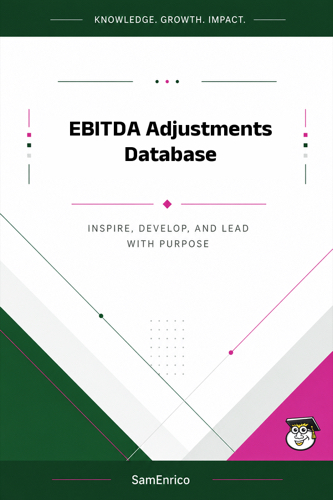
Non-FictionCapital & Valuation RegisterEBITDA
EBITDA Adjustments Database Audiobook
Catalog add-backs, synergies, and normalized EBITD
Catalog add-backs, synergies, and normalized EBITDA adjustments in LBOs.
Formats
Free sample
Chapter 1: The $10M Illusion--–- On a Tuesday morning in March 2021, a mid-market private equity firm lost $10.3 million. They didn’t lose it to fraud, market volatility, or a failed integration. They lost it to a single line item buried on page 47 of a Quality of Earnings report—a line item labeled “Non-Recurring Consulting Fees.” The seller had added back $1.7 million per year for three years, calling it a one-time expense. The buyer, pressed for time and facing a looming deadline, accepted the add-back without verification. Eighteen months later, the same “non-recurring” consulting fees reappeared on the post-acquisition P&L.
The consultant was the seller’s son. The fee was permanent. And $10.3 million of enterprise value—calculated on the assumption of a sustainable EBITDA that never existed—evaporated into the gap between seller fiction and economic reality.This story opens not with a theoretical definition but with a hard truth: raw EBITDA from financial statements is almost always misleading in a Leveraged Buyout (LBO) context. Every seller presents a version of earnings. Every buyer must construct their own.
The difference between these two numbers is measured not in basis points but in millions of dollars of transaction value, debt capacity, and ultimately, investment returns. Yet despite the staggering sums at stake, no standardized, auditable, or repeatable process exists for determining which expenses belong in normalized EBITDA and which do not. That is the problem this book solves. And it begins with a single, foundational concept: Normalized EBITDA.The Illusion of Reported EBITDAEarnings Before Interest, Taxes, Depreciation, and Amortization (EBITDA) was never designed to serve as the primary valuation metric for leveraged buyouts. Originally conceived in the 1980s as a proxy for operating cash flow, EBITDA gained prominence because it strips away financing decisions, tax structures, and accounting conventions to reveal something approximating operational performance.
But that approximation is dangerously imprecise for LBO purposes. A manufacturing company’s reported EBITDA might include expenses for the owner’s private jet, litigation costs from a one-time patent dispute, rent paid to a related-party LLC at above-market rates, and stock-based compensation that will never recur under new ownership. None of these expenses reflects the sustainable cash-generating capacity of the business under new management. Yet all of them reduce reported EBITDA—and therefore reduce the apparent valuation—unless they are identified and added back.The problem is compounded by the structure of the sell-side marketing process. Every Confidential Information Memorandum…
This is the end of the free sample. Get the Audiobook to keep going. Buy now
About this book
Details
- Author
- Juarez Coralie
- Publisher
- SamEnrico
- Language
- English
- Genre
- Non-Fiction, Capital & Valuation Register, EBITDA
- Released
- 2026-06-08
- Pages (approx.)
- 147
- Available as
- eBook, Audiobook

Listen in the VoxFlicks app
Audiobooks and audio dramas wherever you go. Sign in with your SamEnrico account and press play.
More by Juarez Coralie
 Achievement Hunter Recovery HandbookJuarez Coralie$11.99
 LBO Fund Model GuideJuarez Coralie$11.99
 Bariatric Surgery Psychiatrist ConsultationJuarez Coralie$11.99
 FODMAP and Stress Management GuideJuarez Coralie$11.99
 Voltage Wars: The Tesla vs. Edison Feud That Lit the FutureJuarez Coralie$11.99
 Understanding Cavernous Sinus ThrombosisJuarez Coralie$17.99
 How to Become a Insecticide MixerJuarez Coralie$11.99
 Proposal Resubmission GuideJuarez Coralie$12.99
 AI Financial Peer BenchmarkingJuarez Coralie$12.99
 DZ Delivery DriverJuarez Coralie$11.99
You may also like
 Hong Kong Handover 1997Dunn Johnnie$11.99
 Zumba For Postnatal Recovery CourseNeal Christian$11.99
 Zumba for BeginnersLadner Nikia$11.99
 YouTube Comment Mining GuideHumes Pandora$12.99
 Worry Box MeditationCarlin Rudy$11.99
 Workplace Stress MeditationNguyen Lynn$11.99
 Workplace Stress and Sleep RepairHawley Ivory$11.99
 Workplace Perfectionism CureDelaney Jeffry$11.99
 Workplace Injustice Anger GuideWallen Isabelle$11.99
 Work Addiction and Burnout LinkGreenwood Ester$11.99
 Women in Yoga and WellnessBeattie Galina$11.99
 Women in Stand Up ComedyChun Evangeline$11.99