
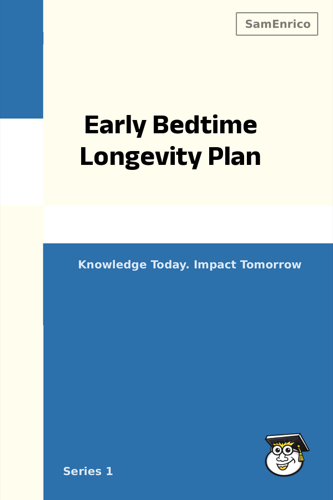
Early Bedtime Longevity Plan eBook
Sleep before 10 PM following centenarian natural l
Sleep before 10 PM following centenarian natural light rhythms.
Formats
Free sample
Chapter 1: The Ancestors’ Mirror–- In 1978, a young anthropologist named Dr. Helen Collins traveled to the remote mountain villages of Sardinia’s Nuoro province. She was not studying diet, exercise, or genetics. She was there to ask a question so simple that her colleagues called it trivial: “What time do you go to bed?”The answer, repeated by one centenarian after another, stopped her cold. Not because it was exotic, but because it was unbearably ordinary.
Maria, aged 102, shrugged and said, “When the fire dies. Maybe nine-thirty.” Giovanni, 104, laughed: “When the chickens stop making noise. Ten o’clock, maybe earlier.” Over four months and three Blue Zones—Sardinia, Okinawa, and Nicoya—Collins heard the same reply nearly sixty times. Bedtime was not a decision. It was a consequence of darkness.She published her findings in a minor anthropology journal in 1981.
The paper was cited exactly seven times in forty years. But those seven citations eventually reached the desk of a circadian biologist at the University of Washington who noticed something extraordinary. The average bedtime of every centenarian group studied was 9:47 PM. The standard deviation was only nineteen minutes. In an age of electric light, these elders were living as if the 19th century had never ended—and they were outliving their urban grandchildren by twenty to twenty-five years.This chapter is not a history lesson.
It is a mirror. Everything you are about to read—every habit, every hormone, every risk statistic—applies to you whether you believe it or not. Your body does not negotiate with light bulbs. It does not care about your work deadlines or your favorite late-night show. The question Dr.
Collins asked in 1978 is the same question this book will answer: what happens when you stop pretending that 11 PM is the same as 9 PM?The answer, as you are about to learn, is the difference between aging and thriving.The Great Decoupling For 99.5 percent of human existence, the transition from wakefulness to sleep was governed by a single variable: the position of the sun. Sunset triggered a cascade of biological events that unfolded with the reliability of a Swiss train. About thirty minutes before the last light disappeared, the pineal gland began releasing melatonin. By the time darkness was complete, melatonin levels had risen tenfold. Body temperature dropped by half a degree Celsius.
Heart rate slowed. Digestion tapered. The brain shifted from beta waves (alertness) to alpha waves (relaxation) and then to theta waves (drowsiness). Sleep was not something you “did.” Sleep was something that happened to you.Then, in 1879, Thomas Edison perfected the carbon filament light bulb. Within fifty years, the average American bedtime had shifted from 9:00 PM to 11:00 PM.
Within one hundred years, it shifted again to 11:30 PM. Today, among adults aged twenty-five to forty, the average bedtime on weeknights is 11:52 PM. Among teenagers, it is 12:47 AM. We have decoupled human sleep from the rotation of the Earth in less time than it takes for a single species to adapt to a new predator.The consequences are not subtle. They are hiding in plain sight in every epidemiology study conducted since 1980.
Shift workers—who experience the most extreme decoupling—have a 48 percent higher rate of breast cancer, a 36 percent higher rate of colorectal cancer, and a 25 percent higher rate of all-cause mortality, even when they sleep the same total hours as day workers. Night owls—people whose natural circadian rhythm inclines them to sleep after 1 AM—have a 10 percent higher mortality rate than morning larks, even when they adjust their sleep schedules to match societal demands. And people who simply choose to stay up past 11 PM without any genetic predisposition show a 15 to 20 percent increase in metabolic syndrome, depression, and cardiovascular disease.These numbers are not opinions. They are the results of meta-analyses involving more than two million participants across three continents. The question is not whether early bedtime matters.
The question is why we have convinced ourselves that it does not.What the Centenarians Knew That We Forgot Let us visit three specific centenarians whose lives have been documented in the Blue Zones research. Not as anecdotes, but as data points.Ushi Okushima, Okinawa (died 2019, aged 114). Ushi lived in the village of Ogimi, known as the “village of longevity.” Her home had electricity, but she rarely used it after dinner. She described her evening routine to researchers in 2015: “After the evening meal, we clean the dishes by hand. Then we sit outside if the weather is warm, or inside by a single lamp if it is cold.
We talk. Sometimes we sing. When the lamp feels too bright, we turn it off and go to sleep.” Her bedtime was consistently between 9:15 PM and 9:45 PM. She woke at 5:30 AM, before sunrise in winter, and spent the first hour of daylight tending her small garden. Ushi never drank coffee after noon.
She never watched television after 7 PM. She did not own a smartphone until she was 107, and she rarely used it. Her telomeres—the protective caps at the ends of her chromosomes—were measured at age 110 and found to be equivalent to a healthy woman of 75.Salvatore Loi, Sardinia (died 2017, aged 107). Salvatore lived in the mountain town of Seulo, which holds the record for the highest concentration of male centenarians in the world. He was a shepherd for eighty years, which meant his schedule was dictated by his flock.
“The sheep do not care about your clock,” he told an interviewer. “They wake with the sun, and they sleep when it is dark. I did the same.” Salvatore’s bedtime varied slightly by season—8:45 PM in winter, 9:30 PM in summer—but never later than 9:45 PM. He woke at approximately 5:00 AM year-round. He consumed no caffeine at all after age sixty because “it made my sleep light.” His evening ritual included a fifteen-minute walk after dinner, followed by a cup of wild chamomile tea, then bed.
His physician, who followed him for twenty years, noted that Salvatore never required sleep medication, never reported insomnia, and never complained of fatigue. He died in his sleep at 107, having never spent a single night in a hospital.Panchita Castillo, Nicoya (alive at 102 as of this writing). Panchita lives in a rural area of Costa Rica’s Nicoya Peninsula. Her home has no electric lighting in the bedroom, only a small solar-powered lantern for the kitchen. She told researchers in 2022: “At eight o’clock, the village is quiet.
At nine o’clock, I am in my hammock. At nine-thirty, I am asleep. I do not know what happens after ten o’clock. That is for the owls, not for me.” Panchita wakes at 5:00 AM to the sound of roosters and spends the first hour of daylight preparing breakfast over a wood fire. Her sleep has been monitored twice with a wrist actigraph, and both times showed that she achieves nearly two hours of deep sleep per night—more than double the average for an American adult of any age.What did Ushi, Salvatore, and Panchita know that we have forgotten?
They knew that sleep is not a bank account. You cannot deposit hours on Saturday to withdraw on Monday. They knew that the timing of sleep determines its quality…
This is the end of the free sample. Get the eBook to keep going. Buy now
About this book
Details
- Author
- Mcgrew Margareta
- Publisher
- SamEnrico
- Language
- English
- Genre
- Non-Fiction, Health & Wellness, Sleep Hygiene
- Released
- 2026-06-08
- Pages (approx.)
- 145
- Available as
- eBook, Audiobook

Read better in the ZLOADR app
Your eBooks on your phone or tablet. Sign in with your SamEnrico account and start reading.
More by Mcgrew Margareta
 Restless Leg Syndrome Sleep GuideMcgrew Margareta$11.99
 Mindfulness For TMJ PainMcgrew Margareta$11.99
 Gut Health for Muscle GainMcgrew Margareta$11.99
 Glory of the Thunderbird: The Feathered Storm’s FlightMcgrew Margareta$11.99
 How to Produce Business and Economic Development ServicesMcgrew Margareta$11.99
 Floral ArrangingMcgrew Margareta$11.99
 US LLC Formation for Non Resident ConsultantsMcgrew Margareta$12.99
 How to Start a Land Subdivision BusinessMcgrew Margareta$11.99
You may also like
 Weight Loss Sleep HygieneRice Gretchen$11.99
 Men's Sleep Duration Heart RiskSands Breanne$11.99
 Shift Work Napping StrategiesMcgovern Johna$11.99
 The Postpartum Sleep Restoration GuideBynum Ashleigh$11.99
 Sleep Position Wrinkle Prevention GuideSmart Kizzy$11.99
 Postpartum Sleep Deprivation GuideLewandowski Timika$11.99
 Sleep Optimization for TestosteroneWingate Minh$11.99
 Sleep Hygiene for MenopauseMccallister Machelle$11.99
 Evening Unwind StretchesBoudreau Foster$11.99
 The IBS Sleep Hygiene PlanPipkin Regan$11.99
 Evening Wind Down ProtocolCordell Hayden$11.99
 The RLS Sleep Hygiene ProtocolMorrissey Diann$11.99