
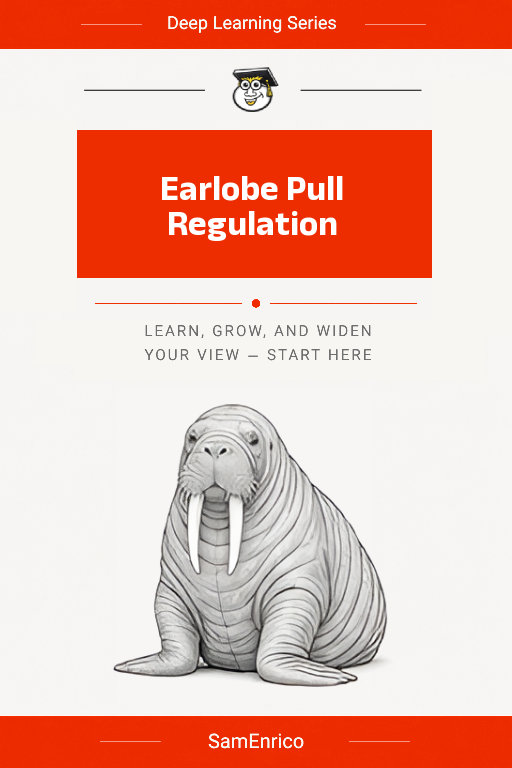
Earlobe Pull Regulation eBook
Gently pull earlobes downward to stimulate acupres
Gently pull earlobes downward to stimulate acupressure points that reduce anxiety.
Formats
Free sample
Chapter 1: The Hunger Beneath--–- Your anxiety is not a character flaw. Repeat that to yourself, slowly, because everything you are about to learn depends on accepting one uncomfortable truth: you have been taught to blame yourself for a biological problem. The racing heart before a meeting. The restless legs at 2:00 a.m. The knot in your stomach when you check your email.
The urge to scroll, snack, or snap at your partner. You have been told these are signs of weakness, poor coping skills, or a lack of discipline. None of that is true. These are signals of a touch-deprived nervous system screaming for regulation—and you have been trying to answer that scream with the wrong tools.This book will hand you the right tool. It is small, always available, costs nothing, and takes two minutes.
It is your earlobe. Before you dismiss this as ridiculous, consider that the same gentle downward pull on your earlobe has been used for thousands of years in acupressure traditions across China, India, and Japan to calm the mind and steady the heart. And in the past decade, neuroscience has caught up to what the ancients knew: the earlobe is a direct gateway to your vagus nerve, the superhighway of calm that runs from your brainstem to your gut. Pulling it in a specific, regulated way resets your nervous system faster than deep breathing alone, faster than a glass of wine, and faster than scrolling through social media. But you have never been taught how to do it correctly.This chapter will explain why modern life has left you touch-starved and wired-stressed, why your go-to coping mechanisms fail, and what the critical difference is between relaxation and regulation.
By the end, you will understand why your earlobe is not just a piece of cartilage but a biological remote control for your nervous system—and you will be ready to learn exactly how to use it.The Epidemic You Didn't Know You Had Let us begin with a question. When was the last time someone touched you with the explicit, gentle, intentional purpose of making you feel safe? Not a handshake. Not a pat on the back. Not a romantic overture or a medical exam.
Just touch for the sake of regulation. For most people reading this book, the answer is weeks, months, or even years ago. Some cannot remember at all.This absence has a name. In therapeutic circles, it is called skin hunger or touch starvation—a measurable deficit of positive, intentional tactile input. And it has reached epidemic levels in modern society.
According to research compiled in the New York Times bestselling book The Touch Remedy by Michelle Ebbin, the average American now experiences significantly less casual, nurturing touch than any generation in recent history. The reasons are many: the digitization of communication (texting instead of talking, let alone touching), the rise of remote work (fewer incidental shoulder taps from colleagues), the lingering effects of social distancing protocols, and a cultural hyperawareness of physical boundaries that, while necessary and good in many ways, has accidentally created a touch vacuum.Consider the data. A 2020 study from the Touch Research Institute at the University of Miami found that touch-deprived individuals had significantly higher baseline cortisol levels (the stress hormone) and lower oxytocin levels (the bonding and calm hormone) compared to those who received regular, positive touch from a partner or close friend. Another study from University College London showed that even brief intentional touch—as short as twenty seconds—lowered heart rate and blood pressure more effectively than verbal reassurance alone.But here is what most people miss. You do not need another person to get the benefits of touch.
Self-administered acupressure, of which the earlobe pull is a specific and powerful form, has been shown in peer-reviewed studies to produce many of the same physiological effects as touch from another person. The mechanism is the same: pressure on specific points activates nerve endings that signal the parasympathetic nervous system to take over. You can give yourself this gift. You do not have to wait for someone else to notice you are struggling.Why Your Go-To Coping Mechanisms Fail If you are like most people, you already have a set of strategies for dealing with anxiety and stress. You might take deep breaths.
You might pour a glass of wine. You might open social media and scroll. You might eat something sugary or salty. You might watch television for hours. You might vent to a friend.
You might go for a run. Some of these are better than others, but all of them share a fatal flaw when it comes to regulation: they are either temporary distractions, they introduce new problems, or they fail to target the nervous system directly.Let us take deep breathing first. Deep breathing is excellent—when done correctly. But most people do it wrong. They take a huge inhalation, hold it, and then release quickly.
This actually activates the sympathetic (fight-or-flight) nervous system. Correct parasympathetic breathing requires a long, slow, controlled exhalation that is longer than the inhalation. But even correct deep breathing has a limitation: it works primarily on the respiratory and cardiac systems indirectly. It takes time (usually three to five minutes) to shift heart rate variability. The earlobe pull, as you will learn in Chapter 3, works in sixty seconds or less because it directly stimulates a nerve.Now consider alcohol.
Alcohol temporarily reduces anxiety by depressing the central nervous system. But it comes with a rebound effect: as it metabolizes, anxiety often returns worse than before. It also impairs sleep architecture, reduces REM sleep, and can lead to dependence. Alcohol is not regulation; it is sedation. The difference between sedation and regulation is the difference between turning off a car by crashing it into a wall versus pressing the brake pedal.
One is damage. The other is control.Scrolling social media is perhaps the most deceptive. It feels like a break. It feels like distraction from worry. But multiple studies have shown that social media use actually increases cortisol levels, especially when the content is negative or comparative (looking at others' curated lives).
Your phone is not a regulation tool. It is a slot machine for your attention, and the house always wins.Eating for comfort is another common strategy. Carbohydrates and sugars increase serotonin temporarily, creating a brief mood lift. But the crash that follows leaves you lower than before, and chronic stress eating leads to metabolic problems that create more long-term anxiety about health and appearance.Venting to a friend can be helpful, but only if the friend is skilled at holding space without escalating your emotion. Most venting sessions turn into co-rumination, where both people feed each other's anxiety and leave more agitated than before.Exercise is genuinely excellent for stress reduction—over the long term.
But a single bout of intense exercise can temporarily raise cortisol, especially if you are already exhausted. And you cannot go for a run in the middle of a board meeting, a panic attack in a grocery store, or at 3:00 a.m. when you are supposed to be sleeping.What all of these strategies share is…
This is the end of the free sample. Get the eBook to keep going. Buy now
About this book
Details
- Author
- Gilliam Josue
- Publisher
- SamEnrico
- Language
- English
- Genre
- Non-Fiction, Mental Wealth
- Released
- 2026-05-30
- Pages (approx.)
- 143
- Available as
- eBook, Audiobook

Read better in the ZLOADR app
Your eBooks on your phone or tablet. Sign in with your SamEnrico account and start reading.
More by Gilliam Josue
 Overcoming Listening Barriers and DistractionsGilliam Josue$11.99
 Mindful Phone CheckGilliam Josue$11.99
 Parental Leave Expansion ReportGilliam Josue$11.99
 Fear of Failure Journal PromptsGilliam Josue$11.99
 SAD And Color TherapyGilliam Josue$11.99
 Remote Time Tracking GuideGilliam Josue$11.99
 Nonviolent Crisis InterventionGilliam Josue$11.99
 Networking for Social WorkersGilliam Josue$11.99
 The Architect of Modern Football: Max Seagram and the Birth of the Premier LeagueGilliam Josue$11.99
 The Algorithm That Broke the Internet: How a Teen’s App Sparked a Global RevolutionGilliam Josue$11.99
 How to Start a Precision Screw Business (Beginners Guide)Gilliam Josue$11.99
 How to Produce Wall PanelingGilliam Josue$11.99
You may also like
 Hong Kong Handover 1997Dunn Johnnie$11.99
 Zumba For Postnatal Recovery CourseNeal Christian$11.99
 Zumba for BeginnersLadner Nikia$11.99
 YouTube Comment Mining GuideHumes Pandora$12.99
 Worry Box MeditationCarlin Rudy$11.99
 Workplace Stress MeditationNguyen Lynn$11.99
 Workplace Stress and Sleep RepairHawley Ivory$11.99
 Workplace Perfectionism CureDelaney Jeffry$11.99
 Workplace Injustice Anger GuideWallen Isabelle$11.99
 Work Addiction and Burnout LinkGreenwood Ester$11.99
 Women in Yoga and WellnessBeattie Galina$11.99
 Women in Stand Up ComedyChun Evangeline$11.99