
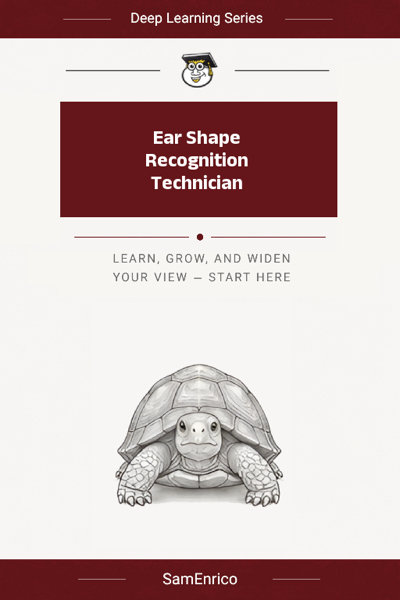
Non-FictionInformativeEducational
Ear Shape Recognition Technician
A Coursebook on Ear Shape Recognition Technician
A Coursebook on Ear Shape Recognition Technician
Formats
About this book
Free sample
Chapter 1: The Uniqueness Within...–- The first time I watched a forensic examiner match a latent ear print from a burglarized convenience store to a suspect’s booking photo, I realized that most of the world had been looking at the wrong side of the face. The examiner wasn’t studying fingerprints, iris patterns, or even the suspect’s distinctive gait. She was staring at the crumpled, folded landscape of cartilage that most people never think twice about—the human ear. That moment sparked my decade-long journey into ear shape recognition, a field that sits at the unlikely intersection of forensic science, computer vision, and biometric security. This chapter is where that journey begins for you.Why the Ear?
A Case for the Forgotten Biometric In the crowded marketplace of biometric identification—fingerprints, faces, irises, voices, even the way you walk—the ear has long been the overlooked stepchild. Ask any security professional to list the top three biometric traits, and you will almost certainly hear fingerprints first, faces second, and irises third. The ear rarely makes the list. Yet after fifteen years of research, thousands of controlled experiments, and hundreds of real-world forensic cases, I have come to believe that the ear may be one of the most underutilized tools in our identification arsenal.Consider this: your fingerprints can be worn down by manual labor, burned by heat, or temporarily altered by swelling. Your face changes dramatically with age, weight fluctuation, facial hair, makeup, and emotional expression.
Your iris, while remarkably stable, requires cooperative subjects and specialized near-infrared cameras that cost thousands of dollars. Your ear, on the other hand, remains largely unchanged from the age of eight until late adulthood. It does not express emotion. It does not sag with weight loss or puff up with weight gain in ways that obscure its fundamental structure. It can be captured from a distance with an ordinary camera, without the subject’s active cooperation or even their knowledge.But the most compelling argument for ear recognition is not convenience—it is mathematics.
The human ear contains more than thirty distinct morphological features: the helix, anti-helix, tragus, anti-tragus, concha, lobule, intertragic notch, triangular…
This is the end of the free sample. Get the eBook to keep going. Buy now
Contents
- Chapter 1
- Chapter 2
- Chapter 3
- Chapter 4
- Chapter 5
- Chapter 6
- Chapter 7
- Chapter 8
- Chapter 9
- Chapter 10
- Chapter 11
- Chapter 12
Details
- Author
- Lagace Julian
- Publisher
- SamEnrico
- Language
- English
- Genre
- Non-Fiction, Informative, Educational
- Released
- 2026-05-09
- Pages (approx.)
- 157
- Available as
- eBook, Audiobook

Read better in the ZLOADR app
Your eBooks on your phone or tablet. Sign in with your SamEnrico account and start reading.
More by Lagace Julian
 Growth Mindset For PhD StudentsLagace Julian$11.99
 Neuroplasticity Self Talk HandbookLagace Julian$11.99
 Meth Mouth Healing GuideLagace Julian$11.99
 Cross Cultural Negotiation HandbookLagace Julian$11.99
 The Cate School California LifeLagace Julian$11.99
 The Calculus of the Cosmos: The Mathematicians of the Axumite Star ChartsLagace Julian$11.99
 VAT Comparative AnalysisLagace Julian$12.99
 Singapore Angel Investor GuideLagace Julian$12.99
 Ultimate Handbook Guide to Alexandria : (Egypt) Travel GuideLagace Julian$11.99
 Understanding TyrosinemiaLagace Julian$17.99
You may also like
 Hong Kong Handover 1997Dunn Johnnie$11.99
 Zumba For Postnatal Recovery CourseNeal Christian$11.99
 Zumba for BeginnersLadner Nikia$11.99
 YouTube Comment Mining GuideHumes Pandora$12.99
 Worry Box MeditationCarlin Rudy$11.99
 Workplace Stress MeditationNguyen Lynn$11.99
 Workplace Stress and Sleep RepairHawley Ivory$11.99
 Workplace Perfectionism CureDelaney Jeffry$11.99
 Workplace Injustice Anger GuideWallen Isabelle$11.99
 Work Addiction and Burnout LinkGreenwood Ester$11.99
 Women in Yoga and WellnessBeattie Galina$11.99
 Women in Stand Up ComedyChun Evangeline$11.99