
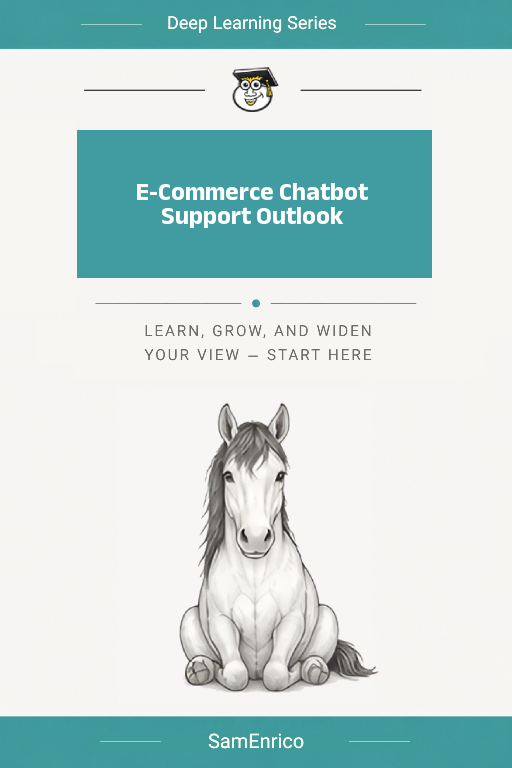
Non-FictionForecast & OutlookChatbots
E-Commerce Chatbot Support Outlook eBook
Project conversational AI resolution rates, pre-pu
Project conversational AI resolution rates, pre-purchase Q&A, post-purchase tracking, and voice agent integration through 2030.
Formats
Free sample
Chapter 1: The $85 Billion Lie--–- In 2019, a midsize direct-to-consumer footwear brand did what most e-commerce leaders were doing at the time. It deployed a chatbot. The goal, as articulated by the VP of Customer Experience in a now-infamous internal memo, was simple: "Deflect 40% of our tier-one tickets by the end of Q3." The chatbot was programmed to answer four questions: order status, shipping delay, return policy, and store hours. It was rule-based, rigid, and frustrating. Customers quickly learned that typing "agent" was faster than trying to navigate its limited menu.
Within six months, the brand had achieved its deflection target. It had also achieved a 12% drop in customer lifetime value, an 8% increase in cart abandonment, and a net promoter score that fell off a cliff. The chatbot saved money on support headcount. It also destroyed customer loyalty. The brand never connected the two outcomes.This is the $85 billion lie that has infected e-commerce for the better part of a decade.
The lie is simple, seductive, and almost universally believed: chatbots are tools for cost reduction. Their primary job is to keep customers away from human agents. Success is measured in deflection rates—the percentage of tickets that never reach a person. Every major e-commerce platform, from Shopify to Salesforce to Zendesk, has sold this lie because it aligns with their customers' immediate pain points. Support is expensive.
Humans are slow. Automate the cheap stuff and save money. The math seems irrefutable.Except the math is wrong. Catastrophically wrong.This chapter will dismantle the deflection mindset and replace it with something far more powerful. We will trace the history of e-commerce chatbots from their rule-based origins to the current era of generative AI and large language models.
We will examine the inflection point where a chatbot stopped being a cost-saving tool and started being a revenue-generating engine. We will introduce case studies from Superbet and NEXT—two brands that achieved 40% to 92% resolution rates on day one, not by deflecting customers but by serving them so well that they spent more money. And we will lay the foundation for the book's central framework: the three levels of AI autonomy that will define e-commerce through 2030. By the end of this chapter, you will understand why the deflection mindset is not just outdated but dangerous, and why the brands that embrace orchestration over deflection will own the next decade of e-commerce.The Origins of the Lie To understand how we arrived at the deflection mindset, we must go back to the early 2010s. E-commerce was booming, but customer support was drowning.
Order volumes were growing at 20–30% annually, but support headcount was growing at maybe 5–10%. The math was unsustainable. Into this gap stepped the rule-based chatbot.These early chatbots were not intelligent by any modern standard. They operated on decision trees. If the customer said "order status," the chatbot would ask for an order number.
If the customer provided a valid number, the chatbot would pull from an API and display tracking information. If the customer said anything outside its programmed tree—"my package says delivered but it's not here"—the chatbot would default to "I'm sorry, I didn't understand that. Let me connect you with an agent." The goal was not to solve complex problems. The goal was to handle the predictable, repetitive, low-value inquiries so that human agents could focus on everything else.This worked. Sort of.For a few years, deflection rates became the key performance indicator for e-commerce support operations.
Vendors like Zendesk, Intercom, and Gorgias built dashboards that celebrated every ticket that never reached a human. Case studies were published showing 30%, 40%, even 50% deflection rates. ROI calculations were straightforward: each deflected ticket saved 3to3 to 3to7 in agent costs. Multiply by volume, subtract the cost of the chatbot software, and you had a compelling business case. CFOs loved it.
VPs of Customer Experience got promotions. The industry patted itself on the back.But something was happening beneath the surface. Customers were not celebrating. They were not spending more. In fact, they were doing the opposite.The Unintended Consequences of Deflection The footwear brand mentioned at the opening of this chapter is not an outlier.
It is archetypal. In 2021, a team of researchers at a major university analyzed the support data of 47 e-commerce brands that had deployed rule-based chatbots. They found a consistent pattern: within six to twelve months of deployment, average order value dropped by an average of 7%, customer lifetime value dropped by 12%, and repeat purchase rates dropped by 9%. The brands with the highest deflection rates saw the largest declines.Why? Because deflection is a form of customer abandonment disguised as efficiency.When a customer reaches out for support, they are not just seeking information.
They are seeking reassurance, connection, and resolution. They have already experienced some friction—a delayed shipment, a confusing product page, a sizing question. Their emotional state is already slightly elevated. When a chatbot deflects them, either by failing to understand their question or by routing them to a generic FAQ, the customer experiences a second friction event. The brand has now failed them twice.
The customer does not think, "How efficient that the brand saved $5 by not connecting me to a human." The customer thinks, "This brand doesn't care about me."This is the hidden cost of deflection. It is not captured on any dashboard because it does not appear in the support ticket data. It appears in subsequent behavior: slower checkout, higher cart abandonment, lower review scores, and ultimately, churn. By the time the CFO looks at the quarterly retention report, the damage is already done. The chatbot saved money on headcount.
It also destroyed millions in future revenue. The two outcomes are causally connected, but the organization never draws the line because the data lives in different departments. Support measures deflection. Marketing measures lifetime value. No one measures the relationship between them.The Generative Inflection Point Everything changed in late 2022.
That was when large language models—LLMs—became accessible to the mainstream e-commerce industry. Chat GPT launched in November of that year, and within months, hundreds of vendors were racing to integrate generative AI into their chatbot products. The difference was immediately apparent.Rule-based chatbots could only respond to pre-programmed intents. If a customer asked, "Will this sofa fit in my elevator?" the rule-based bot had no way to answer unless someone had explicitly programmed a sofa-dimension-to-elevator-size comparison. Generative AI, by contrast, could reason.
It could read the product dimensions from your catalog, infer the typical elevator size in a residential building, do the math, and respond: "Based on the dimensions of this sofa (84" L x 38" W x 32" H) and the average residential elevator door width of 36", the sofa will not fit unless you tilt it at a 45-degree angle. Would you like me to show you sofas under 36" wide?" This is not deflection. This is resolution. This is service. This is sales.The most advanced brands recognized immediately that generative AI changed the calculus entirely.
Deflection was no longer the goal because deflection was no longer necessary. A well-implemented generative AI chatbot could resolve 80–90% of inquiries end-to-end, without ever escalating to a human. Not by shutting down the conversation, but by completing…
This is the end of the free sample. Get the eBook to keep going. Buy now
About this book
Details
- Author
- Beaty Armanda
- Publisher
- SamEnrico
- Language
- English
- Genre
- Non-Fiction, Forecast & Outlook, Chatbots
- Released
- 2026-05-29
- Pages (approx.)
- 155
- Available as
- eBook, Audiobook

Read better in the ZLOADR app
Your eBooks on your phone or tablet. Sign in with your SamEnrico account and start reading.
More by Beaty Armanda
 Parenting Through Trauma Self CareBeaty Armanda$11.99
 Self Esteem After Partner's CriticismBeaty Armanda$11.99
 Energy Audit Personal GuideBeaty Armanda$11.99
 Behavioral Addiction in VeteransBeaty Armanda$11.99
 The Iron Tide: How One Man Built a Global Shipping Empire from NothingBeaty Armanda$11.99
 The Dragon’s Lament: Saint George and the Beast of CappadociaBeaty Armanda$11.99
 How to Become a Kelp CutterBeaty Armanda$11.99
 ABAP DeveloperBeaty Armanda$11.99
 Ivy League Alternative Degree PrimerBeaty Armanda$12.99
 Understanding Hepatitis BBeaty Armanda$17.99
You may also like
 Hong Kong Handover 1997Dunn Johnnie$11.99
 Zumba For Postnatal Recovery CourseNeal Christian$11.99
 Zumba for BeginnersLadner Nikia$11.99
 YouTube Comment Mining GuideHumes Pandora$12.99
 Worry Box MeditationCarlin Rudy$11.99
 Workplace Stress MeditationNguyen Lynn$11.99
 Workplace Stress and Sleep RepairHawley Ivory$11.99
 Workplace Perfectionism CureDelaney Jeffry$11.99
 Workplace Injustice Anger GuideWallen Isabelle$11.99
 Work Addiction and Burnout LinkGreenwood Ester$11.99
 Women in Yoga and WellnessBeattie Galina$11.99
 Women in Stand Up ComedyChun Evangeline$11.99