
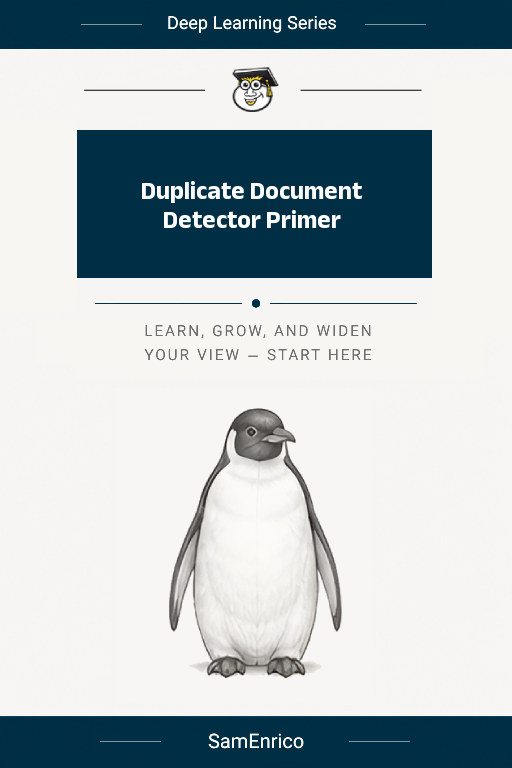
Non-FictionAI OperatorInformation GovernanceDuplicate Guide
Duplicate Document Detector Primer Audiobook
Identify near-duplicate and exact duplicate record
Identify near-duplicate and exact duplicate records across repositories using AI similarity matching. Includes version identification, retention alignment, and storage optimization suggestions.
Formats
Free sample
Chapter 1: The Hidden Tax--–- Every morning, Sarah, a compliance officer at a mid-sized financial services firm, runs a routine query. She searches for all versions of “Q3_2024_Financial_Statement_FINAL_v12.pdf.” Her screen returns 847 results. Among them are drafts from three different shared drives, copies embedded in email attachments sent to 14 colleagues, a version saved on a former employee’s now-frozen laptop, and two identical files with different names—“Q3_final_real_FINAL.pdf” and “Statement_Q3_2024_v FINAL_updated(2).pdf.” Sarah does not laugh. She does not cry. She opens a spreadsheet and manually compares file sizes and modification dates.
It is Tuesday, and this is her job.The scenario above is not an outlier. It is the norm across industries, from healthcare to software development to government archives. The problem has a name, though few organizations track it with the rigor it deserves: the hidden tax of duplicate and near‑duplicate data. This tax is paid not in currency—though the financial equivalent runs into billions of dollars annually—but in wasted storage, degraded system performance, legal exposure, analytical distortion, and human hours that could have been spent on value‑adding work.This book, Duplicate Document Detector Primer, exists to help you stop paying that tax. But before we build solutions, we must first understand the true cost of chaos.
Why do traditional deduplication methods fail? What is the spectrum of duplication, and why does it matter that most tools only see one end of it? Why is artificial intelligence no longer a luxury but a necessity for modern data hygiene? And finally, how do you measure the return on investment of a project that, if done correctly, should make itself nearly invisible?This chapter answers those questions. It establishes the business and technical case for moving beyond simple binary matching to a semantic and contextual understanding of data.
It also introduces a new risk that has emerged with the proliferation of generative AI: the echo loop, where AI agents re‑ingest their own outputs, creating duplicate knowledge at machine speed. By the end of this chapter, you will understand why your current deduplication strategy is likely failing, and you will have the vocabulary and metrics to make a compelling case for change.The Anatomy of Redundancy: More Than Just Copies To fight an enemy, you must name it. Most data professionals use the word “duplicate” to mean…
This is the end of the free sample. Get the Audiobook to keep going. Buy now
About this book
Details
- Author
- Ashworth Jessika
- Publisher
- SamEnrico
- Language
- English
- Genre
- Non-Fiction, AI Operator, Information Governance, Duplicate Guide
- Released
- 2026-05-28
- Pages (approx.)
- 144
- Available as
- eBook, Audiobook

Listen in the VoxFlicks app
Audiobooks and audio dramas wherever you go. Sign in with your SamEnrico account and press play.
More by Ashworth Jessika
 Scuba Instructor Gap GuideAshworth Jessika$11.99
 Mediterranean Diet Gut BrainAshworth Jessika$11.99
 Resentment After Bankruptcy GuideAshworth Jessika$11.99
 Love Has Won Escape MemoirAshworth Jessika$11.99
 Gambling Addiction and Identity TheftAshworth Jessika$11.99
 Blood & Silk: The Untold Empire of the Corsican MafiaAshworth Jessika$11.99
 Carnelian (Variety of Quartz) MiningAshworth Jessika$11.99
 Microfulfillment Center GuideAshworth Jessika$12.99
 Understanding Lassueur–Graham–little SyndromeAshworth Jessika$17.99
 How to Become a Coating-machine-operator HelperAshworth Jessika$11.99
You may also like
 Hong Kong Handover 1997Dunn Johnnie$11.99
 Zumba For Postnatal Recovery CourseNeal Christian$11.99
 Zumba for BeginnersLadner Nikia$11.99
 YouTube Comment Mining GuideHumes Pandora$12.99
 Worry Box MeditationCarlin Rudy$11.99
 Workplace Stress MeditationNguyen Lynn$11.99
 Workplace Stress and Sleep RepairHawley Ivory$11.99
 Workplace Perfectionism CureDelaney Jeffry$11.99
 Workplace Injustice Anger GuideWallen Isabelle$11.99
 Work Addiction and Burnout LinkGreenwood Ester$11.99
 Women in Yoga and WellnessBeattie Galina$11.99
 Women in Stand Up ComedyChun Evangeline$11.99