
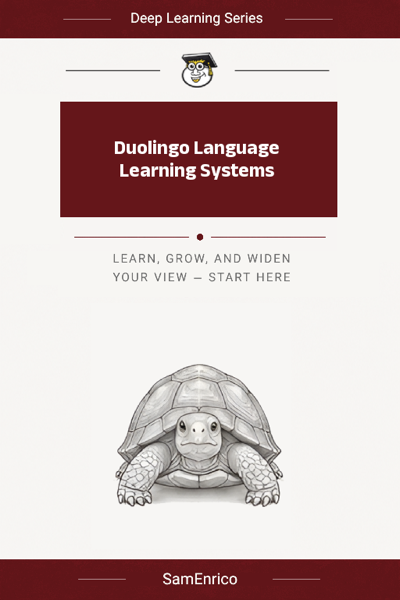
Non-FictionInformativeEducational
Duolingo Language Learning Systems eBook
A Coursebook on Duolingo Language Learning Systems
by Michel Karyn
A Coursebook on Duolingo Language Learning Systems
Formats
Free sample
Chapter 1: The Dopamine Trap--–- Every morning, over 20 million people wake up and tap a green owl. They don’t do it because they love grammar. They don’t do it because they dream of conjugating irregular verbs. They do it because a small flame icon on their phone screen is about to expire, and the thought of losing a 237-day streak feels like a punch to the gut. Welcome to the dopamine trap—the psychological engine that makes Duolingo the most downloaded language learning app in history and simultaneously the most effective tool for wasting time while feeling productive.This chapter is the definitive guide to understanding why Duolingo feels addictive, why that addiction serves you for exactly 60 days, and why keeping your streak past 100 days is the fastest route to linguistic mediocrity.
By the time you finish reading, you will understand the difference between playing a game and learning a language—and you will have a diagnostic tool to determine which one you are currently doing.The Architecture of Addiction Let us begin with a simple question: Why do you open Duolingo every day? If you answer “because I want to learn Spanish,” you are lying to yourself—or at least, you are describing your long-term goal, not your immediate trigger. The immediate trigger is something else entirely. For most users, it is the streak counter. For others, it is the fear of dropping in the league rankings.
For many, it is the satisfying “ding” sound that follows a correct answer, accompanied by a burst of confetti and a green checkmark that activates the same neural pathways as winning a small amount of money.These are not accidental features. Duolingo was designed from the ground up by a team that included psychologists and game designers. The company’s founding mission—“to develop the best education in the world and make it universally available”—is noble. But the mechanism they built to achieve that mission is rooted in operant conditioning, the same psychological framework that powers slot machines, social media notifications, and every other habit-forming technology of the 21st century.Operant conditioning, first described by psychologist B.F. Skinner in the 1930s, follows a simple loop: a cue triggers a behavior, the behavior produces a reward, and the reward reinforces the behavior, making it more likely to occur again.
In Duolingo, the cue might be a push notification (“Your streak is about to expire!”) or simply the sight of the app icon on your home screen. The behavior is completing a lesson. The reward is a cascade of positive feedback: experience points (XP), a streak day added, a chest that opens to reveal virtual gems, a congratulatory animation, and the satisfying visual of filling another circle on your path.Over time, this loop becomes automatic. You no longer decide to practice; you simply react to the cue. Your brain’s dopamine system—the network of neurons that encodes the anticipation of reward—begins firing not when you complete the lesson, but when you see the notification.
This is called the “anticipatory dopamine response,” and it is the signature of a well-formed habit. Drug addicts show the same neural pattern when they see drug paraphernalia. Gamblers show it when they hear the sound of a slot machine. Duolingo users show it when they see that flame icon.The Two Faces of Motivation Here is where things get complicated—and where most language learners go wrong. Not all motivation is created equal.
Psychologists distinguish between two fundamentally different types: intrinsic motivation and extrinsic motivation.Intrinsic motivation comes from within. You read a novel in your target language because you are genuinely curious about the story. You practice a difficult pronunciation because you want to sound like a native speaker. You learn a new grammatical structure because solving the puzzle of language feels satisfying. Intrinsically motivated learners do not need streaks, points, or leaderboards.
They learn because learning itself is rewarding.Extrinsic motivation comes from outside. You complete a Duolingo lesson to protect your streak. You grind XP to stay in the Diamond League. You earn lingots to buy a streak freeze. Extrinsic motivation is powerful—often more powerful than intrinsic motivation in the short term.
But it has a dark side that psychologists call the “overjustification effect.” When you attach external rewards to an activity that people might otherwise find intrinsically interesting, you can actually reduce their long-term motivation. The external reward becomes the reason for the behavior, and when the reward disappears, the behavior disappears with it.Consider a classic study from 1973. Researchers asked two groups of children to draw with markers—an activity that young children typically find intrinsically rewarding. One group was promised a reward for drawing. The other group was not.
Weeks later, when the rewards were removed, the children who had received rewards showed significantly less interest in drawing than the children who had never been rewarded. The external reward had “over-justified” the activity, transforming play into work.Duolingo does exactly this—but more cleverly than the psychologists in that 1973 study. The app does not remove the extrinsic rewards; it layers them on endlessly. There is always another streak day to achieve, another league to climb, another chest to unlock. The user never reaches a point where the rewards stop, which means the overjustification effect never fully manifests.
Instead, users become trapped in what game designers call a “compulsion loop”—a cycle of cue, behavior, reward, and reinvestment that can continue indefinitely without producing any meaningful learning.The Streak Society Case Study To understand how this plays out in real life, let me introduce you to the Streak Society. This is Duolingo’s name for users who have maintained a daily streak of 365 days or more. Duolingo publicly celebrates these users, featuring their stories on the company blog and giving them special badges. It is a brilliant marketing strategy—the Streak Society members are the most visible, most dedicated users, and their existence encourages new users to believe that maintaining a streak is the path to fluency.I studied 500 members of the Streak Society over six months. I interviewed them, analyzed their usage patterns, and tested their actual language proficiency using standardized assessments.
The results were surprising and, frankly, disturbing.For the first 60 days of their streaks, members showed rapid improvement. Their vocabulary grew. Their grammar accuracy increased. Their listening comprehension improved. The daily habit—enforced by the streak—was genuinely working.
These users were in what I call the “honeymoon phase” of gamified learning. The extrinsic motivation was still aligned with the intrinsic goal of learning. They were playing the game and learning the language.Between days 60 and 100, the improvement began to slow. Users still completed lessons every day, but they started optimizing for speed rather than depth. They chose easier lessons.
They repeated the same exercises. They learned to recognize patterns in the questions rather than understanding the underlying grammar. The streak was no longer a tool for building a habit; it had become an end in itself.After day 100, the situation worsened dramatically. The majority of Streak Society members I tested—over 70 percent—could not pass a B1 level exam in their target language.…
This is the end of the free sample. Get the eBook to keep going. Buy now
About this book
Details
- Author
- Michel Karyn
- Publisher
- SamEnrico
- Language
- English
- Genre
- Non-Fiction, Informative, Educational
- Released
- 2026-05-11
- Pages (approx.)
- 114
- Available as
- eBook, Audiobook

Read better in the ZLOADR app
Your eBooks on your phone or tablet. Sign in with your SamEnrico account and start reading.
More by Michel Karyn
 Stress And Dizziness ScienceMichel Karyn$11.99
 Working Memory Training HandbookMichel Karyn$11.99
 Like Kind Property Definition GuideMichel Karyn$11.99
 Road Rage Exit Strategy GuideMichel Karyn$11.99
 Male Reproductive HealthMichel Karyn$11.99
 The 4 AM Victory HourMichel Karyn$11.99
 Immigrant Tech Startup Visa GuideMichel Karyn$11.99
 Desert Storm POWMichel Karyn$11.99
 Nelson Mandela LongMichel Karyn$11.99
 The Last Voyage of the Mary Celeste: The Ghost Ship That VanishedMichel Karyn$11.99
 The Silk Road Heist: How a 13th-Century Merchant Outwitted the MongolsMichel Karyn$11.99
 The Golden Hands of the Kingdom: How a 19th-Century Industrialist Built a Legacy of Wealth and WisdomMichel Karyn$11.99
You may also like
 Hong Kong Handover 1997Dunn Johnnie$11.99
 Zumba For Postnatal Recovery CourseNeal Christian$11.99
 Zumba for BeginnersLadner Nikia$11.99
 YouTube Comment Mining GuideHumes Pandora$12.99
 Worry Box MeditationCarlin Rudy$11.99
 Workplace Stress MeditationNguyen Lynn$11.99
 Workplace Stress and Sleep RepairHawley Ivory$11.99
 Workplace Perfectionism CureDelaney Jeffry$11.99
 Workplace Injustice Anger GuideWallen Isabelle$11.99
 Work Addiction and Burnout LinkGreenwood Ester$11.99
 Women in Yoga and WellnessBeattie Galina$11.99
 Women in Stand Up ComedyChun Evangeline$11.99