
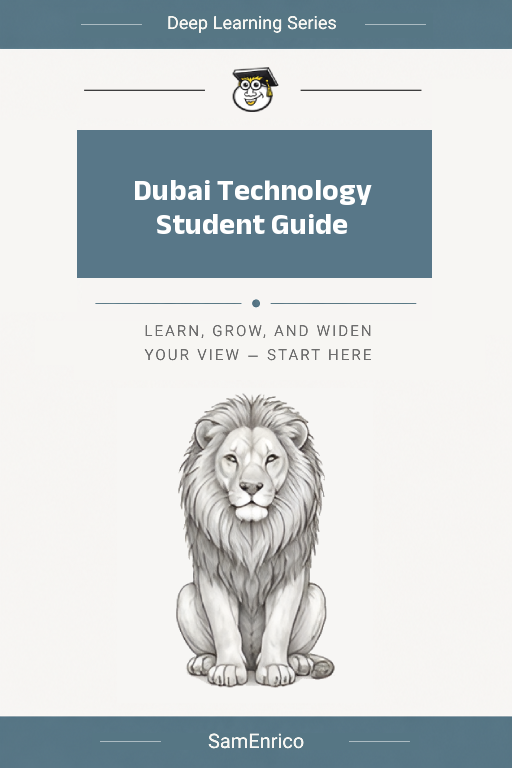
Non-FictionStudent's ShortcutTech Resources
Dubai Technology Student Guide eBook
Use campus Wi-Fi, computer labs, and software acce
by Frost Vance
Use campus Wi-Fi, computer labs, and software access for online learning and assignments.
Formats
Free sample
Chapter 1: The Digital Oasis--Dubai’s skyline is a testament to what happens when ambition meets infrastructure. The Burj Khalifa doesn’t scrape the clouds by accident; it exists because someone engineered the foundation, calculated the wind loads, and installed the elevators. Your university experience in Dubai is no different. Beneath the surface of every seamless Zoom lecture, every instant library database search, and every remote login to a powerful lab computer lies a meticulously designed digital ecosystem—one that most students never bother to understand, and therefore never fully exploit.This book exists because you are not most students.You are studying in one of the most technologically advanced urban environments on Earth. The Dubai International Academic City (DIAC), Dubai Knowledge Park (DKP), and the various free zones that host international university branches are not just collections of buildings.
They are engineered digital landscapes, complete with fiber-optic backbones, high-density wireless grids, and security architectures that would impress corporate IT departments. Yet every semester, thousands of students struggle with the same frustrations: dropped Wi-Fi calls during online exams, lost files because they saved to the wrong drive, software that won’t install, and presentation failures at the worst possible moment.These are not technical failures. They are knowledge failures.The difference between a student who suffers through technology and a student who commands it is not intelligence or wealth. It is understanding a small set of core principles about how campus networks, storage systems, and software licenses actually work. This chapter begins that journey by revealing the blueprint of the Dubai digital campus.
By the time you finish these pages, you will see your university’s Wi-Fi, computer labs, and online portals not as mysterious black boxes but as predictable systems you can navigate with confidence.The Illusion of Simplicity When you open your laptop in a student lounge and see the Wi-Fi icon turn solid, you assume the connection is magic. It is not. What you are witnessing is the end result of a complex chain of technologies that most students ignore until something breaks. The same is true for your university email, your access to software like Matlab or SPSS, and your ability to print a fifty-page assignment at 11:47 PM.Universities in Dubai have invested millions of dirhams into creating what network engineers call a "high-availability, low-latency environment." Translating that jargon: they want you to forget the technology exists so you can focus on your studies. This is a double-edged sword.
When everything works, you learn nothing about how it works. When something fails, you have no mental model for fixing it.Consider the average student’s response to a Wi-Fi dropout during an online quiz. Panic. Restart the laptop. Move to a different seat.
Call a friend. Submit a frantic ticket to IT. What they rarely do is diagnose: Is the problem with their device, the access point, the authentication server, or the internet gateway? Each of these has a different solution, but without a basic map of the territory, every problem looks like a monster under the bed.This chapter provides that map. Not the full technical schematics—those belong in later chapters—but the conceptual foundation that turns confusion into curiosity and frustration into troubleshooting.The Geography of the Dubai Digital Campus Before you can use a tool effectively, you must understand its physical and logical layout.
Your university’s technology infrastructure is not a single machine but a network of interconnected systems, each with its own purpose and limitations.The Physical Layer: Cables, Antennas, and Rooms Start with the tangible. Every keystroke you make eventually travels through wires or radio waves. Dubai’s education hubs benefit from being built from the ground up in the 21st century. Unlike older universities in Europe or North America that retrofit fiber optics into century-old buildings, DIAC and DKP were designed with digital connectivity as a primary requirement.Underground fiber-optic cables connect building to building, often running at 10 or 40 gigabits per second. Inside each building, Ethernet switches distribute that connection to individual rooms.
In computer labs, you will find physical Ethernet jacks—often neglected by students who prefer Wi-Fi. This is a mistake, as you will learn in Chapter 2. Wired connections are faster, more stable, and immune to the interference that plagues wireless.Above the ceiling tiles, mounted on walls, or disguised as smoke detectors, are wireless access points (APs). Each AP covers a specific zone, typically 15 to 30 meters in radius. In high-density areas like lecture halls or student lounges, you might find multiple APs operating on different channels to share the load.
The newest campuses in Dubai are deploying Wi-Fi 6e, which adds a third radio band (6 GHz) specifically to handle overcrowded networks. Chapter 2 explains how to force your device onto the least congested band.The Logical Layer: Authentication, Authorization, and Accounting Once your device connects physically, it must prove who you are. This is where your student ID and password enter the picture. When you join the campus Wi-Fi, you are not simply being polite—you are completing an authentication handshake. Your device sends your credentials to a server called a RADIUS (Remote Authentication Dial-In User Service), which checks them against the university’s database.
If correct, the server tells the access point to let you through.This explains why you cannot use the Wi-Fi before activating your student account, and why changing your password kicks you off all devices until you re-authenticate. It also explains why sharing your password with a friend is not just a security risk (see Chapter 7) but a violation of the Acceptable Use Policy that can lead to disciplinary action.Once authenticated, you are placed on a specific virtual network or VLAN (Virtual Local Area Network). VLANs are how the university separates different types of traffic. Student traffic might be on one VLAN, staff on another, and guest Wi-Fi on a third with heavy restrictions. This segmentation is why you cannot print to a lab printer from your dorm room unless the university specifically configured it—you are on different VLANs.Finally, accounting.
Every byte you send and receive is logged. Not because the university is spying on you, but because they need to plan capacity. If every engineering student starts streaming 4K video during finals week, the network team can see the spike and adjust. Do not assume anonymity on campus Wi-Fi. Your login ID is attached to your traffic, which is another reason to never share your credentials.Why Dubai Invests So Heavily in Campus Technology You might wonder why your university spends what feels like an extravagant amount on technology when they could instead lower tuition or build nicer lounges.
The answer lies in Dubai’s broader economic strategy.Dubai does not have oil in meaningful quantities. Its resources are location, logistics, and a vision to become a hub for the knowledge economy. The Dubai 2030 Smart City plan explicitly calls for world-class digital infrastructure in education, healthcare, and transportation. Universities in Dubai are not just educational institutions; they are showcases for what the city can offer international investors and talent.When a multinational corporation considers opening a regional office in Dubai, they look at the talent pipeline. If university graduates are…
This is the end of the free sample. Get the eBook to keep going. Buy now
About this book
Details
- Author
- Frost Vance
- Publisher
- SamEnrico
- Language
- English
- Genre
- Non-Fiction, Student's Shortcut, Tech Resources
- Released
- 2026-05-29
- Pages (approx.)
- 157
- Available as
- eBook, Audiobook

Read better in the ZLOADR app
Your eBooks on your phone or tablet. Sign in with your SamEnrico account and start reading.
More by Frost Vance
 Chamomile Oil Sleep AidFrost Vance$11.99
 Async Hiring and Interviewing ManualFrost Vance$11.99
 Prostate Cancer Second Opinions GuideFrost Vance$11.99
 Executive Kidnap Crisis Partner NotificationFrost Vance$11.99
 Art Comparison on Instagram RecoveryFrost Vance$11.99
 Echoes from the Abyss: The Hunt for Black Holes in the Southeast Asian SkyFrost Vance$11.99
 The Billionaire’s Blueprint: How Warren Buffett’s Giving Pledge Reshaped PhilanthropyFrost Vance$11.99
 Technical Product OwnerFrost Vance$11.99
 Supply Chain Predictions 2026Frost Vance$12.99
 Understanding Conjunctivitis LigneousFrost Vance$17.99
 How to Become a Motorcycle SubassemblerFrost Vance$11.99
You may also like
 Hong Kong Handover 1997Dunn Johnnie$11.99
 Zumba For Postnatal Recovery CourseNeal Christian$11.99
 Zumba for BeginnersLadner Nikia$11.99
 YouTube Comment Mining GuideHumes Pandora$12.99
 Worry Box MeditationCarlin Rudy$11.99
 Workplace Stress MeditationNguyen Lynn$11.99
 Workplace Stress and Sleep RepairHawley Ivory$11.99
 Workplace Perfectionism CureDelaney Jeffry$11.99
 Workplace Injustice Anger GuideWallen Isabelle$11.99
 Work Addiction and Burnout LinkGreenwood Ester$11.99
 Women in Yoga and WellnessBeattie Galina$11.99
 Women in Stand Up ComedyChun Evangeline$11.99