
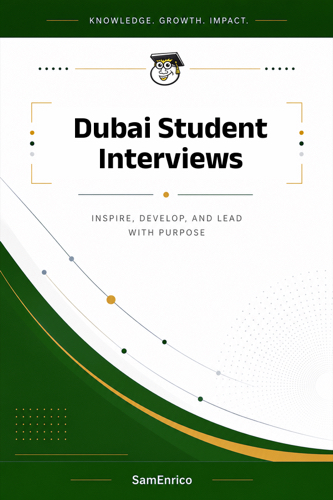
Non-FictionStudent's Shortcut / Interviews
Dubai Student Interviews eBook
undefined
undefined
Formats
Free sample
Chapter 1: The Disappearing Generation...--The first time someone asked me where I was really from, I was sixteen years old, standing in a fluorescent-lit classroom in London, and I had no idea the question would follow me for the rest of my life.I had traveled from Dubai for a summer program—six weeks of pretending to be a university student, staying in dormitories that smelled like instant noodles and cheap detergent. The other participants were from Texas and Toronto and Tokyo, and we had spent the first few days performing the ritual of origin stories: "I'm from Austin." "I'm from Osaka." When my turn came, I said, "I'm from Dubai."A girl with a strong Southern accent tilted her head. "No," she said, not meanly, just curious. "But where are you really from?"I opened my mouth. Closed it.
My parents were Indian. I had a British passport because my grandmother was born in Manchester. I had been born in Dubai, lived there my whole life, never spent more than six weeks anywhere else. But I had never taken the Emirati citizenship test because there was no test to take—citizenship was not something Dubai gave to people like me."I'm from Dubai," I said again, because I didn't know what else to say.She smiled, unconvinced, and turned to the next person.That was the first time I understood that my answer was not acceptable. It would not be the last.The City That Wasn't Anyone's Home Dubai is a city of ninety percent expatriates.
Let that number sit for a moment. Nine out of every ten people you pass on the street, sit next to on the metro, or share a classroom with—none of them are from here. They are from India and Pakistan and the Philippines and Egypt and the United Kingdom and Australia and a hundred other places that have names and borders and histories that stretch back centuries.Dubai has none of those things. Not really. It has a founding myth—pearl divers and Bedouins and a creek that smelled like fish—but the city that exists now was built in a single generation, by people who arrived on airplanes with suitcases and dreams and work visas that could be revoked at any moment.I was one of those people, or rather, I was their child.
I grew up in the Dubai that the brochures don't show you: the Dubai of compound villas with shared swimming pools, of Friday brunches that cost a week's salary, of air-conditioned malls where teenagers gathered because there was nowhere else to go. I attended a British-curriculum school where my classmates had last names that traced back to Cheshire and Chennai and Cairo. I learned to speak English with an accent that no one could place—not quite British, not quite American, not quite anything—and to laugh when people asked me to say "Dubai" because the way I pronounced it gave me away as someone who had never really belonged anywhere else.The students I interviewed for this book—forty-seven of them, over three years, across four continents—all grew up in that same Dubai. They attended American-curriculum schools and Indian-curriculum schools and IB schools and French lycées. Their parents were doctors and taxi drivers and bankers and construction workers.
Their passports were Indian and Pakistani and British and Egyptian and Filipino and Emirati. But they all shared one thing: they had spent their formative years in a city that refused to claim them, and they had emerged with a set of scars and superpowers that the rest of the world did not know how to name.The Paradox of Permanent Temporariness There is a term for people like us: Third Culture Kids. The phrase was coined in the 1950s by sociologist Ruth Hill Useem, who studied American children raised abroad. She noticed that these children did not fully belong to their parents' culture (the "first culture") or their host country's culture (the "second culture"). Instead, they developed a "third culture"—a hybrid identity that borrowed from both and belonged to neither.The foundational text on this subject is Third Culture Kids: Growing Up Among Worlds by David Pollock and Ruth Van Reken.
First published in 1999 and updated several times since, the book has become something like a bible for people like me. Pollock and Van Reken define TCKs as "children who spend a significant part of their developmental years outside their parents' culture." They note that TCKs develop distinct identity patterns, unusual levels of cross-cultural competence, and a peculiar relationship with the concept of "home."But the original TCK literature focused primarily on a particular demographic: missionary kids, military brats, and diplomat children. These were elite, privileged, Western kids whose mobility was funded by governments or churches. Their experience of displacement was cushioned by security clearances and housing allowances and the implicit promise of eventual repatriation to a country that would welcome them back.Dubai's TCKs are different.The updated edition of Pollock and Van Reken expands the definition to "Cross-Cultural Kids" (CCKs), encompassing children of immigrants, refugees, and international adoptees. This expansion is crucial for understanding Dubai, where the student population includes the children of Pakistani construction workers who live in labor camps, Syrian refugees who arrived with nothing, Indian tech professionals who came for the tax-free salary, and British bankers who expected to stay for two years and stayed for twenty.All of these children share classroom space.
All of them are "international students" in the broadest sense. But their privileges are vastly different. The British banker's child has a passport that opens doors; the Pakistani construction worker's child does not. The Indian tech professional's child attends the same school as the Syrian refugee's child—but one family has a safety net and the other does not.This is what I call the paradox of permanent temporariness. Dubai students grow up in a city where no one is from, where everyone is temporary, where the only certainty is that nothing is certain.
They learn to form friendships that they know will end, to love places they know they will leave, to plan for futures that depend on factors entirely outside their control—a parent's visa, a company's restructuring, a government's policy change.And yet, they also learn something else. They learn to adapt. They learn to connect across differences that would divide most adults. They learn to find home in people rather than places, in moments rather than monuments. They learn, in the words of one of my interviewees, to "be from everywhere and nowhere at the same time."Maya: A Story of Not-From-Here Before I introduce the other students whose voices fill this book, I want to introduce you to Maya.
She is a composite character—drawn from multiple interviews, shaped by my own experiences, but not identical to any single person I spoke with. I created Maya because the forty-seven interviews I conducted were too fragmented, too diverse, too contradictory to be captured by any single voice. Maya is the thread that runs through all of them. She is the story that the statistics cannot tell.Maya was born in Dubai in 2002.…
This is the end of the free sample. Get the eBook to keep going. Buy now
About this book
Details
- Author
- Weatherly Elease
- Publisher
- SamEnrico
- Language
- English
- Genre
- Non-Fiction, Student's Shortcut / Interviews
- Released
- 2026-06-07
- Pages (approx.)
- 143
- Available as
- eBook, Audiobook

Read better in the ZLOADR app
Your eBooks on your phone or tablet. Sign in with your SamEnrico account and start reading.
More by Weatherly Elease
 Gacy Psychology EvaluationsWeatherly Elease$11.99
 Pet Product Spending DivideWeatherly Elease$11.99
 Exercise Boost Senior MemoryWeatherly Elease$11.99
 Partner Bipolar GuideWeatherly Elease$11.99
 Angolan Civil War EscapeWeatherly Elease$11.99
 Pediatric IBS GuideWeatherly Elease$11.99
 Circadian Rhythm Children GuideWeatherly Elease$11.99
 The Bridge That Split a City: The 1967 Silver Bridge DisasterWeatherly Elease$11.99
 The Divine Harmonies: Monteverdi and the Birth of OperaWeatherly Elease$11.99
 Understanding PandasWeatherly Elease$11.99
 How to Produce General AdhesiveWeatherly Elease$11.99
 Government Proposal Writing WorkbookWeatherly Elease$12.99
You may also like
 Hong Kong Handover 1997Dunn Johnnie$11.99
 Zumba For Postnatal Recovery CourseNeal Christian$11.99
 Zumba for BeginnersLadner Nikia$11.99
 YouTube Comment Mining GuideHumes Pandora$12.99
 Worry Box MeditationCarlin Rudy$11.99
 Workplace Stress MeditationNguyen Lynn$11.99
 Workplace Stress and Sleep RepairHawley Ivory$11.99
 Workplace Perfectionism CureDelaney Jeffry$11.99
 Workplace Injustice Anger GuideWallen Isabelle$11.99
 Work Addiction and Burnout LinkGreenwood Ester$11.99
 Women in Yoga and WellnessBeattie Galina$11.99
 Women in Stand Up ComedyChun Evangeline$11.99