
Non-FictionStudent's ShortcutHousing GuideStudent Living
Dubai Student Accommodation Guide eBook
Find student housing in Dubai including university
Finds affordable housing near university zones.
Formats
Free sample
Chapter 1: The Bed Space Economy--–- You have just landed at Dubai International Airport. Your suitcase contains two months of clothes, a printed copy of your university acceptance letter, and exactly AED 3,800 in your bank account. Your parents back home think you are living in a university dormitory with meal plans and resident advisors. Your friends think you have moved to a glittering city of skyscrapers and beach clubs. The truth is much simpler and much more terrifying: you need to find a place to sleep tonight, and you have no idea how this city actually works.This chapter is not an introduction.
It is an intervention. Before you scroll through Dubizzle, before you message that “agent” with the profile picture of a luxury car, before you send a deposit to anyone, you need to understand the fundamental rules of housing in Dubai. These rules are different from London, different from New York, different from Sydney, and certainly different from any city your parents have ever lived in. In most of the world, renting a room means signing a contract, paying a deposit, and having legal rights that courts will enforce. In Dubai, for the budget student, none of that is guaranteed.
Welcome to the bed space economy.The Vocabulary You Must Learn Before You Arrive Let us begin with a single definition that will appear in every subsequent chapter of this book. A bed space is exactly what it sounds like: one bed within a shared room, occupied by two to four people who are not related, not in a relationship, and often not even acquainted before they become roommates. You do not rent a bedroom. You rent a bed. The person sleeping three feet away from you might be a Pakistani engineer working the night shift, a Filipino nurse who wakes at 4 AM, or another student from your university who you will either become best friends with or learn to despise within two weeks.The bed space is the fundamental unit of budget housing in Dubai because the city’s economy runs on migrant labor.
Hundreds of thousands of workers earning between AED 1,500 and AED 5,000 per month cannot afford studios or one-bedroom apartments. They cannot even afford partitioned rooms in many cases. So they rent bed spaces. Students, who often earn nothing or survive on part-time wages, slot into the same economy. You are not special.
You are not being exploited uniquely. You are simply young and broke in a city that has perfected the art of extracting money from the young and broke.Here is what a bed space is not. It is not a legal tenancy. It is not registered with the government. It does not come with an Ejari contract, which we will discuss in detail in Chapter 9.
It gives you exactly zero legal standing if the landlord decides to change the locks, keep your deposit, or evict you at midnight. What you are buying is not a property right. You are buying a temporary arrangement based on the goodwill of a landlord who knows you cannot afford to sue him.The Visa Loophole That Defines Student Housing Dubai’s rental laws were designed for employed adults, not students. Under normal circumstances, you cannot sign a legal tenancy contract, known as an Ejari, without a valid residency visa linked to employment or sponsorship. Citizens and residents with jobs have this.
Students on university-sponsored visas generally do not. University visas are issued for the purpose of study, not housing. The Dubai Land Department does not prevent a student from signing an Ejari in theory, but in practice, most landlords will not rent to someone without a steady employment income and a standard residency visa.This creates a legal gray zone where the majority of student housing operates. Landlords who convert villas into partitions or rent bed spaces in International City know their tenants cannot sign formal contracts. They know you have no recourse.
They also know that you need a place to sleep, and the university dormitory is charging AED 5,000 per month. This asymmetry of information and power is the foundation of the budget student housing market. You are not being cheated in the traditional sense of a scam. You are being offered a product that matches your budget. The product simply has no legal protections.The loophole works like this.
You arrive on a tourist visa or a university-sponsored student visa. You find a landlord through Dubizzle, Facebook Marketplace, or a Whats App group. You agree on a monthly rent, typically paid in cash or bank transfer. You receive a handwritten receipt if you are lucky. You move into a bed space or a partition.
The landlord does not report your tenancy to any government body. The government does not ask. You stay for six months, a year, or until you graduate. When you leave, you hope to get your security deposit back. Sometimes you do.
Sometimes you do not. This is the bargain you are making.Chapter 9 will explain exactly how to protect yourself within this gray zone, including the handwritten receipt strategy, the bank transfer paper trail, and the documentation of every crack and stain. For now, understand that you are entering a market where the usual rules of Western housing do not apply. Your handshake with a landlord in International City is not a contract. It is a hope.The Three Geographic Pillars of Dubai Student Housing Before we dive into International City, which will occupy the majority of this book, you need to understand the three geographic zones where students can conceivably live.
Each zone has a distinct price point, commute profile, and quality of life.Pillar One: Academic City Academic City is the dream that does not exist. Several major universities are located here, including Middlesex University Dubai, Heriot-Watt University Dubai’s campus, and Amity University Dubai. The theory is simple: live next to your university, walk to class, save on transportation, and enjoy a campus lifestyle. The reality is that purpose-built student housing within Academic City is extremely limited and expensive. Most of what exists is occupied by students who applied months in advance.
The remaining options are partitioned villas in the surrounding neighborhoods of Al Warqa and Nad Al Sheba, which we will explore in Chapter 7.If you can secure on-campus housing, Chapter 6 will help you evaluate whether the cost is worth the convenience. For most budget students, Academic City is a place you commute to, not a place you live in.Pillar Two: New Dubai New Dubai includes areas like Dubai Marina, Jumeirah Beach Residence, Downtown, and Business Bay. These are the neighborhoods that appear on Instagram. They have waterfront views, luxury lobbies, and rents that start at AED 4,000 per month for a studio and climb rapidly into five figures. Partitioned rooms in New Dubai exist, typically costing AED 2,500 to AED 4,000 per month for a single partition in a shared apartment.
The quality is often higher than International City, and the commute to universities is brutal. Getting from Marina to Academic City takes over an hour by bus and metro.New Dubai is for students with family money or those working full-time while studying. If you are reading…
This is the end of the free sample. Get the eBook to keep going. Buy now
About this book
Details
- Author
- Queen Shaneka
- Publisher
- SamEnrico
- Language
- English
- Genre
- Non-Fiction, Student's Shortcut, Housing Guide, Student Living, Real Estate
- Released
- 2026-05-29
- Pages (approx.)
- 145
- Available as
- eBook, Audiobook

Read better in the ZLOADR app
Your eBooks on your phone or tablet. Sign in with your SamEnrico account and start reading.
More by Queen Shaneka
 Arthritis Pain MeditationQueen Shaneka$11.99
 Solar Temple Leaders Luc Jouret GuideQueen Shaneka$11.99
 Free Scriptwriting Creator ToolsQueen Shaneka$11.99
 LBO Model Assumption AuditQueen Shaneka$11.99
 Lactose Intolerance Social Life GuideQueen Shaneka$11.99
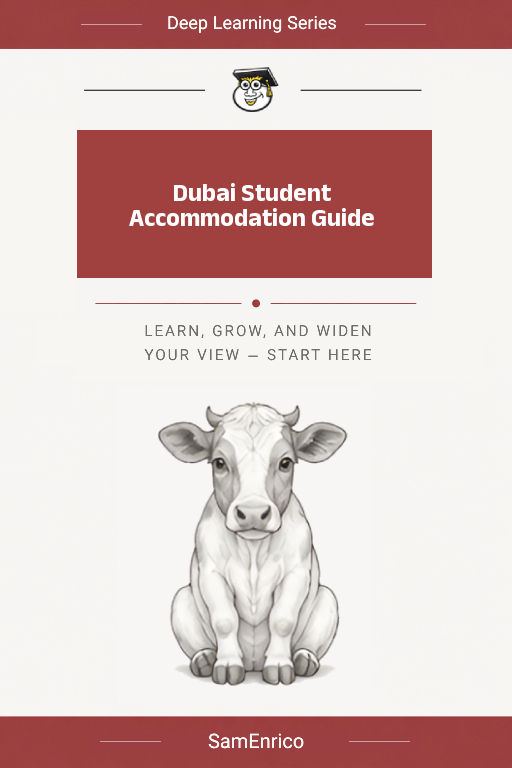 Dubai Student Accommodation GuideQueen Shaneka$12.99
 Echoes of the Last Speaker: The Vanishing Tongue of the Bo LanguageQueen Shaneka$11.99
 Understanding Ceramide TrihexosidosisQueen Shaneka$17.99
 Automotive ESG Comparison GuideQueen Shaneka$12.99
 How to Become a Automatic-pad-making-machine OperatorQueen Shaneka$11.99
 Aircraft MechanicQueen Shaneka$11.99
You may also like
 Hong Kong Handover 1997Dunn Johnnie$11.99
 Zumba For Postnatal Recovery CourseNeal Christian$11.99
 Zumba for BeginnersLadner Nikia$11.99
 YouTube Comment Mining GuideHumes Pandora$12.99
 Worry Box MeditationCarlin Rudy$11.99
 Workplace Stress MeditationNguyen Lynn$11.99
 Workplace Stress and Sleep RepairHawley Ivory$11.99
 Workplace Perfectionism CureDelaney Jeffry$11.99
 Workplace Injustice Anger GuideWallen Isabelle$11.99
 Work Addiction and Burnout LinkGreenwood Ester$11.99
 Women in Yoga and WellnessBeattie Galina$11.99
 Women in Stand Up ComedyChun Evangeline$11.99