
Non-FictionStudent's ShortcutEntrepreneurship
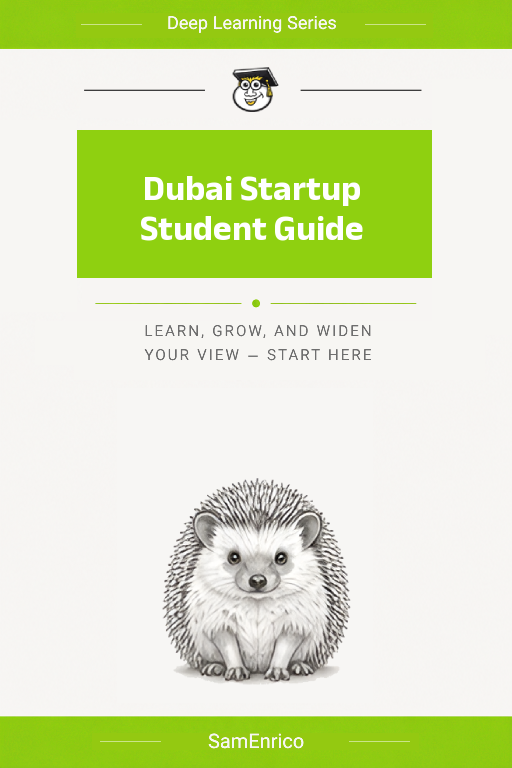
Dubai Startup Student Guide eBook
Access free zones, incubators, and entrepreneurshi
Access free zones, incubators, and entrepreneurship support for student business ideas.
Formats
Free sample
Chapter 1: The Classroom Liberation--–- On a humid Tuesday morning in late March 2026, a nineteen-year-old industrial engineering student named Layla sat in the back row of her Entrepreneurship 301 lecture at the University of Dubai. Her laptop screen displayed two windows: on the left, her professor's slide deck about SWOT analysis; on the right, a partially completed application for a trade license she had discovered she could not afford. The license cost AED 35,000. Her monthly allowance was AED 2,500. The math was simple.
The dream was not.What Layla did not know, as she stared at that application, was that seventy-two hours later the Crown Prince of Dubai would announce a policy change that would render her entire dilemma obsolete. She would not need AED 35,000. She would not need to choose between her degree and her startup. She would not need to wait for graduation to become a legitimate business owner.The rules had changed. And almost no one saw it coming.This chapter is about that change.
It is about the March 31, 2026 announcement that transformed every university campus in Dubai into what this book calls a University Innovation District—a designated space where students can legally operate businesses, hold trade licenses, and count their startup activities toward their degrees. It is about why this matters more than any single entrepreneurship class, any mentorship program, or any pitch competition you will ever attend. And it is about the fundamental distinction that will determine whether you waste your time building Power Point presentations for grades or build something real that actually generates revenue.The Announcement That Changed Everything On March 31, 2026, Sheikh Hamdan bin Mohammed bin Rashid Al Maktoum, Crown Prince of Dubai and Chairman of The Executive Council, issued a directive that received surprisingly little mainstream attention but will reshape the economic future of the Emirates. The directive, buried in the morning news cycle between a real estate announcement and a tourism update, stated simply that Dubai would transform its public and private universities into free economic and creative zones.The full text of Article 6 of Dubai's 50-Year Charter reads: "We will announce our public and private universities as free zones that allow students to carry out business and creative activities, make these activities part of the education and graduation system, and shape integrated economic and creative zones around the universities."Let us pause on those words because they contain multitudes. "Allow students to carry out business and creative activities" is not permission to run a hobby business from a dorm room.
It is a legal designation that places university campuses in the same regulatory category as Dubai Internet City, Dubai Media City, and the Dubai International Financial Centre. "Make these activities part of the education and graduation system" means that building a company is no longer a extracurricular distraction from your degree—it can be the degree itself. And "shape integrated economic and creative zones around the universities" signals that this is not a pilot program or a temporary experiment. It is a permanent structural change to how Dubai approaches the relationship between education and economic production.To understand why this matters, you need to understand what a free zone actually is. In Dubai, free zones are designated geographic areas with their own regulatory frameworks, simplified company formation processes, and—crucially—the ability to issue trade licenses.
Before March 2026, free zones were limited to specific commercial areas: DIFC for finance, Dubai Silicon Oasis for technology, Dubai South for logistics, and so on. A student at the University of Dubai could look at the DMCC free zone and dream of starting a company there, but the physical and financial barriers were substantial. The cheapest license cost tens of thousands of dirhams. The office space requirements were prohibitive. The visa processes assumed you were a working professional, not a twenty-year-old with a laptop and a credit card from your parents.The March 2026 announcement did not create new free zones from scratch.
It reclassified existing spaces. Your university library, your classroom building, your student center, the hallways where you walk between lectures—these are now, legally speaking, part of a free zone. You do not need to leave campus to enter the jurisdiction of entrepreneurship. You are already there.The Two-Tier Framework: What You Can Do Now Versus What You Can Do Later Here is where most student founders get confused, and where the book you are reading deliberately avoids the mistakes of other guides. You will hear people say, "Students can now hold trade licenses while on student visas." This is true.
It is also incomplete, and treating it as the whole truth will lead you into legal trouble.The March 2026 announcement created what this book calls the Two-Tier Framework for student entrepreneurship in Dubai. Understanding the difference between Tier 1 and Tier 2 is the single most important legal distinction you will learn in this entire book.Tier 1: The Student Visa Plus License (Low-Revenue Activities)Under Tier 1, you may hold a trade license while maintaining your student visa. You may register a company in a free zone—ideally through the IFZA Scale360 program described in Chapter 2—and use your university's designated University Innovation District as your operational base. You may conduct business activities, generate revenue, and build your venture.There is, however, a ceiling on Tier 1. The regulatory framework that emerged in the months following the March 2026 announcement established an annual revenue threshold of AED 50,000 (approximately $13,600 USD) for student visa holders.
Below this threshold, you are considered to be operating in an "incubation phase." Above this threshold, or if you hire any employees beyond yourself, or if you enter into formal corporate pilot agreements worth significant value, you must transition to Tier 2.This is not a punishment or a bureaucratic trap. It is a recognition that student visas are designed for students, not for full-time commercial operators. The government wants you to start your company. It also wants you to finish your degree. The AED 50,000 threshold creates a safe harbor where you can do both without triggering the more complex visa requirements.Tier 2: The Entrepreneur Visa and Golden Visa (Active Trading)Once your venture exceeds AED 50,000 in annual revenue, hires employees, or secures corporate pilots that require formal vendor status, you must transition to Tier 2.
This involves applying for a six-month multi-entry entrepreneur visa (renewable once, for a total of up to one year) or, if you qualify, a direct application for a five-year Entrepreneur Golden Visa.Chapter 8 of this book provides the complete roadmap for this transition. For now, understand that Tier 2 is not a barrier to your success—it is a milestone that confirms your success. The moment you need Tier 2 is the moment you know your startup is working.The critical point is this: the March 2026 announcement did not eliminate visa requirements for student entrepreneurs. It created a graduated pathway. You start in Tier 1, where the barriers are low and the paperwork is minimal.
You grow your venture. When you hit the revenue threshold or the hiring milestone, you transition to Tier 2. The government has built a staircase. Your job is to climb it.Why Your Business Plan Is Worthless (And Your MVP Is Priceless)If you have taken an entrepreneurship class at…
This is the end of the free sample. Get the eBook to keep going. Buy now
About this book
Details
- Author
- Rudd Lashawnda
- Publisher
- SamEnrico
- Language
- English
- Genre
- Non-Fiction, Student's Shortcut, Entrepreneurship
- Released
- 2026-05-30
- Pages (approx.)
- 151
- Available as
- eBook, Audiobook

Read better in the ZLOADR app
Your eBooks on your phone or tablet. Sign in with your SamEnrico account and start reading.
More by Rudd Lashawnda
 Eucalyptus Respiratory ReliefRudd Lashawnda$11.99
 Senator Party Whip SystemRudd Lashawnda$11.99
 Executive Kidnap Survival Kit ChecklistRudd Lashawnda$11.99
 Chemotherapy Prostate Cancer GuideRudd Lashawnda$11.99
 Wedding Comparison Online TrapRudd Lashawnda$11.99
 The Day the Moon Stole the Show: How Apollo 11’s Hidden Data Changed EverythingRudd Lashawnda$11.99
 Love Letters from the Arctic: The Untold Romance of the 1942 Convoy PQ-17Rudd Lashawnda$11.99
 Understanding Congenital Vagal HyperreflexivityRudd Lashawnda$17.99
 Tech WriterRudd Lashawnda$11.99
 Supplier Auditing Best PracticesRudd Lashawnda$12.99
 How to Become a Invoice-control ClerkRudd Lashawnda$11.99
You may also like
 Hong Kong Handover 1997Dunn Johnnie$11.99
 Zumba For Postnatal Recovery CourseNeal Christian$11.99
 Zumba for BeginnersLadner Nikia$11.99
 YouTube Comment Mining GuideHumes Pandora$12.99
 Worry Box MeditationCarlin Rudy$11.99
 Workplace Stress MeditationNguyen Lynn$11.99
 Workplace Stress and Sleep RepairHawley Ivory$11.99
 Workplace Perfectionism CureDelaney Jeffry$11.99
 Workplace Injustice Anger GuideWallen Isabelle$11.99
 Work Addiction and Burnout LinkGreenwood Ester$11.99
 Women in Yoga and WellnessBeattie Galina$11.99
 Women in Stand Up ComedyChun Evangeline$11.99