
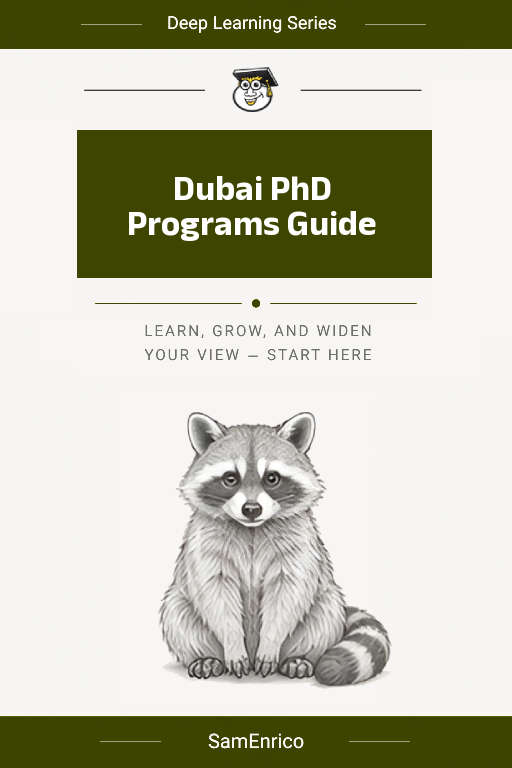
Dubai PhD Programs Guide eBook
Find doctoral research opportunities at Dubai's br
Find doctoral research opportunities at Dubai's branch campuses.
Formats
Free sample
Chapter 1: The $300,000 Mistake--For seven years, Sarah had dreamed of earning a doctorate. She had mapped it out meticulously during the final year of her Master's program at a respectable British university—the applications, the funding searches, the conversations with potential supervisors. When the acceptance letter arrived from a well-regarded London institution, she cried tears of joy. She had done it. She was going to be Dr.
Sarah.Four years later, she sat in a cramped flat share in Zone 3, staring at an overdraft notification on her phone. Her Ph D was unfinished. Her funding had been cut in the third year after her supervisor took an unexpected sabbatical and the departmental budget was restructured. She had accumulated £47,000 in debt. Her visa was expiring in ninety days.
And she had not published a single paper."I followed every rule," she told me during our interview for this book. "I got good grades. I had a solid proposal. I worked sixty-hour weeks. And the system just… ate me alive."Sarah is not an anomaly.
She is the rule.According to a comprehensive study published in Nature Biotechnology (2019), approximately 50% of Ph D students in the United Kingdom do not complete their degrees within seven years of enrollment. In the humanities and social sciences, attrition rates approach 60%. The United States fares no better: the Council of Graduate Schools reports that only 57% of doctoral candidates complete their programs within ten years. Australia's completion rate hovers around 68% after a decade of study.These numbers represent hundreds of thousands of brilliant, motivated people who entered doctoral programs with hope and left with debt, depression, and a lingering sense of failure.But Sarah eventually finished her Ph D. Not in London.
Not after four more years of struggle. She finished in Dubai, at a branch campus of a British university that offered the exact same degree she had been pursuing in the UK—same charter, same certificate, same academic standards—for one-third of the cost, while she worked full-time and kept her mental health intact.This chapter exists because her story is not unique, but it is secret. The information you are about to read is not available in any university prospectus, not advertised by government agencies, and rarely discussed in academic advising offices. The branch campus Ph D pathway has been hiding in plain sight for nearly two decades, quietly serving a small but growing population of insiders while the rest of the world suffers through the traditional doctoral model.This book ends that silence. And it begins with a simple question: why is the traditional Ph D model so catastrophically broken, and how can Dubai's branch campuses provide the escape route you have been looking for?The Broken Promise of the Traditional Ph DLet us begin with a definition.
A Doctor of Philosophy, or Ph D, is the highest academic degree awarded by universities. It signifies that the holder has made an original contribution to knowledge in their field and has demonstrated the capacity to conduct independent research. In theory, it is the pinnacle of intellectual achievement. In practice, for a staggering number of candidates, it is a financial and emotional trap.The Financial Collapse The first myth to dismantle is the assumption that funded Ph D positions cover your living expenses. In a small number of elite programs—primarily in STEM fields at wealthy universities—full funding is indeed available.
These positions are hypercompetitive, with acceptance rates often below 10%. For the vast majority of doctoral candidates, "funding" means partial tuition remission, not a living stipend. And even when a stipend is offered, it has not kept pace with inflation.Consider the United Kingdom. Research council stipends for Ph D students in 2024 are approximately £18,622 per year in London and £15,609 outside London. The average rent for a studio apartment in London is £1,500 per month—£18,000 annually.
That leaves £622 for food, utilities, transport, health insurance, and everything else. The Joseph Rowntree Foundation, a respected anti-poverty organization, calculates that a single adult in London needs at least £25,500 per year for a minimally acceptable standard of living. The UK research council stipend is £6,878 below that threshold.Australia tells a similar story. The standard Research Training Program (RTP) stipend in 2024 is AUD 32,000 per year. The average rent for a one-bedroom apartment in Perth or Brisbane is AUD 1,800 per month—AUD 21,600 annually.
That leaves AUD 10,400 for everything else. The Australian Council of Social Service defines the poverty line for a single adult as AUD 489 per week, or AUD 25,428 per year. The RTP stipend is AUD 6,572 above that line, which sounds acceptable until you remember that this figure excludes health insurance, which international students must purchase separately at a cost of AUD 2,000-3,000 per year.The United States is even more brutal. Many Ph D stipends range from 20,000to20,000 to 20,000to35,000 per year, with significant variation by field and institution. However, these stipends are often tied to teaching or research assistantships that demand 20 hours of work per week on top of coursework and dissertation research.
A 2022 study in e Life surveyed doctoral students across fifteen countries and found that 38% reported financial stress that negatively impacted their mental health. Twenty-four percent reported skipping meals to save money.These numbers are not abstract statistics. They are the lived reality of people like you who entered doctoral programs believing that the investment would pay off.The Visa Nightmare for International Students For candidates from outside the host country, the financial pressure is compounded by visa uncertainty. The United Kingdom's Tier 4 (General) student visa allows Ph D candidates to remain in the country for up to five years, but the visa is tied to their enrollment. If funding runs out, if the supervisor leaves, if the candidate struggles to make progress—the visa can be curtailed.
The UK Home Office reports that approximately 8% of international Ph D students overstay their visas or have them revoked annually, often due to circumstances beyond their control.Australia's student visa (subclass 500) allows doctoral candidates to stay for four to five years, but requires proof of "genuine temporary entry"—a requirement that has become increasingly difficult to satisfy as more international students express interest in post-study work pathways. The Department of Home Affairs refused 15% of Ph D student visa applications in 2023, often on grounds that applicants could not demonstrate sufficient financial capacity or had weak ties to their home country.The United States is perhaps the most anxiety-inducing of all. The F-1 student visa is issued for the "duration of status" (D/S), which theoretically allows the student to remain as long as they are making progress toward their degree. In practice, Ph D candidates must file annual check-ins with their Designated School Official (DSO), and any disruption—funding loss, supervisor departure, academic probation—can trigger a review. Optional Practical Training (OPT) allows STEM Ph D graduates to work for three years after graduation, but the H-1B work visa lottery has acceptance rates below 30%.
Hundreds of thousands of highly educated professionals are forced to leave the United States each year not because they lack talent, but because they lose a visa lottery.One of my interview subjects, a Pakistani engineer who completed a Ph D in Australia, described the experience this way: "Every…
This is the end of the free sample. Get the eBook to keep going. Buy now
About this book
Details
- Author
- Kirkland Melodi
- Publisher
- SamEnrico
- Language
- English
- Genre
- Non-Fiction, Student's Shortcut
- Released
- 2026-05-26
- Pages (approx.)
- 151
- Available as
- eBook, Audiobook

Read better in the ZLOADR app
Your eBooks on your phone or tablet. Sign in with your SamEnrico account and start reading.
More by Kirkland Melodi
 The Debt of Honor 1857Kirkland Melodi$11.99
 Anki For Bird IdentificationKirkland Melodi$11.99
 Loving Kindness for a GaslighterKirkland Melodi$11.99
 Behavioral Weight MythsKirkland Melodi$11.99
 Spouse Loss Memorial GuideKirkland Melodi$11.99
 Infusion Therapy MindfulnessKirkland Melodi$11.99
 The Stress Cholesterol LinkKirkland Melodi$11.99
 The Materials Engineer CreativityKirkland Melodi$11.99
 Yakuza in CambodiaKirkland Melodi$11.99
 The Flame and the Sword: Love and War in the Siege of Chittorgarh (1567)Kirkland Melodi$11.99
 Quetzalcoatl's Song: The Feathered Serpent's HymnKirkland Melodi$11.99
 Ghana English Localization GuideKirkland Melodi$12.99
You may also like
 LSE Online Program LengthAgee Letisha$11.99
 Harvard Extension School for Working AdultsRoush Yer$11.99
 LSE Online Reading ListAshford Ludivina$11.99
 LSE Online Language RequirementsWhitten Daphine$11.99
 LSE Online Class SizeHughey Garret$11.99
 LSE Online Alumni MentorshipWild Lyla$11.99
 London School of Economics Alumni NetworkDutton Chantal$11.99
 Harvard Extension School Student SupportCantrell Christene$11.99
 Harvard Extension School Library AccessSantana Adah$11.99
 Harvard Extension School Degree CompletionBray Wyatt$11.99
 Harvard Extension School Course AuditingAbbott Craig$11.99
 Harvard Extension School Extension DiplomaNew Joane$11.99