
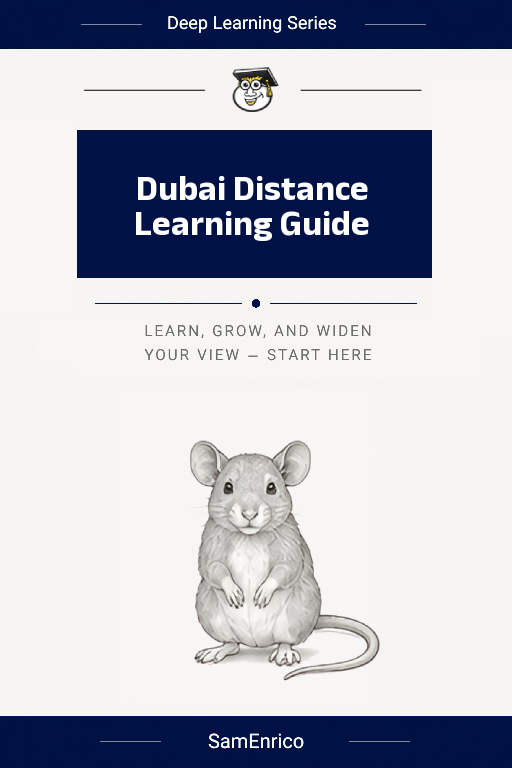
Non-FictionStudent's ShortcutDistance LearningOnline Education
Dubai Distance Learning Guide eBook
Study Dubai university programs online from home c
by Bruner Elma
Study Dubai university programs online from home country with flexible schedules and lower tuition fees for remote students.
Formats
Free sample
Chapter 1: The Geography Gambit--–- On a humid Tuesday evening in Manila, a 34-year-old intensive care nurse named Fatima Reyes did something that her university advisor had called “financially impossible.” She enrolled in a British MBA program offered through a Dubai-based campus, paid her first installment of 1,200,andneverbookedaflight.Eighteenmonthslater,shegraduatedwiththesamedegreeasherclassmateswhohadspent1,200, and never booked a flight. Eighteen months later, she graduated with the same degree as her classmates who had spent 1,200,andneverbookedaflight.Eighteenmonthslater,shegraduatedwiththesamedegreeasherclassmateswhohadspent45,000 on tuition, 18,000on Londonrent,andtwoyearsawayfromtheirfamilies.Fatima’stotalcost:18,000 on London rent, and two years away from their families. Fatima’s total cost: 18,000on Londonrent,andtwoyearsawayfromtheirfamilies.Fatima’stotalcost:11,400. Her secret was not a scholarship, not a lottery, and not debt. It was a structural loophole in how global education prices itself—and she found it in Dubai.This book exists because Fatima’s story is not an anomaly.
It is the leading edge of a shift that most students, parents, and even career counselors have not yet noticed. The old rule of international education was simple: you go to the prestige. You pack your bags, you apply for a visa, you borrow against your future, and you sit in a lecture hall in London, Sydney, or Boston. That rule cost the average international student $38,000 per year in tuition and living expenses before they earned a single dollar of post-graduation income.The new rule, still hidden in plain sight, is the opposite: the prestige comes to you. And Dubai has built a $7.2 billion education industry around that single insight.This chapter is not an introduction.
It is a strategic reorientation. Before you learn about accreditation, applications, or scholarships—before you even decide on a program—you need to understand why Dubai became the world’s most aggressive laboratory for remote higher education. You need to see the numbers that make the traditional study-abroad model look like a relic. And you need to confront a question that will determine whether this book saves you $30,000 or merely entertains you for an afternoon: Are you willing to stop asking “Where should I go?” and start asking “Which institution will come to me?”The Million-Dollar Misconception Let us begin with a funeral. Not a literal one, but the quiet, unacknowledged death of a belief that has governed international education for three decades.
That belief is: physical presence equals educational quality.For generations, families assumed that if a degree was worth earning, it was worth earning in person. The logic seemed unassailable. How could you network from a laptop? How could you absorb culture through a screen? How could an employer take you seriously if you had never walked across a graduation stage?These questions are not stupid.
They are just outdated. They belong to an era when “online learning” meant grainy videos of a professor writing on a whiteboard, when discussion forums were ghost towns, and when the only universities offering remote degrees were the ones that could not fill their classrooms. That era ended sometime between 2020 and 2022, when the entire planet was forced into an experiment that proved, definitively, that high-quality education can be delivered asynchronously, across borders, without a dorm room.But here is the twist that most people miss. While American and European universities scrambled to build half-functional Zoom schools during the pandemic, Dubai had already spent fifteen years preparing for that moment. The Hamdan Bin Mohammed Smart University, founded in 2002, was the world’s first government-funded “smart university.” Its entire infrastructure was built for remote learners.
While Harvard was figuring out how to proctor an exam online, HBMSU had already graduated thousands of students who had never set foot in the UAE.The result is a strange and profitable asymmetry. Western universities treat remote education as a secondary product—a cheaper, less prestigious cousin to their main business. Dubai treats remote education as its primary product. And that difference in mentality creates a pricing gap that you can drive a truck through.The Three Numbers That Change Everything Before we go any further, you need to see the math. Not as an abstraction, but as a concrete comparison between three identical degrees delivered in three different ways.The Control Case: A Murdoch University MBAMurdoch University is an Australian institution with a well-regarded business school.
It operates a full campus in Dubai Knowledge Park and offers the same MBA in Perth, Australia; in Dubai, UAE; and now, fully online from anywhere in the world. The curriculum is identical. The faculty is the same (rotating between locations). The degree certificate does not say “online.” Here is what each path costs:Path Tuition Living & Visa (2 years)Total Time to Completion On-campus in Perth, Australia$45,000 USD$32,000 USD (rent, food, health insurance, visa)$77,00018-24 months On-campus in Dubai, UAE$28,000 USD$24,000 USD (studio apartment, transport, visa)$52,00018-24 months Remote from home country$12,000 USD$0$12,00018-30 months (flexible)Let those numbers land. A student in Nigeria, India, or the Philippines can earn the exact same degree as a student in Perth for $65,000 less.
That is not a discount. That is a different economic universe.Now, you might object: “But I want the experience of studying abroad. I want to live in a new country. I want to network in person.” Those are valid desires. This book will not tell you that remote learning is better for everyone.
What it will tell you is that the experience of studying abroad now carries a premium of 40,000to40,000 to 40,000to65,000 that you do not have to pay if your priority is the credential itself.And here is the kicker. That premium is not driven by better teaching. It is driven almost entirely by real estate, visas, and arbitrage.The Structural Advantage: Why Dubai Specifically?If remote education is so cheap, why not just enroll in a random online program from any university anywhere? Why Dubai?Three reasons. Each one is a pillar of the argument you will see repeated throughout this book.Reason One: Time Zone Bridge Dubai operates on Gulf Standard Time (UTC+4).
That is not a neutral fact. It is a strategic advantage for students from three of the world’s largest education-exporting regions:South Asia (India, Pakistan, Bangladesh, Sri Lanka): UTC+5 to UTC+6 → Dubai classes land in late afternoon or early evening, after work but before sleep.Southeast Asia (Philippines, Indonesia, Vietnam, Thailand): UTC+7 to UTC+8 → Dubai classes land in evening, prime study hours.Africa (Nigeria, Kenya, Ghana, South Africa): UTC+1 to UTC+3 → Dubai classes land in late morning or early afternoon, perfect for part-time students.Middle East (Egypt, Jordan, Saudi Arabia): UTC+2 to UTC+3 → nearly synchronous.Compare this to a British or American university. A student in Manila trying to attend a live lecture at Boston College would need to wake up at 2:00 AM. A student in Lagos attending a live lecture at the University of London would join at 11:00 PM. Dubai’s time zone is the only major education hub that sits comfortably between Asia, Africa, and Europe without requiring extreme sleep disruption for any of them.Reason Two: Branch Campus Density Dubai is home to more international branch campuses than any city outside of London.
According to the 2023 Cross-Border Education Research Team data, Dubai hosts 32 international branch campuses, compared to 23 in Singapore…
This is the end of the free sample. Get the eBook to keep going. Buy now
About this book
Details
- Author
- Bruner Elma
- Publisher
- SamEnrico
- Language
- English
- Genre
- Non-Fiction, Student's Shortcut, Distance Learning, Online Education
- Released
- 2026-06-01
- Pages (approx.)
- 133
- Available as
- eBook, Audiobook

Read better in the ZLOADR app
Your eBooks on your phone or tablet. Sign in with your SamEnrico account and start reading.
More by Bruner Elma
 Exercise for Emotional HealthBruner Elma$11.99
 Elderly Senior Loneliness GuideBruner Elma$11.99
 Solar Temple Baby Abduction Cases WorkbookBruner Elma$11.99
 Free Creator Cold Email Stack GuideBruner Elma$11.99
 Mindfulness for Retirement TransitionBruner Elma$11.99
 The Crown’s Shadow: How Queen Elizabeth II’s Secret War Cabinet Shaped the Modern MonarchyBruner Elma$11.99
 Love Letters in the Attic: The Secret Romance of Anne Frank and Peter van PelsBruner Elma$11.99
 Understanding Cerebro Oculo Skeleto Renal SyndromeBruner Elma$17.99
 ESG Performance Supply Chain RiskBruner Elma$12.99
 How to Start a Positioner for Pneumatic Control Equipment Business (Beginners Guide)Bruner Elma$11.99
 Collection Agency OperationBruner Elma$11.99
You may also like
 Hong Kong Handover 1997Dunn Johnnie$11.99
 Zumba For Postnatal Recovery CourseNeal Christian$11.99
 Zumba for BeginnersLadner Nikia$11.99
 YouTube Comment Mining GuideHumes Pandora$12.99
 Worry Box MeditationCarlin Rudy$11.99
 Workplace Stress MeditationNguyen Lynn$11.99
 Workplace Stress and Sleep RepairHawley Ivory$11.99
 Workplace Perfectionism CureDelaney Jeffry$11.99
 Workplace Injustice Anger GuideWallen Isabelle$11.99
 Work Addiction and Burnout LinkGreenwood Ester$11.99
 Women in Yoga and WellnessBeattie Galina$11.99
 Women in Stand Up ComedyChun Evangeline$11.99