
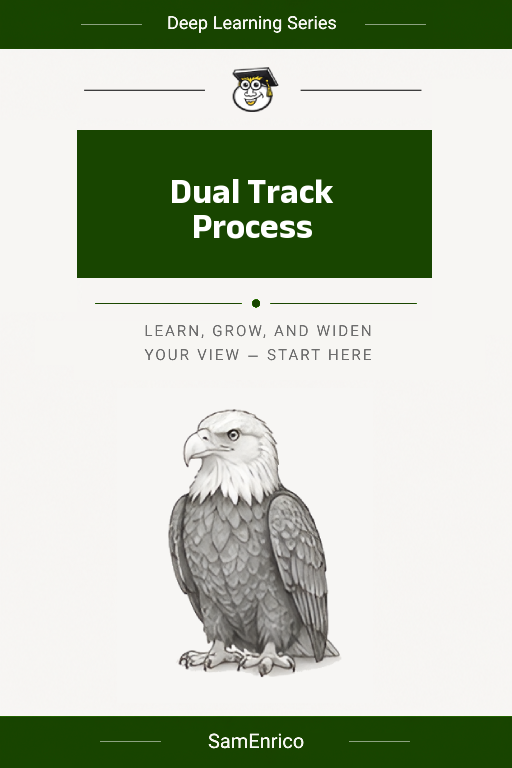
Non-FictionStartup GuideDual TrackCompetitive Bidding
Dual Track Process eBook
Run IPO and sale conversations simultaneously to c
by Conner Jaime
Run IPO and sale conversations simultaneously to create competitive tension.
Formats
Free sample
Chapter 1: The Linear Lie--–- The CEO of a mid-sized software company sat across from his board, presenting two crisp options on a single Power Point slide. Option A: sell to a strategic buyer for what he called “a fair price.” Option B: take the company public at a slightly lower valuation but retain independence. The board debated for three hours. They chose Option A. The deal closed eight months later.
Within two years, that “fair price” looked like a fire sale as the acquirer flipped the combined entity for nearly triple the purchase price. The CEO never ran another exit process. He didn’t need to. He had retired, wealthy but haunted by the knowledge that he had left nine figures on the table. His mistake was not in his preparation, his negotiation tactics, or his choice of bankers.
His mistake was in believing that he had to choose.This chapter dismantles the traditional either/or approach to exiting a business—the assumption that a company must choose between an IPO and a private sale. Drawing on analysis of modern market dynamics and decades of failed transactions, it argues that volatile markets and persistent valuation gaps have made the linear exit obsolete. In a world where IPO windows open and close unpredictably and strategic buyers time their acquisitions opportunistically, committing to a single path is not prudence. It is gambling with shareholder value.The Linear Lie is the false choice that has cost selling shareholders hundreds of billions of dollars over the past three decades. It is the assumption that an exit is a fork in the road rather than a parallel runway.
It is the belief that running two processes simultaneously is too expensive, too distracting, or too legally risky. And it is wrong.The Origins of the False Choice To understand why the linear lie persists, one must understand how the investment banking industry evolved. For most of Wall Street’s history, there were two distinct tribes. The IPO tribe sat in equity capital markets divisions. They worked with companies preparing registration statements, scheduling roadshows, and pricing offerings with institutional investors.
Their compensation came from underwriting fees, typically a percentage of the proceeds raised. The M&A tribe sat in mergers and acquisitions divisions. They worked with buyers and sellers on negotiated transactions, auctions, and takeover defenses. Their compensation came from advisory fees, typically a percentage of the transaction value.These two tribes operated in different buildings, reported to different management chains, and rarely spoke to one another. When a company approached a bank for exit advice, the banker’s first question was not “what is the best path?” but “which desk gets the fee?” An IPO referral fed the equity capital markets team.
A sale referral fed the M&A team. The banker’s internal incentives—bonus pools, promotion committees, annual reviews—were aligned not with the client’s outcome but with the bank’s internal revenue allocation.This structural bias created a self-reinforcing cycle. Companies were told they had to choose because the bankers they spoke to had already chosen for them. The IPO banker would argue that going public preserved optionality, that the control premium in a sale was illusory, that the company was leaving money on the table by selling too early. The M&A banker would argue that a sale provided certainty and speed, that the IPO market was fickle, that the company would be a small fish in a large public pond.
Both were often right about the weaknesses of the other path and conveniently silent about the weaknesses of their own.The result was a generation of companies that exited suboptimally, not because they lacked smart advisors but because their advisors were structurally prevented from giving unbiased advice. The dual track—running both processes simultaneously—was theoretically possible but practically rare. It required a banker willing to forgo the immediate fee allocation, a board willing to pay for two workstreams, and a management team willing to endure the chaos of two diligence processes.That era is ending. The tribes are merging. Boutique banks have built hybrid practices.
The largest banks now have “integrated exit” teams that can pivot between IPO and M&A without internal revenue fights. And the companies that have run dual tracks have demonstrated, repeatedly, that the juice is worth the squeeze.The Option Value Argument The most sophisticated way to understand the dual track is through the lens of real options theory, a branch of financial economics that revolutionized corporate finance in the 1990s. A real option is the right, but not the obligation, to take a future action—to invest, to expand, to abandon, or to wait. Unlike financial options (calls and puts on traded securities), real options are embedded in business decisions. And they have value.Consider a simple example.
A company has the opportunity to exit today at a known price. It can sell to a strategic buyer for 500millionincash.Alternatively,itcanwaitsixmonths,runan IPOprocess,andpotentiallyachievea500 million in cash. Alternatively, it can wait six months, run an IPO process, and potentially achieve a 500millionincash.Alternatively,itcanwaitsixmonths,runan IPOprocess,andpotentiallyachievea550 million valuation—or potentially see the market turn and end up at 450million.Atraditionalnetpresentvaluecalculationwoulddiscounttheexpectedfuturevalue(450 million. A traditional net present value calculation would discount the expected future value (450million.Atraditionalnetpresentvaluecalculationwoulddiscounttheexpectedfuturevalue(500 million, assuming equal probabilities) back to today and compare it to the certain $500 million. The numbers are roughly equal.
The decision is a toss-up.But this analysis misses the option value. When the company runs the IPO process, it does not merely generate a single future valuation. It generates information. It learns what institutional investors are willing to pay. It receives feedback on its story, its financials, its management team.
And crucially, it creates a public stalking horse. Once the S-1 is filed, strategic buyers cannot claim ignorance of the company’s value. They know exactly what public investors are willing to pay. To win, they must exceed that price by a control premium.The option value of the dual track is the value of keeping both doors open. It is the ability to wait for the best possible outcome without foreclosing alternatives.
It is the premium that comes from forcing the market to bid against itself. And it is substantial. Empirical studies of dual-track processes suggest that the option value averages 15-25% of enterprise value. In plain English, running a dual track typically adds 15-25% to the ultimate exit price compared to committing to a single path upfront.Why is the option value so large? Because the dual track solves the fundamental information asymmetry that plagues both single-track exits.
In a pure IPO, the seller does not know what strategic buyers would pay. In a pure M&A process, the seller does not know what public investors would pay. In a dual track, the seller knows both. And that knowledge is power.The One-Way Mirror The legal architecture of the dual track creates a fascinating and powerful asymmetry. Acquirers have full visibility into the IPO process.
Once the S-1 registration statement is publicly filed, any strategic buyer can read it. They can see the company’s financial statements, its risk factors, its management discussion and analysis…
This is the end of the free sample. Get the eBook to keep going. Buy now
About this book
Details
- Author
- Conner Jaime
- Publisher
- SamEnrico
- Language
- English
- Genre
- Non-Fiction, Startup Guide, Dual Track, Competitive Bidding
- Released
- 2026-05-29
- Pages (approx.)
- 133
- Available as
- eBook, Audiobook

Read better in the ZLOADR app
Your eBooks on your phone or tablet. Sign in with your SamEnrico account and start reading.
More by Conner Jaime
 Self Esteem for Blue Collar WorkersConner Jaime$11.99
 RLS And Periodic Limb Movement Disorder GuideConner Jaime$11.99
 Rural Homestead Emergency PrepConner Jaime$11.99
 Net Zero Valuation ImpactConner Jaime$11.99
 The Waco Congressional HearingsConner Jaime$11.99
 Godard Revolutionary FrameConner Jaime$11.99
 Female Rulers Execution Decision PlaybookConner Jaime$11.99
 Lawyer Burnout RecoveryConner Jaime$11.99
 Bipolar Irritability ReworkConner Jaime$11.99
 The Unbroken Chain: How Aristotle's Lost Dialogues Reshaped the Western MindConner Jaime$11.99
 The Great Train Heist: Inside the 1963 Millions CaperConner Jaime$11.99
 The Billion-Dollar Block: How a Single NYC Lot Redefined Real EstateConner Jaime$11.99
You may also like
 Hong Kong Handover 1997Dunn Johnnie$11.99
 Zumba For Postnatal Recovery CourseNeal Christian$11.99
 Zumba for BeginnersLadner Nikia$11.99
 YouTube Comment Mining GuideHumes Pandora$12.99
 Worry Box MeditationCarlin Rudy$11.99
 Workplace Stress MeditationNguyen Lynn$11.99
 Workplace Stress and Sleep RepairHawley Ivory$11.99
 Workplace Perfectionism CureDelaney Jeffry$11.99
 Workplace Injustice Anger GuideWallen Isabelle$11.99
 Work Addiction and Burnout LinkGreenwood Ester$11.99
 Women in Yoga and WellnessBeattie Galina$11.99
 Women in Stand Up ComedyChun Evangeline$11.99