
Non-FictionSelf-HelpCognitive Training
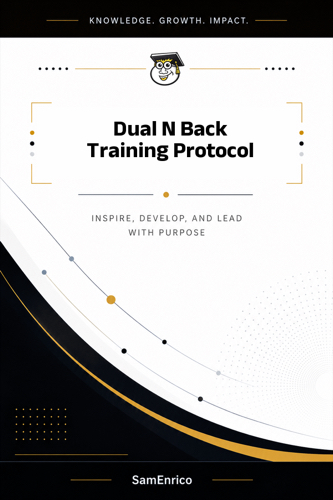
Dual N Back Training Protocol eBook
Exercise your working memory with visual and audit
by Owens Linda
Exercise your working memory with visual and auditory simultaneous recall tasks.
Formats
Free sample
Chapter 1: The Intelligence Lie--There is a lie you have been told your entire life, repeated so often by teachers, parents, and experts that it has hardened into an unquestioned truth. The lie sounds reasonable, even humble. It goes like this: you are born with a certain amount of intelligence, and that amount is fixed for life. You can learn new facts. You can acquire new skills.
You can become more knowledgeable. But your core intelligence—your raw cognitive horsepower, the thing that allows you to solve novel problems, see patterns others miss, and adapt to unfamiliar challenges—is largely determined by your genes and your early childhood environment. By the time you reach adulthood, that number is set. You can polish the engine, but you cannot make it bigger.This lie is the intellectual equivalent of telling a child that height cannot be increased after puberty. It is a self-fulfilling prophecy disguised as scientific fact.
And it has done more to limit human potential than any other single belief in modern psychology.The lie has deep roots. In the early twentieth century, psychologists like Charles Spearman and Lewis Terman built elaborate mathematical systems to measure what they called general intelligence, or the g-factor. They discovered that people who performed well on one type of cognitive test tended to perform well on many others, suggesting a common underlying ability. That discovery was legitimate. But from that legitimate observation, an illegitimate conclusion was drawn: if intelligence could be measured reliably, and if those measurements remained relatively stable over a person's lifetime, then intelligence must be fixed.
The test scores, which were merely snapshots of a moment in time, were reimagined as permanent biological ceilings.The consequences of this lie are catastrophic and invisible precisely because they are so pervasive. Children who struggle in school are told they are "not math people" or "not smart enough for advanced classes." Adults who feel their mental sharpness fading accept cognitive decline as an inevitable feature of aging, like wrinkles or gray hair. High-performing professionals hit career plateaus and assume they have reached the natural limits of their problem-solving abilities. Students preparing for graduate school entrance exams believe they are measuring a fixed quantity, not training a trainable system.This chapter exists to destroy that lie. Not with wishful thinking or motivational slogans, but with hard data from cognitive neuroscience, longitudinal intervention studies, and the emerging science of neuroplasticity.
The evidence is clear: fluid intelligence—the very core of raw problem-solving ability—can be improved through targeted training. And the most effective, most replicable, most scientifically validated method for doing so is the subject of this book: the dual n-back protocol.Before we can understand why dual n-back works, we must first understand exactly what it is training. And before we can understand that, we must dismantle the faulty map of human intelligence that most people carry in their heads.The Two Faces of Intelligence Intelligence is not a single thing. This is the first crack in the fixed-intelligence lie. Psychologists have known for decades that what we casually call "smart" actually consists of multiple relatively independent cognitive abilities.
The most important distinction for our purposes is between crystallized intelligence and fluid intelligence.Crystallized intelligence is the library. It includes everything you have learned: vocabulary words, historical dates, multiplication tables, the capital of France, how to change a tire, the lyrics to songs from your college years, and the face of everyone you have ever met more than twice. Crystallized intelligence grows throughout life. A sixty-year-old typically knows more words than a twenty-year-old. An experienced doctor has a vastly larger library of medical knowledge than a first-year medical student.
This is the kind of intelligence that shows up on trivia shows and that people demonstrate when they say "I know a lot about World War II." It is knowledge, pure and simple, stored in long-term memory.Fluid intelligence is entirely different. It is not about what you know but about what you can figure out. Fluid intelligence is the ability to solve novel problems that you have never encountered before, to see patterns in seemingly random information, to reason by analogy, to navigate unfamiliar territory without a map. It is the cognitive engine that powers creativity, strategic thinking, and rapid adaptation. When you encounter a new software interface and figure out how to use it within minutes, that is fluid intelligence.
When you look at a complex data set and notice a correlation nobody else saw, that is fluid intelligence. When you listen to a political argument and instantly recognize the logical fallacy at its core, that is fluid intelligence.Here is what makes the distinction so important: crystallized intelligence can increase indefinitely through learning and experience. Everyone knows this. Read more books, learn more facts. But fluid intelligence was long believed to peak in early adulthood and then slowly decline, largely resistant to training.
You could add more books to the library, but you could not expand the library itself.Or so the lie went.The Rate-Limiting Step If fluid intelligence is the engine, working memory is the throttle. And understanding why dual n-back works requires understanding working memory at a visceral, intuitive level.Working memory is not the same as short-term memory, though the two are often confused. Short-term memory is simple storage—the ability to hold a phone number in your head for the thirty seconds it takes to dial it. Working memory is storage plus manipulation. It is the cognitive workspace where information is not just held but actively processed, combined, compared, and transformed.
Think of short-term memory as a whiteboard. Working memory is that whiteboard plus the hand holding the marker, actively writing, erasing, and rewriting.The capacity of working memory is severely limited, and this limitation is the single greatest bottleneck on human cognition. The classic finding, first described by psychologist George Miller in 1956, is that the average person can hold about seven items in working memory at once. More recent research has revised that number downward to four or five items for most people under most conditions. When you try to juggle more than that, something drops.This limitation explains almost every cognitive frustration you have ever experienced.
Why do you walk into a room and forget why you entered? Because working memory was holding multiple goals, and the act of moving through a doorway (which requires spatial navigation, visual processing, and motor planning) consumed enough cognitive resources that one of the goals was pushed out. Why do you struggle with complex math problems that involve multiple steps? Because each intermediate result must be held in working memory while the next operation is performed, and the system becomes overloaded. Why do you lose your train of thought during a heated argument?
Because emotional arousal consumes working memory capacity, leaving fewer resources for logical reasoning.The relationship between working memory and fluid intelligence is so tight that some researchers have argued they are essentially the same thing. Every test of fluid intelligence—every Raven's Progressive Matrix, every novel problem-solving task, every pattern recognition challenge—requires holding information in mind while manipulating it. You cannot solve a novel problem if you cannot keep the…
This is the end of the free sample. Get the eBook to keep going. Buy now
About this book
Details
- Author
- Owens Linda
- Publisher
- SamEnrico
- Language
- English
- Genre
- Non-Fiction, Self-Help, Cognitive Training
- Released
- 2026-06-06
- Pages (approx.)
- 130
- Available as
- eBook, Audiobook

Read better in the ZLOADR app
Your eBooks on your phone or tablet. Sign in with your SamEnrico account and start reading.
More by Owens Linda
 Kenny Rogers Gambler LifeOwens Linda$11.99
 Second Generation Career PathOwens Linda$11.99
 Lady Bird JohnsonOwens Linda$11.99
 The Relationship Resilience PlanOwens Linda$11.99
 Anger and Attachment StylesOwens Linda$11.99
 Somali Therapy Access GuideOwens Linda$11.99
 Cardiac Risks DetoxOwens Linda$11.99
 The Iron Horse and the Iron Will: Leland Stanford and the Transcontinental RailroadOwens Linda$11.99
 Baba Yaga's Iron Spire: The Witch's Forbidden TowerOwens Linda$11.99
 Middle East Government Sales GuideOwens Linda$12.99
 Essay Outline AI Prompt GuideOwens Linda$12.99
 How to Produce Forklift and Warehouse SystemsOwens Linda$11.99
You may also like
 Hong Kong Handover 1997Dunn Johnnie$11.99
 Zumba For Postnatal Recovery CourseNeal Christian$11.99
 Zumba for BeginnersLadner Nikia$11.99
 YouTube Comment Mining GuideHumes Pandora$12.99
 Worry Box MeditationCarlin Rudy$11.99
 Workplace Stress MeditationNguyen Lynn$11.99
 Workplace Stress and Sleep RepairHawley Ivory$11.99
 Workplace Perfectionism CureDelaney Jeffry$11.99
 Workplace Injustice Anger GuideWallen Isabelle$11.99
 Work Addiction and Burnout LinkGreenwood Ester$11.99
 Women in Yoga and WellnessBeattie Galina$11.99
 Women in Stand Up ComedyChun Evangeline$11.99