
Non-FictionHealth & WellnessClothing Offgassing
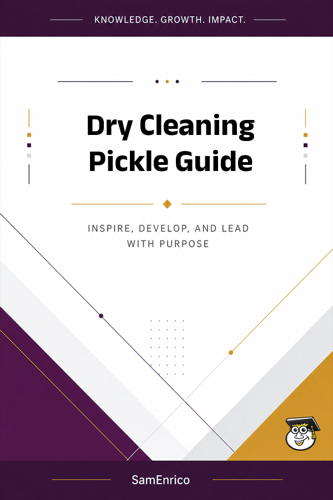
Dry Cleaning Pickle Guide eBook
Air out dry-cleaned clothes before bringing indoor
by Lowman Mendy
Air out dry-cleaned clothes before bringing indoors, ideally for 24 hours to offgas perc.
Formats
Free sample
Chapter 1: The Chemistry of Convenience--–- The suit hangs on the back of the door, wrapped in thin plastic, emanating that unmistakable smell of freshness. You brought it home from the dry cleaner three hours ago, and already the odor has migrated from the garment bag into the hallway, then under the bedroom door, then into the very air you are breathing as you read this sentence. That smell—the one the industry has trained you to associate with cleanliness, professionalism, and care—is not a sign of purity. It is a chemical signal, a vapor trail leading directly into your lungs. This chapter reveals the molecular identity of that smell, explains why the dry cleaning industry fell in love with a toxic solvent, and exposes the fundamental paradox that defines the modern dry cleaning pickle: the very properties that make perchloroethylene an exceptional cleaner are the same properties that make it an inescapable indoor air pollutant.The Molecule Behind the Smell Perchloroethylene—known in the trade as Perc, PCE, or tetrachloroethylene—is a chlorinated hydrocarbon with the chemical formula C₂Cl₄.
Its structure is deceptively simple: two carbon atoms double-bonded to each other, with each carbon also bonded to two chlorine atoms. The molecule is symmetrical, nonpolar, and remarkably stable. Those three characteristics explain almost everything about why dry cleaners love it and why toxicologists fear it.The stability of Perc is what allows it to be recycled. In a dry cleaning machine, the same Perc can be used hundreds of times, distilled and filtered between cycles to remove the oils, greases, and soils it has dissolved. Unlike hydrocarbon solvents such as gasoline or mineral spirits, Perc does not readily break down under heat or pressure.
It can be heated to 121 degrees Celsius (250 degrees Fahrenheit) without decomposing—a property that makes the drying cycle possible.The nonpolar nature of Perc is what makes it such an effective degreaser. Polar solvents like water dissolve polar substances—salts, sugars, most organic acids. But the stains that plague fine clothing—body oils, lipstick, butter, salad dressing, motor oil—are nonpolar. They repel water. Trying to remove an oil stain with water alone is like trying to mix oil and vinegar without an emulsifier; the two phases simply separate.
Perc, being nonpolar, dissolves nonpolar stains readily, lifting them from the fabric without distorting the fibers.The symmetry of the Perc molecule contributes to its high density. At room temperature, liquid Perc has a specific gravity of 1.62, meaning it is 1.6 times heavier than water. A gallon of Perc weighs nearly 13.5 pounds compared to a gallon of water at 8.3 pounds. That density matters for off-gassing, as we shall see, because Perc vapor is correspondingly heavy. While most gases mix readily with air, dense vapors like Perc tend to settle, pooling near the floor and creating concentration gradients from the ground up.A Brief History of a Controversial Chemical Perc was first synthesized in 1821 by the British chemist Michael Faraday, who was more interested in its physical properties than its commercial applications.
For more than a century, it remained a laboratory curiosity. Then came World War II, and with it the need for a safe, effective, non-flammable solvent for degreasing military equipment. The United States military adopted Perc on a massive scale, and after the war, the technology migrated to the civilian dry cleaning industry.Before Perc, dry cleaners used petroleum-based solvents such as Stoddard solvent, gasoline, and kerosene. These worked well enough, but they were dangerously flammable. Fires and explosions were common.
The 1930s saw the introduction of synthetic chlorinated solvents—first carbon tetrachloride, then trichloroethylene, then Perc. Carbon tetrachloride proved too toxic to the liver and was phased out. Trichloroethylene was linked to neurological damage and possible carcinogenicity. Perc, by comparison, seemed benign. It was non-flammable, stable, and appeared to have lower acute toxicity than its predecessors.By the 1950s, Perc had become the dominant solvent in the dry cleaning industry, a position it has never relinquished.
Today, approximately 70 to 80 percent of dry cleaners in the United States still use Perc as their primary solvent, according to the EPA. The remaining 20 to 30 percent have switched to hydrocarbon solvents, silicone-based systems, liquid carbon dioxide, or professional wet cleaning—each of which has its own trade-offs, as discussed in Chapter 10.Why Dry Cleaners Love It To understand why Perc has proven so difficult to replace, you have to understand the economics and engineering of dry cleaning. A dry cleaning machine is essentially a closed-loop system: a rotating drum inside a sealed chamber, connected to a distillation unit, a filtration system, and a drying circuit. The machine washes garments in Perc, extracts the excess solvent by spinning at high speed, then dries them with heated air while recovering the evaporated Perc through condensation.The recovery efficiency of a modern dry cleaning machine is impressive. Fourth-generation closed-loop machines with refrigerated condensers and carbon adsorbers can recover 95 to 99 percent of the Perc used in each cycle.
But that one to five percent that escapes—through fugitive emissions, door openings, filter changes, and residual solvent left in garments—adds up. The EPA estimates that each Perc dry cleaning machine releases 200 to 1,000 pounds of Perc annually into the environment.From the perspective of a dry cleaner, however, Perc has undeniable advantages. It cleans aggressively without water, so there is no shrinkage, no felting, no dye bleeding. It dries quickly because it evaporates at room temperature, unlike water which requires heat. It is non-flammable, so the fire risk that plagued the petroleum-based era has been eliminated.
It is compatible with virtually all fabric types, from delicate silk to sturdy wool to synthetic blends that would melt under high heat. It is reusable, making it cost-effective. And it has been used for so long that the entire supply chain—machine manufacturers, solvent suppliers, waste haulers, regulators—is built around it.This is the convenience paradox: the very features that make Perc so useful to dry cleaners are the features that make it so difficult to eliminate from your clothing. Because Perc evaporates at room temperature, it off-gasses continuously. Because it is nonpolar, it binds tightly to synthetic fibers that are also nonpolar.
Because it is stable, it persists in the fabric for hours or days, releasing slowly over time.The Vapor Problem: From Liquid to Gas at Room Temperature To understand why a garment that appears dry can still be a source of ongoing exposure, you need to understand vapor pressure. Every liquid has a tendency to evaporate, to transition from the liquid phase to the gas phase. That tendency is quantified as vapor pressure, measured in millimeters of mercury (mm Hg). A high vapor pressure means the liquid evaporates easily. A low vapor pressure means it stays liquid.Water at 20 degrees Celsius (room temperature) has a vapor pressure of approximately 17.5 mm Hg.
That is why a puddle of water on the counter will evaporate over several hours. Perc at the same temperature has a vapor pressure of 14 to 18 mm Hg, depending on the specific formulation—similar to water. But here is the critical difference: Perc's boiling point is 121 degrees Celsius, compared to water's 100 degrees Celsius. Despite having similar vapor…
This is the end of the free sample. Get the eBook to keep going. Buy now
About this book
Details
- Author
- Lowman Mendy
- Publisher
- SamEnrico
- Language
- English
- Genre
- Non-Fiction, Health & Wellness, Clothing Offgassing
- Released
- 2026-06-07
- Pages (approx.)
- 150
- Available as
- eBook, Audiobook

Read better in the ZLOADR app
Your eBooks on your phone or tablet. Sign in with your SamEnrico account and start reading.
More by Lowman Mendy
 Book Conversation StartersLowman Mendy$11.99
 Live Service Game SpendingLowman Mendy$11.99
 Body Scan For Zoom FatigueLowman Mendy$11.99
 MBSR for Corporate ProfessionalsLowman Mendy$11.99
 Frozen Echoes of the Lost ExpeditionLowman Mendy$11.99
 Startup Marketing One Page PlanLowman Mendy$12.99
 Express Entry After PGWP ExpiryLowman Mendy$12.99
 Facility Executive TechnicalLowman Mendy$11.99
 Understanding Pulmonary Alveolar Proteinosis, CongenitalLowman Mendy$17.99
 How to Become a Oiling-machine OperatorLowman Mendy$11.99
You may also like
 Hong Kong Handover 1997Dunn Johnnie$11.99
 Zumba For Postnatal Recovery CourseNeal Christian$11.99
 Zumba for BeginnersLadner Nikia$11.99
 YouTube Comment Mining GuideHumes Pandora$12.99
 Worry Box MeditationCarlin Rudy$11.99
 Workplace Stress MeditationNguyen Lynn$11.99
 Workplace Stress and Sleep RepairHawley Ivory$11.99
 Workplace Perfectionism CureDelaney Jeffry$11.99
 Workplace Injustice Anger GuideWallen Isabelle$11.99
 Work Addiction and Burnout LinkGreenwood Ester$11.99
 Women in Yoga and WellnessBeattie Galina$11.99
 Women in Stand Up ComedyChun Evangeline$11.99