
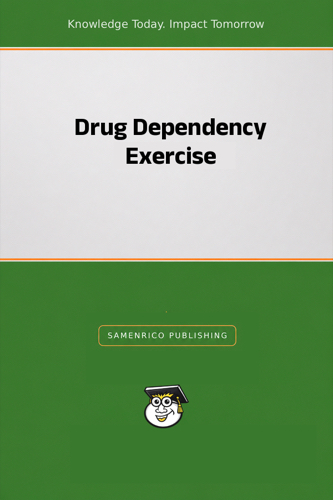
Drug Dependency Exercise eBook
Use physical activity to support recovery.
by Nix Lavada
Use physical activity to support recovery.
Formats
Free sample
Chapter 1: The Broken Thermostat–- The first time Marcus tried to feel joy without drugs, he sat on the edge of his bed for forty-seven minutes, staring at a pair of running shoes he had not touched in three years. He had been clean for eleven days. The acrid smell of withdrawal sweat still clung to his sheets. His hands trembled when he reached for the laces. And somewhere beneath the nausea, the insomnia, and the voice in his head screaming that one more hit would make everything bearable, he asked himself a question that had no easy answer: If I cannot feel good from anything anymore, what is the point of staying sober?This is not a moral failing.
It is not a lack of willpower, a character defect, or evidence that Marcus lacked sufficient motivation to change his life. It is neurochemistry. And until you understand how deeply drugs have rewired your brain's reward system, you will continue to blame yourself for a biological process that you never chose and cannot out-think.Every person who has struggled with substance dependence knows the experience that Marcus was going through. The first few weeks of sobriety are not defined by relief or hope or the triumphant turning of a new leaf. They are defined by anhedonia—the clinical term for the inability to experience pleasure from activities that should be enjoyable.
Food tastes like cardboard. Music sounds like noise. The warmth of the sun on your skin feels like nothing at all. Laughter from other people becomes irritating rather than infectious. And the things that used to bring you joy before the drugs—a good meal, a conversation with a friend, a lazy Sunday afternoon, the simple satisfaction of a job completed—now produce absolutely nothing.This is the moment when most relapses happen.
Not because the person is weak, but because the absence of pleasure is genuinely unbearable. The brain has been so thoroughly flooded with artificial dopamine that it has effectively forgotten how to manufacture its own.The Neurochemistry of Surrender To understand why exercise is not just helpful but arguably essential for long-term recovery, you must first understand what drugs actually did to your brain. This is not abstract neuroscience for its own sake. This is the difference between fighting blind and fighting with a map.Dopamine is often described as the brain's "pleasure chemical," but that is a misleading simplification. Dopamine is better understood as the neurotransmitter of motivation and anticipation.
It is what makes you want to get out of bed in the morning. It is what makes a goal feel worth pursuing. It is the chemical signal that says, "This will be rewarding—go get it." When dopamine is functioning properly, ordinary life feels worth living. Not every moment is ecstatic, but there is a baseline sense that effort will lead to satisfaction.Drugs hijack this system with brutal efficiency. Consider what happens when someone uses cocaine, amphetamine, or methamphetamine.
These substances cause dopamine levels to spike to 300 to 1,500 percent above baseline—a flood so massive that the brain's natural recycling systems cannot keep up. Opioids like heroin and prescription painkillers work slightly differently but produce a similar effect: they trigger a massive release of dopamine by disinhibiting the brain's reward circuitry. Even alcohol and nicotine, often seen as less "hard" drugs, cause significant dopamine surges that distort the brain's reward set point.Your brain is designed for homeostasis—the maintenance of a stable internal environment. When it is repeatedly flooded with unnaturally high levels of dopamine, it adapts by reducing its own dopamine production and, more importantly, by removing dopamine receptors from the cell surfaces. This process is called downregulation.
Think of it as the brain turning down the volume on its own reward system because the music has been too loud for too long.The result is what this book calls Exercise Reward Deficiency Syndrome—a state where the brain no longer finds natural rewards pleasurable. Food, social interaction, sex, achievement, sunlight, rest, and yes, light exercise—all of these produce only a fraction of the dopamine response they once did. The brain has essentially forgotten how to feel good from normal life.This is why willpower fails. You cannot will yourself to produce dopamine when your brain has physically removed the receptors required to detect it. It would be like trying to hear a whisper after deliberately destroying your eardrums.
The problem is not that you are not trying hard enough. The problem is that the hardware is broken.The Myth of the Moral Failure If you have spent any time in traditional recovery settings, you have likely heard some version of the following: your addiction is a spiritual malady, your willpower is insufficient, and you need to surrender to a higher power because you are powerless over your addiction. There is a grain of truth in the humility that these programs encourage. But there is also a dangerous implication: that your suffering is your fault, that you are broken in some fundamental moral way, and that only supernatural intervention can save you.This is false. And believing it keeps people trapped in cycles of shame and relapse.The idea that addiction is a moral failing has been thoroughly discredited by decades of neuroscience.
The American Medical Association recognized addiction as a brain disease in 1956. The National Institute on Drug Abuse defines it as "a chronic, relapsing disorder characterized by compulsive drug seeking and use despite adverse consequences." The language of disease is imperfect—it can make people feel like passive victims rather than agents of their own recovery—but it is infinitely more accurate than the language of sin and weakness.Here is what the disease model actually means for you: your brain has been physically altered by prolonged substance use. Those alterations are real. They can be measured with brain imaging. They are not metaphors or spiritual diagnoses.
The good news is that the brain is plastic—it can change. The bad news is that change requires specific, sustained interventions. Sitting in a circle and admitting powerlessness is not enough. Praying is not enough. White-knuckling your way through anhedonia is not enough.You need to actively repair your reward system.
And there is no known intervention that repairs the dopamine system more effectively than structured, progressive physical activity.The Repair Mechanism You Already Have Exercise stimulates the release of three classes of neurochemicals that are directly relevant to addiction recovery: dopamine, endorphins, and BDNF (Brain-Derived Neurotrophic Factor). Each of these plays a distinct and essential role in rebuilding the broken reward system.Dopamine release from exercise is different from dopamine release from drugs in two critical ways. First, the magnitude: exercise typically raises dopamine levels by 50 to 100 percent above baseline, not 1,500 percent. This is a gentle, sustainable increase rather than a catastrophic flood. Second, the pattern: drugs produce a sharp spike followed by a crash below baseline, while exercise produces a gradual rise and fall that does not trigger the brain's compensatory downregulation mechanisms.
In other words, exercise teaches your brain that pleasure can come in waves rather than explosions.Endorphins are the body's natural opioids. They bind to the…
This is the end of the free sample. Get the eBook to keep going. Buy now
About this book
Details
- Author
- Nix Lavada
- Publisher
- SamEnrico
- Language
- English
- Genre
- Non-Fiction, Self-Help, Exercise
- Released
- 2026-06-08
- Pages (approx.)
- 157
- Available as
- eBook, Audiobook

Read better in the ZLOADR app
Your eBooks on your phone or tablet. Sign in with your SamEnrico account and start reading.
More by Nix Lavada
 Stress Induced Nagging CycleNix Lavada$11.99
 EQ For Eating Disorder RecoveryNix Lavada$11.99
 Boundary Setting for ActivistsNix Lavada$11.99
 The Learning Style StressNix Lavada$11.99
 Neuropathic Pain WorkbookNix Lavada$11.99
 US Germany Remote Tax GuideNix Lavada$11.99
 Light Therapy for BipolarNix Lavada$11.99
 Keyword Mnemonic Language GuideNix Lavada$11.99
 The Golden Age of Viennese Science: From Freud to the Quantum LeapNix Lavada$11.99
 The Whistleblower's Dilemma: Frances Haugen vs. FacebookNix Lavada$11.99
 Whispers in the Lamplight: The Djinn of Baghdad’s Forgotten QuarterNix Lavada$11.99
 The Mineral Guide to DiaboleiteNix Lavada$11.99
You may also like
 Hong Kong Handover 1997Dunn Johnnie$11.99
 Zumba For Postnatal Recovery CourseNeal Christian$11.99
 Zumba for BeginnersLadner Nikia$11.99
 YouTube Comment Mining GuideHumes Pandora$12.99
 Worry Box MeditationCarlin Rudy$11.99
 Workplace Stress MeditationNguyen Lynn$11.99
 Workplace Stress and Sleep RepairHawley Ivory$11.99
 Workplace Perfectionism CureDelaney Jeffry$11.99
 Workplace Injustice Anger GuideWallen Isabelle$11.99
 Work Addiction and Burnout LinkGreenwood Ester$11.99
 Women in Yoga and WellnessBeattie Galina$11.99
 Women in Stand Up ComedyChun Evangeline$11.99