
Non-FictionHealth & WellnessAdvanced Training
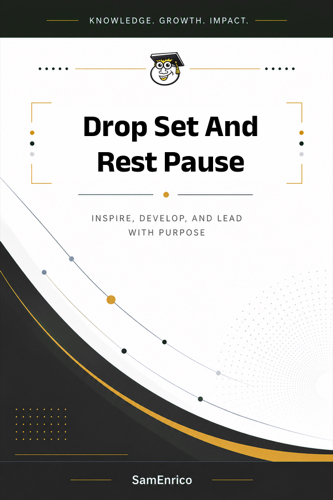
Drop Set And Rest Pause eBook
Teaches intensity techniques to push past failure
by Moody Marta
Teaches intensity techniques to push past failure for growth stimulation.
Formats
Free sample
Chapter 1: The Efficiency Trap...--–- The first time you hit muscular failure, you probably remember it. You were pushing through your last set of bench press, the bar slowing halfway up, your spotter's hands hovering just under the bar. You fought for the rep—teeth clenched, veins bulging—and then nothing. The bar stopped. Your muscles had given everything they had.
You racked the weight, sat up, and felt a strange sense of accomplishment. You had found your limit. You had discovered what failure felt like.That was then. Now, hitting failure is routine. You know exactly where it will come—rep eight on your first set, rep seven on your second, rep six on the third.
The numbers have stopped moving up. Your logbook shows the same weights, the same reps, week after week. The pump that used to last for hours fades before you leave the gym. The progress that came so easily in your first years of training has slowed to a crawl. You have reached the plateau.
And you are starting to wonder: Is this it? Is this as big and strong as I will ever get?This book exists because of that question. It exists because the difference between an average physique and an extraordinary one is not just about showing up—it is about what you do when your muscles say "no more." The techniques within these pages—drop sets, rest-pause training, forced negatives, lengthened partials, and beyond—are the tools that champions use to push past failure and force growth when standard training stalls. They are not for beginners. They are not for the faint of heart.
They are for the lifter who has mastered the basics and is ready to take their training to the highest level of intensity.But before we can teach you how to push past failure, we must first understand why you stopped growing in the first place. You have not gotten weaker. You have not lost your work ethic. You have fallen into what I call the Efficiency Trap.The Efficiency Trap: Why Your Body Refuses to Grow Your body is a masterpiece of biological engineering. It is designed to survive.
It is not designed to build muscle. From an evolutionary perspective, muscle is expensive—it requires calories, oxygen, and recovery resources that could otherwise be used for reproduction, immune function, or fat storage. Your body will not grow muscle unless it is absolutely forced to.In your first year of training, you forced it. You added weight to the bar every week. You added reps to your sets.
You challenged your muscles with stimuli they had never experienced before. Your nervous system adapted, sending stronger signals to your motor units. Your muscles adapted, adding new contractile proteins. Your connective tissue adapted, becoming thicker and more resilient. You grew.
You got stronger. It felt like magic.But your body is also a masterpiece of adaptation. It learns. It remembers. After a year or two of consistent training, your body has figured out exactly how much effort is required to move the weight you are lifting.
It has optimized every system involved in that movement: the neural pathways, the muscle fiber recruitment patterns, the energy systems, even the psychological tolerance for discomfort. You have become efficient. Terribly, frustratingly efficient.And efficiency is the enemy of growth.Here is the hard truth: your body will not waste resources on muscle growth unless it believes it has no choice. When you perform the same workout with the same weights and the same reps, your body says: "I have handled this before. I can handle it again.
No need to build new muscle." Your progress stalls not because you are weak, but because you are efficient. You have trained your body to do more with less. And now it refuses to do anything more at all.The Three Layers of Failure (And Why Most Lifters Stop Too Early)Before we can train past failure, we must define what failure actually means. In resistance training, "failure" is a surprisingly slippery term. Most lifters think they know what it means—the point where you cannot complete another rep.
But there are actually three distinct layers of failure, and most lifters stop at the first or second layer, leaving significant growth potential on the table.Technical Failure The first layer is technical failure. This occurs when you cannot complete another repetition while maintaining proper form. The bar slows. Your back rounds. Your elbows flare.
Your hips shoot up. You are still moving the weight, but your form is breaking down. Most lifters stop here—and for good reason. Continuing with poor form increases injury risk. In many exercises (deadlifts, squats, bent-over rows), technical failure is a sensible stopping point.But here is what most lifters do not realize: technical failure is not muscular failure.
Your muscles still have capacity. Your form is breaking down because your primary muscles are fatiguing, and your body is recruiting secondary muscles to compensate. You are not done. You are just getting started.Concentric Failure The second layer is concentric failure. This occurs when you cannot lift the weight through the positive (concentric) phase of the movement, even with compromised form.
You push, and the weight does not move. It sits there, mocking you. This is true muscular failure for the concentric portion of the lift.Most lifters who push past technical failure stop at concentric failure. They rack the weight, rest, and move to the next set. But here is what the latest research reveals: your muscles are not empty at concentric failure.
They are tired, yes. But they still have eccentric strength—the ability to lower weight under control—and they still have capacity for partial-range reps, particularly in the stretched position.Eccentric Failure The third layer is eccentric failure. This occurs when you can no longer lower the weight under control. The weight drops faster than you intend. This is true, complete muscular failure—your muscles have exhausted their ability to generate force in any phase of the movement.Eccentric failure is significantly harder to reach than concentric failure.
You are approximately 20-40% stronger during the eccentric (lowering) phase of most exercises than during the concentric (lifting) phase. This means that after you hit concentric failure, you can still perform several controlled negatives before reaching eccentric failure. Those negatives are pure growth stimulus.Most lifters never experience eccentric failure. They stop at technical or concentric failure, rack the weight, and walk away. They leave the gym with gas still in the tank.
The techniques in this book are designed to help you access that remaining capacity safely and effectively.The Plateau: When Progressive Overload Fails Progressive overload is the fundamental principle of muscle growth: to get bigger and stronger, you must continually increase the demands placed on your muscles. In practice, this usually means adding weight to the bar or doing more reps. For the first year or two of training, this works beautifully. Your nervous system adapts, your muscles grow, and you add weight to your lifts almost every week.But eventually, the easy gains run out. Your body adapts to the stimulus you are providing…
This is the end of the free sample. Get the eBook to keep going. Buy now
About this book
Details
- Author
- Moody Marta
- Publisher
- SamEnrico
- Language
- English
- Genre
- Non-Fiction, Health & Wellness, Advanced Training
- Released
- 2026-06-06
- Pages (approx.)
- 127
- Available as
- eBook, Audiobook

Read better in the ZLOADR app
Your eBooks on your phone or tablet. Sign in with your SamEnrico account and start reading.
More by Moody Marta
 Teresa of Ávila Interior CastlesMoody Marta$11.99
 Hepatitis C and Drug UseMoody Marta$11.99
 Overland Cambodia Northern PlainsMoody Marta$11.99
 Charles Frederick Worth: The King of Parisian Couture and His British RootsMoody Marta$11.99
 KC135 Pilot InstructorMoody Marta$11.99
 Cost Based Pricing Formula WorkbookMoody Marta$12.99
 How to Produce Canned and Jarred FruitsMoody Marta$11.99
 How to Start a Millwork (including Flooring) BusinessMoody Marta$11.99
You may also like
 Hong Kong Handover 1997Dunn Johnnie$11.99
 Zumba For Postnatal Recovery CourseNeal Christian$11.99
 Zumba for BeginnersLadner Nikia$11.99
 YouTube Comment Mining GuideHumes Pandora$12.99
 Worry Box MeditationCarlin Rudy$11.99
 Workplace Stress MeditationNguyen Lynn$11.99
 Workplace Stress and Sleep RepairHawley Ivory$11.99
 Workplace Perfectionism CureDelaney Jeffry$11.99
 Workplace Injustice Anger GuideWallen Isabelle$11.99
 Work Addiction and Burnout LinkGreenwood Ester$11.99
 Women in Yoga and WellnessBeattie Galina$11.99
 Women in Stand Up ComedyChun Evangeline$11.99