
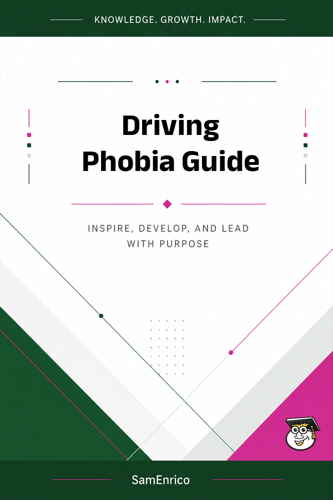
Driving Phobia Guide eBook
Reduce highway and bridge anxiety through hypnotic
by Fife Andree
Reduce highway and bridge anxiety through hypnotic rehearsal.
Formats
Free sample
Chapter 1: The Locked Windshield...--You are sitting in the driver’s seat. The engine is off. The keys are not even in the ignition. And yet, your heart is already pounding.This is the paradox of driving phobia. Your body is reacting as if you are already in danger—racing heart, shallow breath, sweating palms—while you are perfectly still.
The threat is not on the road ahead. The threat is a memory, a prediction, a ghost in the neural circuits of your own brain.If you are reading this book, you likely know the experience intimately. Perhaps you once crossed a high bridge and felt the world tilt. Perhaps you merged onto a highway and suddenly could not breathe. Perhaps you have never had a single traumatic event—only a slow, creeping certainty that one day you will lose control behind the wheel.
Whatever your story, you are here because driving, which most people treat as mundane as tying their shoes, has become a battle.Here is the first truth you need to hear, and it is the foundation of everything that follows: You do not have a character flaw. You have a learned pattern.That pattern lives in a small, almond-shaped region of your brain called the amygdala. Its job is to detect threats and sound the alarm. Millions of years of evolution have honed this system to be exquisitely sensitive—because in the ancestral environment, missing a predator meant death. But your amygdala cannot tell the difference between a saber-toothed tiger and a suspension bridge.
It cannot distinguish between a genuine mechanical emergency and the sensation of your own heartbeat speeding up. All it knows is: this feels like last time, sound the alarm.This chapter will dismantle the mystery of driving phobia. You will learn why your brain treats a highway ramp like a life-or-death threat, how avoidance makes the fear stronger not weaker, and—most importantly—why the fact that you learned to be afraid means you can learn to be calm. By the end of this chapter, you will have completed your first hypnotic rehearsal session, sitting exactly where you are right now, and you will have experienced the alpha state—the neurological doorway to rewiring your fear response.The Geography of Fear: Phobia vs. Worry Before we change anything, we must name it correctly.
The word “phobia” is thrown around casually—“I have a phobia of deadlines” or “I’m phobic about public speaking”—but a clinical phobia is a specific, measurable, and deeply physical phenomenon.A specific phobia is an intense, irrational fear of a particular object or situation that poses little to no actual danger. The fear is disproportionate to the threat. It is persistent, typically lasting six months or more. And crucially, it leads to avoidance—you change your life to stay away from the trigger.Driving phobia (sometimes called vehophobia when specific to driving, or gephyrophobia when specific to bridges) falls squarely into this category. It is not generalized anxiety.
It is not agoraphobia, though the two can overlap. It is a laser-focused fear response tied to the act of operating a vehicle in specific conditions: highways, bridges, tunnels, high speeds, merging traffic, or any combination of these.Here is the crucial distinction: Generalized anxiety feels like a radio left on static—constant, diffuse, without a clear source. Driving phobia is a smoke alarm that goes off only when you approach a particular trigger. The rest of your life may be perfectly calm. You might be a confident, capable person in every other domain.
That is what makes driving phobia so baffling and humiliating for many sufferers. Why can I run a meeting, raise children, handle a crisis—but I cannot cross a bridge?The answer lies not in your personality but in your nervous system’s learning history.The Fear-of-Fear Cycle: How Panic Begets Panic Let us walk through a typical scenario. You are driving toward a highway on-ramp. You have done this route a hundred times before. But today, for no obvious reason, you feel a flutter in your chest.
Your mind notices the flutter and thinks, Oh no—here it comes.That thought—here it comes—is the spark. Your amygdala interprets the thought as a threat. It releases adrenaline. Your heart rate jumps from 75 to 110. You feel the jump, which confirms your prediction: See?
I knew it was starting. Your amygdala releases more adrenaline. Now your heart is at 130. Your vision narrows. Your hands feel disconnected from the steering wheel.
You are now in a full panic attack—not because of anything on the road, but because you were afraid of having a panic attack.This is the fear-of-fear cycle. It is the engine that drives all phobias, and it operates on a simple feedback loop:Physical sensation → Interpretation as threat → More adrenaline → Stronger physical sensation → Stronger interpretation as threat The only way to break this loop is to interrupt it at the interpretation stage. But you cannot interrupt what you do not understand. So let us understand it.The physical symptoms of panic—racing heart, rapid breathing, sweating, dizziness, tunnel vision, derealization (the feeling that you or the world is not real)—are not dangerous. They are uncomfortable.
Sometimes they are terrifying. But they are not harmful. Your heart can safely beat at 160 beats per minute for hours. Your breathing will not stop; you will hyperventilate, which feels like suffocation but is actually too much oxygen. Dizziness will not make you faint while seated—fainting requires a drop in blood pressure, and panic raises blood pressure.Every single symptom of a panic attack is your body preparing to fight or flee from a predator.
The problem is that there is no predator. You are in a car. You are safe. But your amygdala does not know that.And here is the liberating truth: The fear-of-fear cycle is a learned pattern. It was not installed at birth.
It was not written into your DNA. It was conditioned through experience—one bad drive, one moment of unexpected panic, one catastrophic thought that stuck. And what has been learned can be unlearned.Classical Conditioning on the Highway: How One Bad Drive Changes Everything Ivan Pavlov is famous for his dogs. He rang a bell, gave them food, and soon the bell alone made them salivate. That is classical conditioning—a neutral stimulus (bell) becomes associated with a meaningful stimulus (food) and then triggers the same response (salivation).Driving phobia works exactly the same way, except the response is panic instead of salivation.Here is how it happens.
You are driving across a bridge—something you have done a hundred times without issue. But this time, for some reason (maybe you are tired, maybe you had too much coffee, maybe you were already stressed about work), your heart starts racing. The racing heart is uncomfortable. You grip the wheel tighter. The bridge sways slightly.
You think, This bridge is unstable. Your amygdala, hearing that thought, releases more adrenaline. Now you are in a full panic attack. You exit the bridge, pull over, and promise yourself you will never drive that route again.That single event—one panic attack on one…
This is the end of the free sample. Get the eBook to keep going. Buy now
About this book
Details
- Author
- Fife Andree
- Publisher
- SamEnrico
- Language
- English
- Genre
- Non-Fiction, Self-Help
- Released
- 2026-06-09
- Pages (approx.)
- 121
- Available as
- eBook, Audiobook

Read better in the ZLOADR app
Your eBooks on your phone or tablet. Sign in with your SamEnrico account and start reading.
More by Fife Andree
 Sexist Workplace Anger GuideFife Andree$11.99
 The Body Language for Law EnforcementFife Andree$11.99
 Creative Professional EsteemFife Andree$11.99
 WeChat Moments Social PressureFife Andree$11.99
 Silk and Steel: The Unseen Trade Wars of the Han DynastyFife Andree$11.99
 Understanding Microphthalmia Microtia Fetal AkinesiaFife Andree$17.99
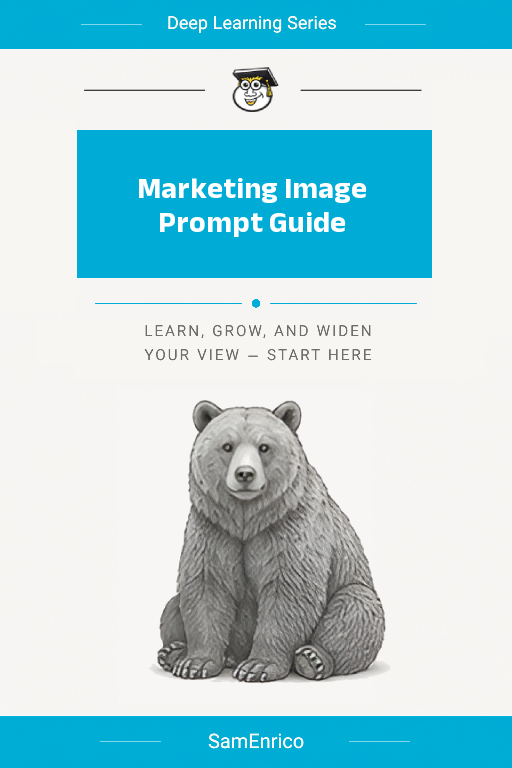 Marketing Image Prompt GuideFife Andree$12.99
 Clean Energy Capital AllocationFife Andree$12.99
 How to Start a Bunk Beds Made of Metal Business (Beginners Guide)Fife Andree$11.99
 Alligator TrapperFife Andree$11.99
You may also like
 Hong Kong Handover 1997Dunn Johnnie$11.99
 Zumba For Postnatal Recovery CourseNeal Christian$11.99
 Zumba for BeginnersLadner Nikia$11.99
 YouTube Comment Mining GuideHumes Pandora$12.99
 Worry Box MeditationCarlin Rudy$11.99
 Workplace Stress MeditationNguyen Lynn$11.99
 Workplace Stress and Sleep RepairHawley Ivory$11.99
 Workplace Perfectionism CureDelaney Jeffry$11.99
 Workplace Injustice Anger GuideWallen Isabelle$11.99
 Work Addiction and Burnout LinkGreenwood Ester$11.99
 Women in Yoga and WellnessBeattie Galina$11.99
 Women in Stand Up ComedyChun Evangeline$11.99