
Non-FictionSelf-HelpFast Food Psychology
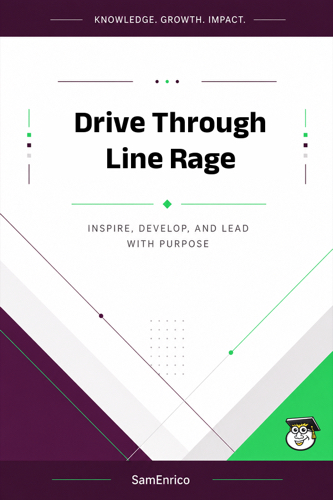
Drive Through Line Rage eBook
Waits calmly for coffee and fast food without ange
Waits calmly for coffee and fast food without anger.
Formats
Free sample
Chapter 1: The Unspoken Contract--You are not angry about the wait.Let that land for a moment. You are not angry about the seven minutes idling behind a rusty sedan whose driver appears to be ordering a five-course meal for a family of eight. You are not angry about the fact that you can see your coffee sitting on the ledge inside the window, steam rising from its lid like a taunt. You are not angry about the car ahead of you that inexplicably left a four-car gap, as if afraid of offending the exhaust fumes of the vehicle in front of them.You are angry about something you never said out loud.Deep in the basement of your brain, below the level of conscious thought, you made a deal. The terms were simple: I will enter this line.
In exchange, the universe will deliver my iced latte with oat milk and an extra shot within 180 seconds. If the universe fails to deliver, the universe has wronged me. And I am entitled to my fury.This is the Unspoken Contract. And it is the single greatest driver of drive-through rage on the planet.The Invention of "Time Debt"Let us name the beast. Psychologists who study waiting behavior have identified a phenomenon called "time debt" —the unconscious assumption that the world owes you a specific speed of service.
You did not negotiate this debt. No one signed a document. The cashier did not promise you three minutes. The menu board did not flash a guarantee. And yet, when the seventh minute arrives and your coffee is still behind glass, you feel the visceral sensation of being stolen from.Someone has taken something that belongs to you.This is the peculiar genius of the Unspoken Contract.
It creates a debt that only you can see, only you can enforce, and only you can feel victimized by. The other party to the contract—the teenager at the window, the understaffed kitchen, the broken milkshake machine—has no idea they are in breach. They are simply living their life, dropping fries, struggling with a sticky card reader. Meanwhile, you are mentally drafting a lawsuit against reality itself.Consider the Starbucks Fallacy. You pull into the drive-through.
You have done this route a hundred times. In your mind, a movie begins to play: you at the speaker, ordering with crisp efficiency; you pulling forward as the car ahead magically vanishes; you at the window, handing over your card; you driving away, latte in hand, victorious. The runtime of this mental movie is approximately three minutes.But reality is not a movie. Reality is a messy, unscripted documentary. The car ahead of you has a coupon.
The person at the speaker cannot decide between a muffin and a brownie. The card reader is rebooting. By the time you reach the window, seven minutes have passed. Your mental movie is now four minutes overdue. And because your brain cannot tell the difference between a real violation and an imagined one, your body responds as if someone has broken into your home and stolen your silverware.Your heart rate rises.
Your jaw clenches. Your hands tighten on the steering wheel.You have not been wronged. You have been disappointed by your own imagination.Clock Time vs. Emotional Time Here is a distinction that will save you thousands of dollars in blood pressure medication. There are two clocks running at all times.Clock time is objective.
It is measured by atoms vibrating in a cesium fountain. It does not care if you are happy or miserable, late or early, in love or in hate. Seven minutes of clock time is exactly seven minutes. It is neutral. It is a fact, like gravity or the price of eggs.Emotional time is subjective.
It is measured by your nervous system. When you are bored, anxious, or waiting for something you want, emotional time expands like a balloon filling with helium. Seven minutes of clock time can feel like thirty minutes of emotional time. When you are engaged, joyful, or distracted, emotional time compresses. Seven minutes can feel like thirty seconds.The drive-through rage spiral happens when you confuse the two.
You feel thirty minutes of emotional time. You look at the clock and see seven minutes of clock time. Your brain does the math and concludes: something is wrong. The math is wrong because the units do not match. You are comparing subjective suffering to objective duration.
It is like comparing apples to the concept of Tuesday.The Unspoken Contract always uses emotional time as its currency. I should have my coffee by now uses the word "now" not as a clock measurement but as a feeling. "Now" means before I started feeling impatient. "Now" means before my mental movie ended. "Now" means before the discomfort of waiting exceeded my tolerance for discomfort.No drive-through has ever promised you any of those things.The Anatomy of a Breached Contract Let us dissect a typical drive-through rage episode.
You are in line. Something slows down—a complicated order, a trainee, a spilled drink. You feel the first twinge of irritation. That twinge is not rage yet. It is a notification.
Your brain is sending you a message: The contract is at risk of breach.Then the wait continues. The notification becomes an alarm. Your brain begins scanning for evidence: Is the car ahead of me on their phone? Is the cashier laughing with a coworker instead of working? Is the person at the window counting change like they are learning arithmetic for the first time?
You are not looking for facts. You are looking for confirmation of injustice.Then the breach occurs. In your mind, the contract has been violated. The terms were clear (even though they were never stated). The other party has failed (even though they never agreed).
And now you are entitled to something—an apology, a discount, a visible sign of suffering from the people who have wronged you.This is the moment when irritation becomes rage. Because rage is not just anger. Rage is moral anger. It is anger with a certificate of righteousness. You are not merely annoyed; you are justified.
The world has wronged you, and by God, someone is going to know about it.But here is the question this entire book will ask you, over and over, until it becomes a reflex:What if there was no contract?What if you never made a deal? What if the drive-through owes you nothing except what it explicitly promised: a chance to order food, a reasonable effort to prepare it, and a transaction at the window? What if "reasonable effort" includes spilled milkshakes, trainee cashiers, and credit card machines that choose the worst possible moment to freeze?What if the only person who promised you three minutes was you?The Liberating Power of Cancellation If the Unspoken Contract is the problem, then the solution is brutally simple: cancel the contract.You cannot cancel a contract you never signed. But you have been signing it, unconsciously, every time you enter a drive-through. The signature is your expectation.
The ink is your imagined timeline. The notary is your nervous system, stamping the deal with the seal of "this…
This is the end of the free sample. Get the eBook to keep going. Buy now
About this book
Details
- Author
- Switzer Lecia
- Publisher
- SamEnrico
- Language
- English
- Genre
- Non-Fiction, Self-Help, Fast Food Psychology
- Released
- 2026-06-05
- Pages (approx.)
- 140
- Available as
- eBook, Audiobook

Read better in the ZLOADR app
Your eBooks on your phone or tablet. Sign in with your SamEnrico account and start reading.
More by Switzer Lecia
 IBS Food Poisoning PreventionSwitzer Lecia$11.99
 Montevideo Uruguay GuideSwitzer Lecia$11.99
 Lumbar Spinal Fusion Post-Op ExerciseSwitzer Lecia$11.99
 The Interruption Buffer System CourseSwitzer Lecia$11.99
 Persuasive Storytelling GuideSwitzer Lecia$11.99
 Christmas Eve DisappearanceSwitzer Lecia$11.99
 Scripting VisualizationsSwitzer Lecia$11.99
 The Freelance Contract Template KitSwitzer Lecia$11.99
 The Great Wall Breaks: The Fall of the Ming and the Rise of the QingSwitzer Lecia$11.99
 Codebreakers & Spies: The Untold Cold War Battle for the InternetSwitzer Lecia$11.99
 The Vanishing Crown: The Untold Story of the 1953 Coronation HeistSwitzer Lecia$11.99
 How to Start a Motorcycle Hire Business (Beginners Guide)Switzer Lecia$11.99
You may also like
 Hong Kong Handover 1997Dunn Johnnie$11.99
 Zumba For Postnatal Recovery CourseNeal Christian$11.99
 Zumba for BeginnersLadner Nikia$11.99
 YouTube Comment Mining GuideHumes Pandora$12.99
 Worry Box MeditationCarlin Rudy$11.99
 Workplace Stress MeditationNguyen Lynn$11.99
 Workplace Stress and Sleep RepairHawley Ivory$11.99
 Workplace Perfectionism CureDelaney Jeffry$11.99
 Workplace Injustice Anger GuideWallen Isabelle$11.99
 Work Addiction and Burnout LinkGreenwood Ester$11.99
 Women in Yoga and WellnessBeattie Galina$11.99
 Women in Stand Up ComedyChun Evangeline$11.99