
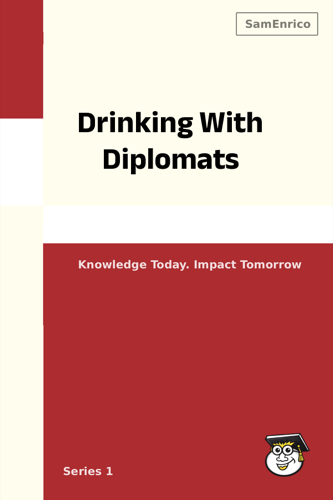
Non-FictionBiographyAlcohol Culture
Drinking With Diplomats eBook
Reveals how vodka toasts, whiskey deals, and wine
by Walls Ester
Reveals how vodka toasts, whiskey deals, and wine cellars sealed or sank international agreements.
Formats
Free sample
Chapter 1: The Binding Pour...--The first time I watched a negotiation collapse over a drink, I was standing in a freezing Moscow hotel bar in February 1994, clutching a glass of warm white wine that tasted like regret. The man across from me—a Russian deputy minister whose name I have promised never to print—had just finished a fifteen-minute toast about the heroic resilience of the Russian people. He had spoken of winter, of war, of suffering and survival. He had raised his glass four times. And then he had looked at my American colleague, a bright young trade attaché named Sarah, and asked a simple question: "Why did you not finish your vodka?"Sarah had an answer.
It was a good answer. She was on medication. She had an early meeting. She was not accustomed to drinking spirits. All of these were true.
None of them mattered.The deputy minister did not shout. He did not storm out. He simply set down his glass, very carefully, as if placing a monument on a grave. He looked at Sarah with something worse than anger—disappointment. And then he said, in English so precise it felt like a scalpel: "In my country, when we drink together, we become brothers.
You have refused to be my brother. So we have nothing more to discuss."The meeting ended. The negotiation—six months of preparation, two prior visits, a draft agreement on agricultural subsidies that would have saved American soybean farmers roughly forty million dollars—ended with it. Sarah flew home the next morning. The deputy minister never took another meeting with our delegation.
And I learned a lesson that no textbook, no briefing book, and no diplomatic training seminar had ever taught me: alcohol is not a social lubricant. It is a binding agent. And when you refuse the pour, you are not refusing a drink. You are refusing the relationship.This book is about that lesson and everything I learned in the thirty years that followed. I have negotiated in vodka-soaked dachas outside Moscow, in whiskey-lit backrooms of Belfast, in Beijing banquet halls where the baijiu flowed like tap water, and in Riyadh conference rooms where the only drinks were date juice and bitter coffee.
I have seen deals sealed over a shared bottle of eighteen-year-old Macallan and deals sunk because someone clinked glasses the wrong way. I have watched young diplomats rise like rockets by mastering the toast and senior ambassadors crash to earth because they thought "no thank you" was a complete sentence.This is not a book about drinking. It is a book about power, trust, and the strange rituals humans use to decide whether to risk cooperation. And it starts, as all things do in the world I have inhabited for three decades, with a pour.The Three Functions of Alcohol in Diplomacy Before we descend into the trenches of specific cultures and case studies, I need to establish a framework that will guide every chapter to come. In my thirty years of observing and participating in high-stakes negotiations, I have come to believe that alcohol serves three distinct functions in diplomacy—and the failure to distinguish between them is the single greatest source of liquid disaster.Function One: The Binding Contract.
This is vodka's domain. In cultures that use alcohol as a commitment mechanism, the shared drink is a substitute for a signed document. You toast, you finish, you have given your word. There is no take-back, no "the drink talking" excuse, no plausible deniability. The Russian deputy minister who walked away from Sarah was not being theatrical.
He was enforcing a cultural rule older than the Kremlin: a person who will not drink with you will not die with you.Function Two: The Exploratory Backchannel. This is whiskey's territory. Unlike vodka, which commits, whiskey allows for exploration without consequence. The late-night decanter pass, the shared bottle of bourbon, the "one more for the road" that turns into a conversation about what each side really wants—these moments are precious precisely because they are deniable. If someone proposes a deal at 2 AM over Scotch, they can wake up the next morning and say, "I was drunk.
I didn't mean it." Sometimes that's a lie. Sometimes it's the truth. Either way, the deniability allows ideas to surface that would never survive a formal negotiation.Function Three: The Status Signal. This is wine's specialty. Wine is not about bonding or exploring.
It is about signaling who belongs and who does not. The choice of vintage, the temperature, the glassware, the order of pours—these are not details. They are the message. When the French serve a thirty-year-old Château Margaux to a visiting dignitary, they are saying: you are one of us. When they serve a cheap table wine, they are saying: you are not.
The insult is invisible to outsiders but screamingly obvious to those who speak the language.Every chapter of this book will return to these three functions. But before we dive into the specifics of vodka, whiskey, and wine, we need to address the question that haunts every modern diplomat: Why do we still do this? In an age of Zoom calls, encrypted messaging, and artificial intelligence translation, why does anyone still believe that sharing a drink matters?The Vulnerability Principle The answer is simple, uncomfortable, and essential: alcohol creates mutual vulnerability, and mutual vulnerability creates trust.Think about what happens when you drink with someone. You are, quite literally, poisoning yourself. Your judgment blurs.
Your tongue loosens. Your guard lowers. And crucially, the other person knows you are doing this. They know that you are making yourself vulnerable in their presence. They know that you are trusting them not to exploit that vulnerability.
And that knowledge—that shared acknowledgment of risk—is the foundation of something no contract can replicate: the belief that the other party is acting in good faith.This is not a new insight. The anthropologist Robin Dunbar has shown that social bonding across human cultures is correlated with the release of endorphins, which alcohol artificially stimulates. The political scientist James C. Scott has documented how drinking rituals across history have served as "trust tests"—ways for strangers to prove they are not threats. And every diplomat who has ever closed a deal over a bottle knows that the real negotiation happens not in the conference room, but in the moment when both sides agree to be slightly less than fully in control.But here is the twist: vulnerability can be faked.
And the best diplomats know how to fake it.I once worked with a Scandinavian envoy who was famous for his drinking stamina. He would match Russian counterparts shot for shot, toast for toast, hour for hour—and then wake up the next morning fresh as a daisy, having remembered every word spoken. His secret? He had learned, over decades, to pour his own vodka. And his pours were always, shall we say, conservative.
He would raise his glass, perform the ritual, touch the rim to his lips—and swallow barely a teaspoon while his counterpart drained a full shot. He was not drinking. He was performing drinking.Was this ethical?…
This is the end of the free sample. Get the eBook to keep going. Buy now
About this book
Details
- Author
- Walls Ester
- Publisher
- SamEnrico
- Language
- English
- Genre
- Non-Fiction, Biography, Alcohol Culture
- Released
- 2026-06-08
- Pages (approx.)
- 137
- Available as
- eBook, Audiobook

Read better in the ZLOADR app
Your eBooks on your phone or tablet. Sign in with your SamEnrico account and start reading.
More by Walls Ester
 NVC For Receiving CriticismWalls Ester$11.99
 Harvard Extension School Thesis OptionWalls Ester$11.99
 Transcendental Meditation for ADHDWalls Ester$11.99
 The Poisoned Rum Conspiracy: Colombia's Deadly Prohibition PlotWalls Ester$11.99
 Smart Contract AuditingWalls Ester$11.99
 Hostile Surveillance DetectionWalls Ester$12.99Smart Contract AuditingWalls Ester$11.99
 How to Produce Bicycle SkinsuitsWalls Ester$11.99
 How to Start a Boots and Shoes (retail) Business (Beginners Guide)Walls Ester$11.99
You may also like
 Hong Kong Handover 1997Dunn Johnnie$11.99
 Zumba For Postnatal Recovery CourseNeal Christian$11.99
 Zumba for BeginnersLadner Nikia$11.99
 YouTube Comment Mining GuideHumes Pandora$12.99
 Worry Box MeditationCarlin Rudy$11.99
 Workplace Stress MeditationNguyen Lynn$11.99
 Workplace Stress and Sleep RepairHawley Ivory$11.99
 Workplace Perfectionism CureDelaney Jeffry$11.99
 Workplace Injustice Anger GuideWallen Isabelle$11.99
 Work Addiction and Burnout LinkGreenwood Ester$11.99
 Women in Yoga and WellnessBeattie Galina$11.99
 Women in Stand Up ComedyChun Evangeline$11.99