
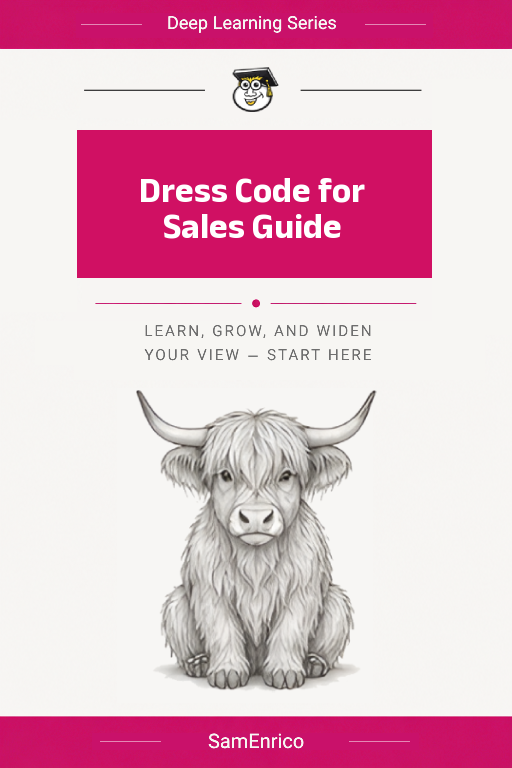
Non-FictionBusiness BriefDress Code
Dress Code for Sales Guide eBook
Wear conservative formal attire for B2B sales in S
Wear conservative formal attire for B2B sales in Saudi Arabia and Kuwait. Men suit and tie; women loose fitting long sleeves and high neckline.
Formats
Free sample
Chapter 1: The Seven-Second Verdict--Every sale begins before you speak a single word. This is not a metaphor or a motivational quote—it is a neurological fact. In the time it takes a receptionist to look up from her desk, a procurement director to glance over his reading glasses, or an executive assistant to wave you toward a waiting area, your fate has already been weighted. Not sealed, perhaps, but weighted. And the scale tipping that weight is not your product's features, your company's reputation, or your carefully rehearsed value proposition.
It is your collar. Your cuffs. The drape of your jacket. The height of your neckline. The polish on your shoes.This chapter dismantles the single most expensive misconception in international B2B sales: that attire is secondary to content.
In Saudi Arabia and Kuwait, your clothing is not a costume you wear to a meeting. It is the meeting's first document—a non-verbal contract signed in fabric and silhouette before you have shaken a single hand.The Seven-Second Research Base Decades of social psychology research, much of it conducted in cross-cultural business contexts, consistently demonstrates that humans form lasting first impressions within seven to seventeen seconds of initial encounter. A landmark study published in the Journal of Cross-Cultural Psychology found that in high-context cultures—including all Gulf Cooperation Council countries—this window narrows rather than widens. In low-context cultures like Germany or the Netherlands, where direct verbal communication dominates, a salesperson might receive thirty to sixty seconds of grace. In high-context Saudi Arabia and Kuwait, where meaning is carried through status, relationships, and non-verbal cues, the verdict arrives in less than ten seconds.Consider what happens in those seconds.
The client registers, in roughly this order: your silhouette from across the room, the quality of your fabric as you approach, the cleanliness of your grooming at handshake distance, and finally—only finally—the words coming out of your mouth. By the time you introduce yourself, the client has already categorized you as serious or frivolous, trustworthy or suspect, worth listening to or worth dismissing politely.The authors of the best-selling sales text The Trust Edge quantify this phenomenon through what they call the "Credibility Gap": the measurable difference between how salespeople perceive themselves and how clients perceive them. In surveys of B2B buyers across the Gulf, 94 percent stated that they prioritize trust over price or product features. When asked what generates that trust most quickly, the top three answers were not "technical knowledge," "references," or "presentation skills." They were: professional appearance, punctuality, and consistency of demeanor. In other words, how you look when you arrive matters more than what you know.The Western Anxiety Paradox Ask any expatriate sales representative preparing for their first meeting in Riyadh or Kuwait City what worries them most, and the answers follow a predictable pattern: "Will I offend anyone?" "What if I shake hands the wrong way?" "Is my suit too hot?" Buried beneath these surface concerns is a deeper anxiety rarely articulated aloud: the fear of being perceived as overdressed.This is the Western Anxiety Paradox.
In London, New York, or Sydney, wearing a full suit and tie to a meeting where the client wears business casual marks you as desperate, rigid, or out of touch. Sales cultures in Anglophone countries have spent twenty years relaxing dress codes in the name of authenticity and approachability. The result is a generation of sales professionals who have internalized the belief that formal attire is a handicap—something you tolerate for a court appearance or a wedding, not something you weaponize for commercial advantage.The paradox emerges when these same professionals land in the Gulf. They arrive carrying the unspoken assumption that business casual is the global default. They see their Kuwaiti or Saudi counterpart wearing a beautifully tailored thobe or dishdasha—a garment that is, by any objective measure, deeply formal.
The thobe is not casual wear. It is not loungewear. It is the traditional equivalent of a morning coat, rendered in breathable cotton or wool for desert temperatures. And yet, because it lacks a tie and a collar, the Western eye misreads it as relaxed. The visiting salesperson then makes the catastrophic error of mirroring what they believe they see: they wear chinos, a polo shirt, or—unforgivably—an open-collared shirt.The result is a mismatch so profound that it registers as disrespect.
The client thinks, This person did not bother to dress for me. The salesperson thinks, I am being approachable and authentic. Both are wrong about the other's intentions. The deal suffers.This book calls this phenomenon The Casualty of Casual—the millions of dollars in lost contracts and stalled negotiations that result from dressing down when the culture expects dressing up.Why Saudi and Kuwait Are Different Before proceeding, the book must address a question that every experienced salesperson will ask: Is this really different from selling in Dubai or Doha? The answer is yes, emphatically.
The United Arab Emirates and Qatar have built their economies on being cosmopolitan hubs where Western business casual has become normalized. A salesperson wearing chinos and a blazer in a Dubai Marina high-rise will not raise eyebrows. The same outfit in a Riyadh government ministry or a Kuwaiti family-owned trading company will be noted—and not favorably.Saudi Arabia and Kuwait share several cultural characteristics that elevate the importance of conservative formal attire beyond any other Gulf market:First, the centrality of the family-owned conglomerate. Unlike Dubai's proliferation of multinational branch offices and free-zone startups, the Saudi and Kuwaiti private sectors remain dominated by multi-generational family firms. These entities operate on relational trust built over decades.
Dressing formally signals that you understand the weight of a family's reputation and that you are treating the meeting with appropriate gravity.Second, the enduring influence of tribal and religious values. While Saudi Vision 2030 has accelerated social and economic reforms, the underlying cultural architecture remains deeply conservative. Modesty in dress is not merely a preference—it is a reflection of Haya, a concept we will explore in depth in Chapter 2. A salesperson who violates modesty norms is not committing a fashion faux pas; they are signaling a lack of social intelligence so profound that it raises questions about their judgment in business matters.Third, the physical environment. Desert heat that regularly exceeds 45 degrees Celsius creates a practical challenge: dressing formally is uncomfortable.
The salesperson who endures that discomfort signals commitment. The salesperson who sacrifices formality for comfort signals laziness. This is not a rational calculation that clients make consciously. It is an evolutionary heuristic: If this person cannot manage their own body under mild adversity, how can they manage my supply chain?The Silent Contract Defined The central thesis of this book is that attire in Saudi and Kuwaiti B2B sales operates as a Silent Contract—an unwritten but rigorously enforced agreement about what professional respect looks like. Unlike a written contract, which can be negotiated and amended, the Silent Contract is absolute.
It does not care about your intentions. It does not care about your track record in other markets. It only cares about what you are wearing at the moment you walk through the…
This is the end of the free sample. Get the eBook to keep going. Buy now
About this book
Details
- Author
- Aguirre Kiesha
- Publisher
- SamEnrico
- Language
- English
- Genre
- Non-Fiction, Business Brief, Dress Code
- Released
- 2026-06-01
- Pages (approx.)
- 156
- Available as
- eBook, Audiobook

Read better in the ZLOADR app
Your eBooks on your phone or tablet. Sign in with your SamEnrico account and start reading.
More by Aguirre Kiesha
 The Roommate ConfrontationAguirre Kiesha$11.99
 The Liking Persuasion MethodAguirre Kiesha$11.99
 Flight To Varennes AccountAguirre Kiesha$11.99
 Hypnosis Scripting GuideAguirre Kiesha$11.99
 Discussing Infidelity Recovery GuideAguirre Kiesha$11.99
 Opioid Recovery Relationship Repair WorkbookAguirre Kiesha$11.99
 Body Image For EndometriosisAguirre Kiesha$11.99
 Postpartum Anxiety Body Scanning GuideAguirre Kiesha$11.99
 Physical Therapy for Chronic Back Pain GuideAguirre Kiesha$11.99
 The Double Helix Diaries: The Race to Map Humanity’s CodeAguirre Kiesha$11.99
 Silk Roads and Secrets: The Forgotten Explorers of Central AsiaAguirre Kiesha$11.99
 Understanding AngiomaAguirre Kiesha$17.99
You may also like
 Hong Kong Handover 1997Dunn Johnnie$11.99
 Zumba For Postnatal Recovery CourseNeal Christian$11.99
 Zumba for BeginnersLadner Nikia$11.99
 YouTube Comment Mining GuideHumes Pandora$12.99
 Worry Box MeditationCarlin Rudy$11.99
 Workplace Stress MeditationNguyen Lynn$11.99
 Workplace Stress and Sleep RepairHawley Ivory$11.99
 Workplace Perfectionism CureDelaney Jeffry$11.99
 Workplace Injustice Anger GuideWallen Isabelle$11.99
 Work Addiction and Burnout LinkGreenwood Ester$11.99
 Women in Yoga and WellnessBeattie Galina$11.99
 Women in Stand Up ComedyChun Evangeline$11.99