
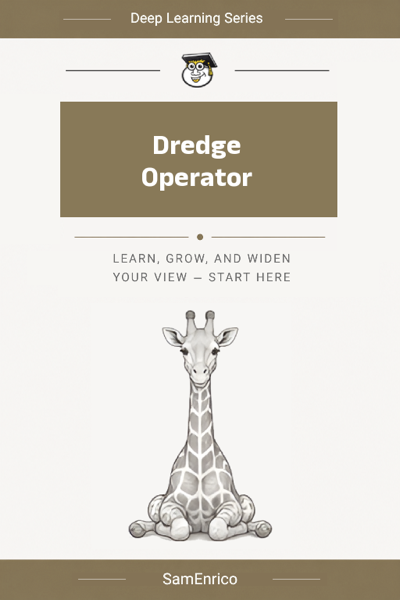
Dredge Operator eBook
A Coursebook on Dredge Operator
A Coursebook on Dredge Operator
Formats
Free sample
Chapter 1: Why We Dig--– The coffee in your hand this morning traveled 7,000 miles to reach you. It crossed two oceans, passed through three canals, and transferred between fourteen ships. Every single one of those ships required water deep enough to float. That depth did not come from nature. It came from a dredge.
Someone, somewhere, spent their night shift sucking sand and silt off the bottom so that a container vessel could pass without scraping its hull. You never saw that person. You never will. But without them, your coffee would have rotted on a dock in Cartagena.This is the invisible architecture of modern life. Every phone, every car, every piece of clothing, every grain of imported rice—all of it rides on dredged channels.
The global shipping industry moves 11 billion tons of cargo annually, and 90 percent of that volume travels by water. Not because ships are faster than planes—they aren’t. Not because they are more convenient than trucks—they aren’t. But because a single container ship can carry the equivalent of 15,000 trucks, and moving goods by water costs a fraction of any other method. That economic miracle depends entirely on channels deep enough, wide enough, and stable enough for the largest vessels afloat.Someone has to keep those channels open.
That someone is a dredge operator.The Question Most People Never Ask If you live within fifty miles of a coast, the odds are excellent that the nearest port performs dredging at least once a year. Rivers carry sediment downstream. Tides push sand into shipping lanes. Storms rearrange bottoms overnight. Even the most perfectly designed channel will fill itself back in if left alone.
Nature hates a hole. Gravity wants to fill every low spot, and water wants to carry whatever it can carry until it runs out of energy and drops its load. That load becomes a shoal. That shoal becomes a grounding. That grounding becomes a million-dollar salvage operation and a week of blocked trade.Dredging exists to fight that natural process.
It is not glamorous. It is not clean. It is not the kind of work that inspires Hollywood movies or bestselling memoirs. But it is essential in the same way that breathing is essential—unnoticed when it works, catastrophic when it stops.Before this book teaches you how to operate a dredge, it must first answer a more fundamental question: why does this job exist at all, and why should you care? The answer determines everything that follows.
If you understand why we dig, you will understand which dredge to use, where to place it, how deep to cut, and when to stop. If you do not understand why we dig, you are just moving dirt underwater—and that is a recipe for expensive mistakes.The Four Reasons We Dredge Every dredging project in human history falls into one of four categories. Learn these categories. They are the lens through which you will see every job site, every contract, and every decision an operator makes.Navigation Maintenance The oldest and largest category of dredging is simply this: keeping existing channels deep enough for the ships that use them. Ports do not stay the same depth year to year.
The Mississippi River delta, for example, deposits enough sediment each year to fill a football stadium to the height of the Empire State Building—every single week. Without constant dredging, the shipping channel from the Gulf of Mexico to Baton Rouge would become impassable for ocean vessels within eighteen months.Navigation maintenance dredging is predictable work. The same shoals form in the same places every year. The same currents deposit the same type of sediment. Experienced operators learn to anticipate where the trouble will appear before the survey boat confirms it.
This is the bread and butter of the dredging industry—steady, repetitive, and absolutely critical.But predictable does not mean easy. Maintenance dredging often happens in active shipping lanes, with container ships and tankers passing within a hundred feet of the dredge. The operator must maintain production while dodging traffic, working around tides, and avoiding the anchored vessels that seem to materialize out of fog. Night shifts are common. Weekend work is standard.
The channel does not care about your schedule.Capital Dredging Capital dredging is the opposite of maintenance. Instead of preserving what exists, capital dredging creates something new. A port decides to deepen its channel from forty feet to fifty feet to accommodate larger ships. A new terminal needs a turning basin where none existed. A canal is cut through an isthmus to connect two seas.These projects are massive, expensive, and high-stakes.
A capital dredging project for a major port can cost hundreds of millions of dollars and take years to complete. The operator is not just removing loose sediment—they are often cutting into compacted clay, glacial till, or even rock. The tolerances are tight. The penalties for over-dredging (removing too much material) can be as severe as the penalties for under-dredging (leaving too much behind). Over-dredge by six inches across a mile-long channel, and you have just removed thousands of cubic yards of material that the contract says you must pay to replace.Capital dredging demands precision, patience, and the ability to interpret complex engineering drawings.
The operator becomes a surgeon with a cutterhead, carving the seabed to a specific elevation while monitoring a dozen sensors and adjusting for tides that change the effective depth by the minute. It is the most challenging type of dredging—and the most rewarding for those who master it.Mining Dredging Not all dredging is about navigation. A significant portion of the industry exists purely to extract valuable material from the bottom of rivers, lakes, and oceans. Sand and gravel for concrete production. Tin, gold, and diamonds from river deltas.
Rare earth minerals from continental shelves. The dredge becomes a mining machine, and the operator becomes a miner.Mining dredging changes the economic calculation entirely. In navigation projects, the dredged material is a waste product—something to be disposed of as cheaply as possible. In mining, the dredged material is the revenue. The operator’s goal is not just to move volume but to maximize the recovery of valuable material while minimizing dilution from overburden or barren sediment.This requires a different mindset.
A navigation operator cares about density only as it relates to production efficiency. A mining operator cares about density because it tells them when they are in the pay zone and when they have cut through it. The sensors that seemed like abstract numbers in a training course become real-time profit indicators. A drop in density of 5 percent might mean the dredge has left the ore body and is now mining waste—burning fuel for zero return.Environmental Remediation The fourth category is the newest and the fastest-growing. Environmental dredging removes contaminated sediment from industrial waterways, harbors, and lakes.
Decades of pollution—PCBs, heavy metals, oil, and other toxins—settle into the bottom and become a continuing source of contamination for the water column and the food chain. Removing that sediment is often the only way to restore a waterway to health.Environmental dredging is the opposite of mining. In mining…
This is the end of the free sample. Get the eBook to keep going. Buy now
About this book
Details
- Author
- Vanmeter Maxwell
- Publisher
- SamEnrico
- Language
- English
- Genre
- Non-Fiction, Informative, Educational
- Released
- 2026-05-06
- Pages (approx.)
- 118
- Available as
- eBook, Audiobook

Read better in the ZLOADR app
Your eBooks on your phone or tablet. Sign in with your SamEnrico account and start reading.
More by Vanmeter Maxwell
 Marat Safin Enigmatic GeniusVanmeter Maxwell$11.99
 Low Carb Meal Prep GuideVanmeter Maxwell$11.99
 Menopause Fibroid GuideVanmeter Maxwell$11.99
 The Meadow Relaxation GuideVanmeter Maxwell$11.99
 Equifax Arbitration Clause OutrageVanmeter Maxwell$11.99
 The Unlikely Friendship That Saved a War: The Story of Two Soldiers and a ViolinVanmeter Maxwell$11.99
 The Hidden Antibiotic Hunters: Asia's War Against SuperbugsVanmeter Maxwell$11.99
 Remote Research Assistant ManualVanmeter Maxwell$12.99
 Bleisure Travel SpendingVanmeter Maxwell$12.99
 Understanding Gemss SyndromeVanmeter Maxwell$17.99
 How to Start a Primary Copper Business (Beginners Guide)Vanmeter Maxwell$11.99