
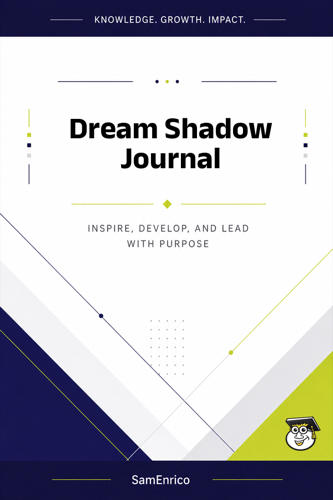
Non-FictionSelf-HelpShadow Work
Dream Shadow Journal eBook
Explore dark or disturbing dream content with Jung
Explore dark or disturbing dream content with Jungian techniques.
Formats
Free sample
Chapter 1: The Scale Never Lies...--You wake up with your heart slamming against your ribs like a prisoner demanding release. The clock reads 3:17 AM. The room is dark. Nothing is actually wrong – no intruder, no fire, no emergency – but your body doesn't know that. Your body is still back there, in the dream, running from something you can already feel slipping away from memory like water through clenched fists.You lie still, trying to catch the fragments.
A hallway. A door that shouldn't be there. A figure – someone, something – that wanted something from you. Or wanted to hurt you. Or both.
The details dissolve the harder you chase them, leaving only the residue: shame, dread, a vague sense that you've done something wrong without knowing what.If this has happened to you once, you're normal. If it happens regularly, you're exhausted. And if you've started to fear going to sleep – to dread the moment your head hits the pillow because you know what's waiting for you on the other side – then you are exactly the person this book was written for.Here is the first and most important thing you need to understand: your nightmare is not a curse. It is not a sign that you are broken, crazy, or secretly evil. It is not a premonition.
And despite what pop culture has taught you, it is almost never a literal warning about the future.Your nightmare is a letter. A difficult, badly written, screaming-in-all-caps letter from a part of yourself that has no other way to get your attention.This chapter is about learning to read that letter. Not to fear it. Not to suppress it. But to understand the algebra of the unconscious – what I call the Nightmare Math – that governs why the darkest dreams visit exactly when they do.The Great Reframe: From Warning to Negotiation Every spiritual and psychological tradition has tried to explain nightmares.
Ancient Mesopotamians thought they were messages from demons. Medieval Christians saw them as temptations from Satan. Freud believed they were disguised wishes (which, frankly, explained very little to the terrified dreamer). But the most useful framework – the one that actually helps people stop having the same nightmare over and over – comes from Carl Jung, a Swiss psychiatrist who spent decades listening to his own terrifying dreams.Jung noticed something strange. The people who came to him with the most disturbing nightmares were often the most put-together people in waking life.
They were successful, pleasant, kind, morally upright. They hadn't had a dark thought in years. They were, by all external measures, doing wonderfully.And yet their unconscious minds were screaming at them.Jung's insight was this: the psyche is a self-regulating system. When one part becomes too extreme – too bright, too rigid, too optimistic, too moral – another part compensates. The unconscious sends dark images specifically to balance a conscious attitude that has become one-sided.This is called the Compensatory Function.
It is the single most important concept in this entire book.Think of a thermostat. If your waking life is set to seventy-two degrees – calm, pleasant, productive – the unconscious doesn't need to send a nightmare. But if your waking life is cranked to ninety – relentless positivity, constant productivity, never allowing yourself to feel anger or sadness or envy – the thermostat doesn't just turn off. It blasts cold air directly into your face at three in the morning.Your nightmare is not an enemy. It is a physician with terrible bedside manner.Here is what this means in practice: when you wake up from a nightmare, your first instinct is to ask "Why did this happen to me?" or "What's wrong with me?" Those questions lead nowhere except shame and self-diagnosis on Web MD.The question you actually need to ask is different.
It is uncomfortable. And it is the only one that will set you free:"What is my waking life overlooking that my dream is screaming about?"This reframe – from "warning" to "negotiation" – changes everything. Your nightmare is not a prophecy of doom. It is an invitation to sit down at a table with a part of yourself you have been ignoring, and ask what it wants.The Persona Trap: Why Nice People Have Vicious Dreams Let me tell you about Sarah. (All names and identifying details in this book are changed, but the patterns are real.)Sarah was a thirty-four-year-old elementary school teacher.
She was beloved by her students, admired by her colleagues, and considered the rock of her family. Her husband described her as "the kindest person I've ever met." Sarah agreed with this assessment. She prided herself on never raising her voice, never holding a grudge, and never, ever being angry.Every night, Sarah dreamed of a woman made of black smoke who would chase her through her own house, smashing furniture and screaming obscenities at Sarah's children. The dream woman's face was always obscured, but her voice was unmistakable: low, cruel, and utterly without mercy.Sarah came to me convinced that the dream woman was a demon. She wanted to know how to pray her away.We sat down with her journal.
I asked her to describe her waking self in three words. She said: "Patient, kind, gentle."I asked her to describe the dream woman in three words. She said: "Raging, destructive, cruel."Then I asked the question that changed everything: "Sarah, when was the last time you were angry at anyone?"She paused. Then she started to cry. She hadn't been angry at anyone in years – not because she didn't have reasons, but because she had decided that a good person doesn't get angry.
She had been swallowing her rage like poison, smiling through every insult, every unfairness, every boundary violation.The dream woman was not a demon. The dream woman was Sarah's own rage, personified, given a voice and a face. The rage hadn't disappeared just because Sarah refused to feel it. It had gone underground, where it grew teeth.This is the Persona Trap. The Persona (from the Latin word for "mask") is the version of yourself you present to the world.
It is not fake – it is a real, necessary part of psychological health. But when your Persona becomes too rigid, when you refuse to let yourself be seen as anything other than kind, competent, or good, the unconscious responds by sending a Shadow figure that carries everything you've disowned.The heavier the Persona, the heavier the Shadow.Your nightmare is not random. It is not a glitch in your brain's software. It is a calibrated response to a specific imbalance in your waking life. The more extreme your daytime personality, the more extreme your nighttime terror.Nightmare Math: The Equation You Didn't Know You Were Solving Let me give you the formula explicitly.
It is simple enough to write on a sticky note, and profound enough to spend a lifetime understanding:The intensity of your nightmare = The degree of one-sidedness in your waking life × The amount of energy you spend maintaining your Persona If you are moderately one-sided – let's say you're a little too nice, a little too productive, a little too optimistic – your nightmares will be…
This is the end of the free sample. Get the eBook to keep going. Buy now
About this book
Details
- Author
- Spicer Kendall
- Publisher
- SamEnrico
- Language
- English
- Genre
- Non-Fiction, Self-Help, Shadow Work
- Released
- 2026-06-06
- Pages (approx.)
- 134
- Available as
- eBook, Audiobook

Read better in the ZLOADR app
Your eBooks on your phone or tablet. Sign in with your SamEnrico account and start reading.
More by Spicer Kendall
 Stress Management for Long Distance LoveSpicer Kendall$11.99
 Before Meeting Breath FocusSpicer Kendall$11.99
 Listening In Aviation GuideSpicer Kendall$11.99
 Joyful Parenting Through GratitudeSpicer Kendall$11.99
 The Delegation FearSpicer Kendall$11.99The Delegation FearSpicer Kendall$11.99
 Mental Health First Aid TrainingSpicer Kendall$11.99
 Athlete Master GuideSpicer Kendall$11.99
 The Grape HarvestSpicer Kendall$11.99
 The Silk and Steel Diaries: How a Spinster Outwitted the TonSpicer Kendall$11.99
 Whispers in the Dark: The Forgotten Uprising of the MaroonsSpicer Kendall$11.99
 Jutland: The Unfinished Symphony of Steel and FireSpicer Kendall$11.99
You may also like
 Hong Kong Handover 1997Dunn Johnnie$11.99
 Zumba For Postnatal Recovery CourseNeal Christian$11.99
 Zumba for BeginnersLadner Nikia$11.99
 YouTube Comment Mining GuideHumes Pandora$12.99
 Worry Box MeditationCarlin Rudy$11.99
 Workplace Stress MeditationNguyen Lynn$11.99
 Workplace Stress and Sleep RepairHawley Ivory$11.99
 Workplace Perfectionism CureDelaney Jeffry$11.99
 Workplace Injustice Anger GuideWallen Isabelle$11.99
 Work Addiction and Burnout LinkGreenwood Ester$11.99
 Women in Yoga and WellnessBeattie Galina$11.99
 Women in Stand Up ComedyChun Evangeline$11.99