
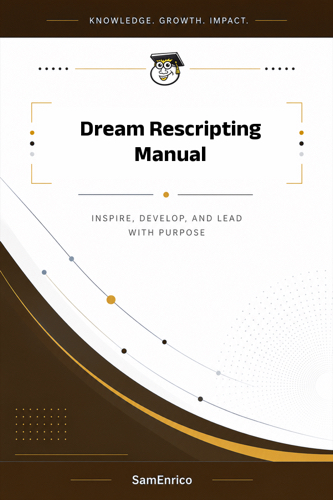
Non-FictionSelf-HelpRescriptingImagery
Dream Rescripting Manual eBook
Rewrite distressing dream endings during waking ho
Rewrite distressing dream endings during waking hours to change nightmare outcomes.
Formats
Free sample
Chapter 1: The 3 AM Terror--Every night, millions of people wake up at 3:00 AM with their hearts pounding, sheets soaked with sweat, and an unshakable sense that something terrible is about to happen. They lie in the darkness, afraid to close their eyes, because they know what waits for them on the other side of sleep. Another nightmare. The same one. Or a new one with the same feeling of helplessness, the same chase, the same falling, the same face at the window.If this is you, you are not broken.
You are not weak. And you are certainly not alone.The Hidden Epidemic of Nightmares Clinical nightmare disorder affects approximately four percent of adults worldwide. That is over 300 million people. In the United States alone, more than ten million adults suffer from nightmares that significantly impair their daily functioning. Yet despite these staggering numbers, nightmare disorder remains one of the most underdiagnosed and undertreated conditions in mental health.Why?
Because most people believe nightmares are "just dreams." They are told to "get over it," "stop watching scary movies," or "try not to think about it before bed." Some are prescribed medications that may suppress REM sleep temporarily but do nothing to address the underlying mechanism. Others spend years in talk therapy exploring the "meaning" of their nightmares, only to find that understanding why they have the nightmare does not make it stop.The truth is that nightmares are not just dreams. They are a specific neurological phenomenon that follows predictable patterns, responds to specific interventions, and—most importantly—can be stopped.What This Chapter Will Do for You By the end of this chapter, you will understand the difference between a bad dream and a clinical nightmare. You will learn why your brain gets trapped in a loop of repeating terror. You will take a simple self-assessment to determine whether this book is right for you.
And you will receive a promise: the solution to your nightmares does not require medication, expensive therapy, or learning to control your dreams while asleep. It requires a specific waking cognitive exercise that you can learn in fifteen minutes and practice in ten minutes a day.Let us begin by understanding what is actually happening to you at 3:00 AM.The Anatomy of a Nightmare A clinical nightmare is not simply an unpleasant dream. The diagnostic criteria established by the American Academy of Sleep Medicine and the American Psychiatric Association's Diagnostic and Statistical Manual of Mental Disorders (DSM-5) include four specific features.First, the dream is extended, complex, and story-like. It is not a fragment or a single image. It unfolds over time, often with a clear sequence of events—a beginning where things are normal or only slightly unsettling, a middle where tension builds, and an end where terror peaks and wakes you up.Second, the dream involves threats to survival, security, or physical integrity.
These threats can be realistic—being chased, attacked, falling, drowning, trapped in a burning building—or fantastic—monsters, demons, supernatural forces, apocalyptic scenarios. The key is that the dreamer experiences genuine fear, not just unease.Third, the dreamer wakes up from the dream quickly and fully, not gradually. Nightmare awakening is abrupt. One moment you are being chased through a dark forest; the next moment your eyes are open, your heart is racing, and you are staring at your bedroom ceiling. This distinguishes nightmares from bad dreams, which may be unpleasant but do not cause abrupt awakening.Fourth, upon awakening, the dreamer is oriented and alert, not confused or disoriented.
This may seem like a minor detail, but it is clinically significant. Nightmare sufferers wake up knowing exactly where they are and what just happened. The distress is not confusion—it is fear.The Critical Difference Between a Bad Dream and a Clinical Nightmare Many people use the words "nightmare" and "bad dream" interchangeably. For clinical purposes, the distinction matters enormously.A bad dream is an unpleasant dream that does not wake you up. You might remember it briefly upon waking in the morning, feel unsettled for a few minutes, and then go about your day.
Bad dreams are normal. Everyone has them. They are not a disorder.A clinical nightmare wakes you up. And once you are awake, you have difficulty falling back asleep. You lie there, heart pounding, replaying the dream in your mind, afraid that if you close your eyes you will go right back into it.
The next day, you are exhausted. You feel anxious. You may start dreading bedtime hours before it arrives.This is the key differentiator: sleep interruption and next-day impairment. A bad dream is a minor nuisance. A clinical nightmare is a sleep disorder that affects your waking life.If you are reading this book, you likely know which category you fall into.
But let us be precise.The Self-Assessment Checklist Take a moment to answer these five questions honestly. There is no judgment here. The answers simply help you understand where you are.One. In the past month, have you had a dream that woke you up with feelings of fear, terror, or extreme anxiety?Two. After waking from such a dream, did you have difficulty falling back asleep?Three.
On the day after such a dream, did you experience significant fatigue, daytime sleepiness, anxiety, irritability, or difficulty concentrating?Four. Have you started avoiding sleep-related activities, such as going to bed at your normal time, because you fear having another nightmare?Five. Have these experiences been happening at least once per week for the past three months?If you answered yes to at least two of the first three questions, and yes to question five, you may have clinical nightmare disorder. If you also answered yes to question four, the disorder is significantly impacting your quality of life.If you answered yes to question one but no to question two or three, you may be experiencing occasional bad dreams rather than a clinical disorder. The techniques in this book will still help you, but you may see results faster than someone with full nightmare disorder.If you answered no to question one, you likely do not need this book.
Consider giving it to someone who does.The Nightmare Loop: Why Your Brain Gets Stuck Now we arrive at the central mystery. Why do nightmares repeat? Why does the same terrifying sequence play out night after night, sometimes for years or decades?The answer lies in how the brain processes emotional memories during sleep.During normal REM sleep—the stage of sleep in which most vivid dreaming occurs—the brain performs a crucial housekeeping function called fear memory consolidation. Throughout the day, your amygdala (the brain's fear center) tags certain experiences as emotionally significant. That argument with your spouse.
The near-miss on the highway. The anxious moment before a presentation.During REM sleep, the hippocampus (the brain's memory center) takes those tagged experiences and integrates them into your long-term memory stores. But crucially, it also changes their emotional valence. A memory that was terrifying when it happened becomes, after proper REM processing, a memory that is factual but not frightening. You remember that you were scared, but you do not feel scared when…
This is the end of the free sample. Get the eBook to keep going. Buy now
About this book
Details
- Author
- Christopher Twila
- Publisher
- SamEnrico
- Language
- English
- Genre
- Non-Fiction, Self-Help, Rescripting, Imagery
- Released
- 2026-06-10
- Pages (approx.)
- 140
- Available as
- eBook, Audiobook

Read better in the ZLOADR app
Your eBooks on your phone or tablet. Sign in with your SamEnrico account and start reading.
More by Christopher Twila
 Behavioral Addiction in ConstructionChristopher Twila$11.99
 The Grandparent Raising Grandkids GuideChristopher Twila$11.99
 Afternoon Slump PreventionChristopher Twila$11.99
 The Leprosy Crusader: Paul Brand's Mission to Heal in IndiaChristopher Twila$11.99
 Enkidu's Lament: The Forgotten Heart of GilgameshChristopher Twila$11.99
 Aircraft MaintenanceChristopher Twila$11.99
 Understanding Hepatorenal TyrosinemiaChristopher Twila$17.99
 State By State LLC Registration GuideChristopher Twila$12.99
 E-Commerce AI Agent OutlookChristopher Twila$12.99
 How to Start a Hobby in ModelsChristopher Twila$11.99
You may also like
 Hong Kong Handover 1997Dunn Johnnie$11.99
 Zumba For Postnatal Recovery CourseNeal Christian$11.99
 Zumba for BeginnersLadner Nikia$11.99
 YouTube Comment Mining GuideHumes Pandora$12.99
 Worry Box MeditationCarlin Rudy$11.99
 Workplace Stress MeditationNguyen Lynn$11.99
 Workplace Stress and Sleep RepairHawley Ivory$11.99
 Workplace Perfectionism CureDelaney Jeffry$11.99
 Workplace Injustice Anger GuideWallen Isabelle$11.99
 Work Addiction and Burnout LinkGreenwood Ester$11.99
 Women in Yoga and WellnessBeattie Galina$11.99
 Women in Stand Up ComedyChun Evangeline$11.99