
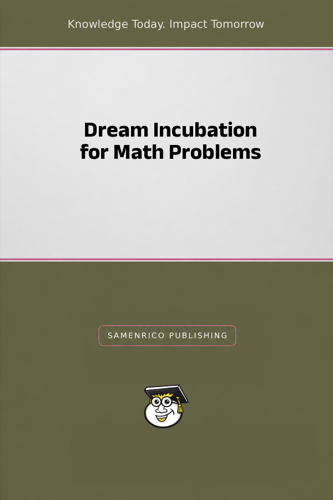
Non-FictionSelf-HelpMathematical Problem Solving
Dream Incubation for Math Problems eBook
Let unconscious mind solve equations you struggled
by Marcus Wai
Let unconscious mind solve equations you struggled with awake.
Formats
Free sample
Chapter 1: The Midnight Mathematician...--–- It begins, as most impossible things do, with a failure.Not a dramatic failure. Not a fire, not a failed exam that ends a career, not a public humiliation. Just the slow, grinding failure of staring at a single equation for four hours while the afternoon light shifts to evening, then to the blue glow of a lamp, then to the dim hour when you realize you have made no progress whatsoever. Your notes are a graveyard of crossed-out attempts. The margin of your textbook is filled with question marks that grow more aggressive with each passing hour.
You have tried every method you know. You have retraced your steps. You have started over from scratch three times. And still, the equation sits there, unchanged, uncracked, silently mocking the limits of your conscious mind.This is the moment when most people give up. They close the book, turn off the light, and tell themselves they will try again tomorrow.
And tomorrow, predictably, the same thing happens. The same fixation. The same dead ends. The same sense that the solution is hovering just out of reach, like a word on the tip of your tongue that refuses to be spoken.But then something strange occurs. Perhaps it has happened to you.
You go to sleep, frustrated and defeated. And in the middle of the night, or in that liminal space just before waking, your dreaming mind serves up an answer. Not always the full answer, but a clue. A new path. A different way of seeing the problem.
You wake up, scribble something on the nearest piece of paper, and fall back asleep. In the morning, you look at what you wrote and think: Where did that come from?That question—where did that come from?—is the subject of this book.The answer, as you may have guessed, is not magic. It is not divine intervention, nor is it some rare gift possessed only by geniuses like Einstein or Ramanujan. It is a neurological process that every single human brain performs every single night. Your unconscious mind is, right now, while you read these words, quietly reorganizing your memories, testing novel connections, and simulating solutions to problems you have not even consciously recognized as problems.
The trick—and this book exists to teach you the trick—is learning how to aim that extraordinary machine at the specific equations, proofs, and logical puzzles that resist your waking efforts.This chapter will establish the foundational paradox of dream incubation for mathematics: why your conscious, focused, deliberate mind so often fails at precisely the kinds of problems your sleeping mind can solve with startling ease. We will explore the cognitive mechanism called the Einstellung effect, which explains why staring longer at a problem often makes you less likely to solve it. We will differentiate between the two sleep states that matter for mathematical insight—NREM sleep, which consolidates what you already know, and REM sleep, which builds the novel bridges between distant ideas. And we will ground this entire enterprise in historical case studies of mathematicians and scientists who made genuine breakthroughs while asleep, including Dmitri Mendeleev's periodic table dream and Mary Cartwright's work on chaotic differential equations. Finally, we will clarify what this book is not: it is not a general guide to lucid dreaming, not a spiritual exploration of dream symbolism, and not a collection of mystical claims.
It is a practical, evidence-based manual for turning your sleeping brain into a mathematical problem-solving partner.By the end of this chapter, you will understand why dream incubation works. The rest of the book will teach you how to do it reliably.The Paradox of Effort Let us begin with a simple experiment. Try to solve the following problem in your head: A bat and a ball cost one dollar and ten cents in total. The bat costs one dollar more than the ball. How much does the ball cost?If you are like most people, the answer that leaps immediately to mind is ten cents.
Ten cents feels right. It is intuitive, effortless, and almost certainly wrong. The correct answer is five cents. If the ball costs five cents and the bat costs one dollar more, the bat costs one dollar and five cents, for a total of one dollar and ten cents. The intuitive answer—ten cents—fails because your brain substituted a simpler question: What is one dollar and ten cents minus one dollar?
This is the Einstellung effect in miniature: the activation of a familiar but incorrect solution path that blocks access to the correct one.Now imagine that same cognitive trap, not on a simple riddle, but on a differential equation, a geometric proof, or a number theory problem you have been wrestling with for days. Your brain, being an efficient organ, loves familiar paths. It has learned, through years of mathematical training, that certain operations lead to certain results. When you encounter a new problem that resembles an old one, your brain automatically retrieves the old solution strategy. This is normally a good thing.
It is what allows you to solve routine problems quickly. But when the problem is non-routine—when it requires a genuine creative leap—that automatic retrieval becomes a prison. You keep applying the same method, getting the same dead end, and assuming you simply need to apply it more carefully or more persistently. You do not. You need a different method.
And your conscious mind, locked into its familiar pathways, cannot see it.This is the paradox of effort. Up to a certain point, more effort produces better results. Study longer, practice more, review your notes again—these actions improve performance on familiar problems. But beyond that point, more effort produces worse results. You become fixated.
Your working memory fills with the same failed approaches. Your stress level rises, which narrows your cognitive focus even further. And eventually, you find yourself exactly where we began: staring at an equation at midnight, unable to see the obvious solution that will come to you in a dream three hours later.The German psychologist Karl Duncker first studied this phenomenon in the 1940s, and he gave it a name that captures its cruel irony. The Einstellung effect comes from the German word for attitude or set. It refers to the brain's tendency to stick with a problem-solving set even when a better set exists.
Duncker's classic experiment involved a candle, a box of thumbtacks, and a book of matches. Participants were asked to attach the candle to a wall so that it would burn without dripping wax on the floor. Most participants tried to tack the candle directly to the wall (it crumbled) or melt wax to glue it (it fell). The solution was to empty the thumbtack box, tack it to the wall, and use it as a shelf for the candle. But participants who had first seen the box used as a container could not see it as a shelf.
The initial function blocked the novel function.Mathematics is full of Einstellung traps. Every time you learn a new technique—integration by parts, Gaussian elimination, proof by induction—you gain a…
This is the end of the free sample. Get the eBook to keep going. Buy now
About this book
Details
- Author
- Marcus Wai
- Publisher
- SamEnrico
- Language
- English
- Genre
- Non-Fiction, Self-Help, Mathematical Problem Solving
- Released
- 2026-06-07
- Pages (approx.)
- 144
- Available as
- eBook, Audiobook

Read better in the ZLOADR app
Your eBooks on your phone or tablet. Sign in with your SamEnrico account and start reading.
More by Marcus Wai
 Menopause Sleep MeditationMarcus Wai$11.99
 Downsizing Your Sports and Hobby GearMarcus Wai$11.99
 Eartha Kitt Holiday TalesMarcus Wai$11.99
 Loneliness Recovery for SeniorsMarcus Wai$11.99
 Interviews With CharacterMarcus Wai$11.99
 Morning Routine for Data ScientistsMarcus Wai$11.99
 Menopause And Diabetes RiskMarcus Wai$11.99
 The Silent Storm: Hiram Revels and the Rebirth of a NationMarcus Wai$11.99
 The Children of the Black Sun: A Cult’s War Over Parenthood in Prohibition EuropeMarcus Wai$11.99
 Service Providers Guide to Business BrokersMarcus Wai$11.99
 Child Benefits for Student ParentsMarcus Wai$12.99
 BSCI Audit Export GuideMarcus Wai$12.99
You may also like
 Hong Kong Handover 1997Dunn Johnnie$11.99
 Zumba For Postnatal Recovery CourseNeal Christian$11.99
 Zumba for BeginnersLadner Nikia$11.99
 YouTube Comment Mining GuideHumes Pandora$12.99
 Worry Box MeditationCarlin Rudy$11.99
 Workplace Stress MeditationNguyen Lynn$11.99
 Workplace Stress and Sleep RepairHawley Ivory$11.99
 Workplace Perfectionism CureDelaney Jeffry$11.99
 Workplace Injustice Anger GuideWallen Isabelle$11.99
 Work Addiction and Burnout LinkGreenwood Ester$11.99
 Women in Yoga and WellnessBeattie Galina$11.99
 Women in Stand Up ComedyChun Evangeline$11.99