
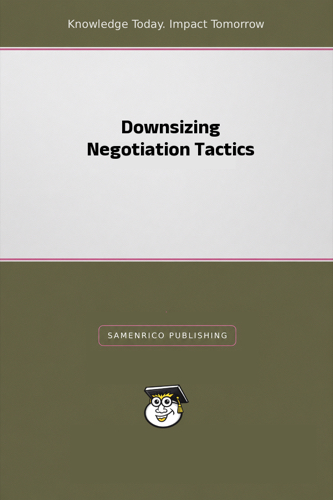
Downsizing Negotiation Tactics eBook
Leverage multiple offers and contingencies when bu
Leverage multiple offers and contingencies when buying retirement home.
Formats
Free sample
Chapter 1: The Empty Nest Advantage--–- Every negotiation begins before you say a single word. It begins with how you see yourself. If you believe you are desperate, you will negotiate like a desperate person—conceding too much, moving too fast, and leaving money on the table. If you believe you have options, you will negotiate from strength, patience, and clarity. This chapter exists to rewire your self-perception completely.You are about to make one of the largest financial transactions of your life.
The difference between a weak offer and a strong one is not actually about cash—it is about leverage. And leverage, in real estate, is rarely what you think it is. Most downsizers walk into their first negotiation carrying an invisible weight: the belief that because they need to sell their current home before buying the next one, they are somehow damaged goods. They apologize for their contingency. They offer above asking price to compensate for their perceived weakness.
They accept unfavorable terms because they are afraid of losing the house.This chapter is going to prove that everything you just read is backwards.The Empty Nest Advantage is not a marketing phrase. It is a specific set of strategic advantages that first-time buyers, investors, and even cash buyers do not possess. You have three distinct forms of leverage that have nothing to do with how much money you have in the bank. Those three advantages are: geographic flexibility, temporal flexibility, and emotional authenticity. When combined, they transform what appears to be a weakness—the need to sell first—into a weapon that can extract thousands of dollars in concessions from motivated sellers.We are going to spend this entire chapter building your new negotiation identity.
By the time you finish, you will never again apologize for being a downsizer. You will understand why some retirees get the deal and others overpay by 5-8 percent. And you will have a clear framework for deciding when to use warmth and when to use pressure—because the single biggest mistake downsizers make is using the wrong tone with the wrong seller.The Three Myths That Keep Downsizers Stuck Before we build your new mindset, we have to tear down the old one. The real estate industry, for all its usefulness, has fed downsizers three dangerous myths that directly contradict the actual data on negotiation outcomes.Myth One: Contingent buyers are less attractive than non-contingent buyers.This is true only if you ignore closing costs, financing risk, and seller psychology. A cash buyer with a seven-day inspection period and no financing contingency is attractive—until they discover mold in the attic and walk away with no penalty.
A contingent buyer who has already sold their home (or has a bridge loan pre-approval) is actually safer for many sellers because their motivation to close is higher. The chapter on contingency overlays will give you the tools to prove this mathematically.Myth Two: The faster you close, the better your offer.Only if the seller needs speed. Many sellers need the opposite: time. They are building a new home that will not be ready for ninety days. They are waiting for their own children to finish the school year.
They are coordinating a cross-country move with an employer's relocation package. For these sellers, a downsizer who can offer a slow, flexible closing is more valuable than any cash buyer demanding possession in fourteen days. This is the essence of temporal leverage, which we will explore in depth later in this chapter.Myth Three: Emotional appeals make you look weak.This myth has cost downsizers more money than any other. In negotiation research, the concept of "perspective-taking"—genuinely understanding and acknowledging the other party's emotional state—consistently produces better outcomes than purely rational bargaining. Sellers are human beings.
Many of them are selling homes filled with decades of memories. They want to know that the next owner will appreciate what they are leaving behind. An authentic emotional connection, deployed correctly, can bridge gaps that logic cannot.These myths persist because they benefit real estate agents who want simple, repeatable scripts and investors who want to scare off emotional buyers. You are neither. You are a strategic downsizer, and you will operate with more nuance than the average buyer.Geographic Flexibility: The Leverage Nobody Talks About First-time buyers are trapped.
They cannot move to a different school district without rearranging their children's entire lives. They cannot add thirty minutes to their commute without sacrificing family dinner. Their geographic range is narrow, and every seller's agent knows it.You have no such constraints. You are buying a retirement home. You do not need schools.
You do not have a commute. You can move to the next town, the next county, or the next state without changing a single thing about your daily life except the view from your window.Here is what that freedom does in a negotiation: it allows you to walk away. And the willingness to walk away is the single most powerful negotiation tool that exists.When a seller's agent senses that a buyer has fallen in love with a specific property—that they have already imagined their furniture in the living room, that they have told their friends about the house—that buyer has lost all leverage. The seller knows they can hold firm on price because the buyer is emotionally committed.You, as a downsizer, should never fall in love with a property you do not yet own. You should like it.
You should see its potential. You should be ready to buy it at the right price. But you should also have a list of three to five alternative properties that you would be almost as happy to purchase. When the seller asks for a counteroffer, you should be able to say, without a hint of desperation, "We like your home, but we also like the one on Maple Street. If we cannot reach an agreement here, we will pursue that one instead."This is not a bluff.
It is a genuine reflection of your geographic flexibility. And it works because the seller knows you have options they do not.Case Study: The Empty Nesters Who Walked Away Twice Mark and Diane, ages sixty-two and fifty-nine, wanted to downsize from their four-bedroom suburban home to a two-bedroom condo near the coast. They identified three properties they liked. On the first property, the seller refused to budge on a $425,000 asking price that comps suggested was worth $395,000. Mark and Diane walked away.
The property sold four months later for $390,000. On the second property, the seller agreed to a $400,000 price but refused to include the washer, dryer, and custom window treatments. Diane said, "We have another property to see this afternoon. Call us if you change your mind." The seller called back within two hours. They closed at $398,000 with all appliances included.
The third property—the one they used as leverage—was never seriously in consideration. It simply existed as an option, and that existence gave Mark and Diane the courage to say no twice.Temporal Flexibility: Why Your Timeline Is a Weapon, Not a Weakness Most buyers need to close on a specific date…
This is the end of the free sample. Get the eBook to keep going. Buy now
About this book
Details
- Author
- Beckham Blaine
- Publisher
- SamEnrico
- Language
- English
- Genre
- Non-Fiction, Business Brief, Negotiation
- Released
- 2026-06-08
- Pages (approx.)
- 146
- Available as
- eBook, Audiobook

Read better in the ZLOADR app
Your eBooks on your phone or tablet. Sign in with your SamEnrico account and start reading.
More by Beckham Blaine
 Hostage Negotiator Stress ControlBeckham Blaine$11.99
 Tailbone Pain ReliefBeckham Blaine$11.99
 Creative Process For AnalystsBeckham Blaine$11.99
 Social Entrepreneur Grant Writing GuideBeckham Blaine$11.99
 The Bone Heist: Uncovering the Secrets of the Pacific's First PeopleBeckham Blaine$11.99
 Whispers of the Ancient Seas: The Lost Library of Alexandria’s Final HopeBeckham Blaine$11.99
 Understanding Factor Xi Deficiency, CongenitalBeckham Blaine$17.99
 Physical Therapy AssistantBeckham Blaine$11.99
 Data Presentation Checklist Before You ShareBeckham Blaine$12.99
 China Brazil Dropshipping GuideBeckham Blaine$12.99
 How to Start a Cycles (wholesale) Business (Beginners Guide)Beckham Blaine$11.99
You may also like
 The Retirement Housing Negotiation ScriptsNg Hans$11.99
 Retail Space Lease NegotiationSaylor Patrick$11.99
 Upwork Contract NegotiationSheets Heriberto$11.99
 Upwork Client NegotiationMears Sherrell$11.99
 Getting To Yes Method GuideBatten Janey$11.99
 The Retirement Housing Negotiation PrimerSweet Loris$11.99
 Freelance Rate Negotiation ScriptsStanley Lynette$11.99
 Wholesaling Negotiation Scripts GuideMarble Daniella$11.99
 Overconfidence in NegotiationValles Stephaine$11.99
 Anchoring Effect StrategiesCharlton Octavia$11.99
 The Reciprocity EffectCorbin Charla$11.99
 Leaseback and Rent Back NegotiationChaffin Noelia$11.99