
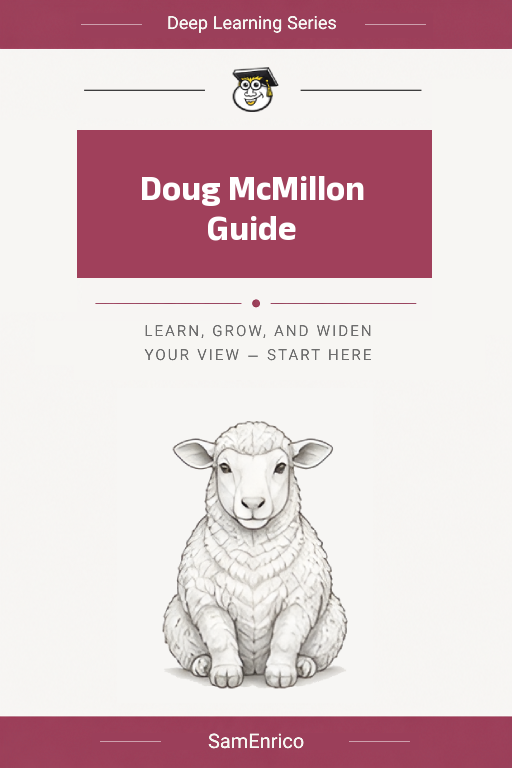
Non-FictionStrategic AtlasRetail Leadership
Doug McMillon Guide eBook
Decode Walmart CEO focus on e-commerce catch-up, g
Decode Walmart CEO focus on e-commerce catch-up, grocery strength, automation investment, and international growth.
Formats
Free sample
Chapter 1: The Repentant Insider--–- The truck roared to life at 4:47 AM on a humid Tulsa morning in June 1984. An eighteen-year-old Doug Mc Millon, wearing jeans soaked through with sweat before his shift even began, climbed onto the loading dock of Walmart Distribution Center #6017. His job was simple: grab boxes from the conveyor belt, stack them onto pallets, and shrink-wrap the results before the next truck arrived. It was hot, loud, and mind-numbingly repetitive. A supervisor later recalled that Mc Millon never complained, never asked for an easier assignment, and never missed a shift.
He simply worked. Thirty years later, that same man would sit in a boardroom in Bentonville, Arkansas, and tell the directors of the world's largest retailer: "I helped build the machine that can't turn. Now I have to break it and rebuild it. And I need your permission to fail along the way."This chapter is not a hagiography. It is not the story of a noble outsider who rode in from Silicon Valley to save a dinosaur.
It is the story of a man who rose through the ranks of Walmart for three decades, who defended its culture, who signed off on its mistakes, and who—only after failing in his own international division—realized that the company he loved was sleepwalking toward obsolescence. The Doug Mc Millon of 2014 was not a savior. He was a repentant insider. And that distinction, this chapter will argue, is the single most important factor in understanding why Walmart survived the retail apocalypse while Sears, JCPenney, and Kmart did not.The Unloading Dock Education (1984-1991)Mc Millon did not arrive at Walmart through a prestigious MBA recruitment program. He arrived because his father worked for the company, because he needed summer money, and because the distribution center was hiring anyone with a pulse and a willingness to lift fifty-pound boxes for eight hours straight.
The work was brutal by modern standards. Temperatures on the loading dock regularly exceeded 100 degrees Fahrenheit. The conveyor belt never stopped, not even when someone dropped a box of glass jars and shattered them across the floor. You cleaned it up while the belt kept moving. You learned to work fast, work clean, and never make the same mistake twice.What Mc Millon learned in those early years was not strategy or finance.
It was empathy. He learned what it felt like to have a supervisor scream at you because a pallet was wrapped incorrectly. He learned what it meant to clock out after a twelve-hour shift with sore shoulders and a boss who didn't care. He learned that the people who worked on the loading dock were not "labor costs" or "headcount reductions." They were fathers, mothers, teenagers saving for college, and retirees who couldn't afford to stop working. Decades later, when Mc Millon would advocate for higher wages and better working conditions, his critics would call it political posturing.
But anyone who had known him since 1984 understood: he remembered the loading dock.After two summers of unloading trucks, Mc Millon transferred to a Walmart store in Tulsa as an hourly associate. He stocked shelves, ran the register, and cleaned the bathrooms. Then he became a buyer trainee for fishing tackle—a notoriously low-prestige category. Fishing tackle, in Walmart's hierarchy, was where they sent people who weren't ready for electronics or apparel. Mc Millon treated it like a Ph D program.
He learned the supply chain for hooks, lines, and sinkers. He learned how vendors lied about inventory. He learned how a one-week delay in shipping could empty an entire shelf and send customers to the Kmart across the street. By the time he was promoted to store manager in Tulsa, he had touched nearly every part of the business except the executive suite.The International Crucible (1991-2009)Mc Millon's rise was steady but unspectacular. He moved from store manager to regional manager to divisional merchandise manager.
He was known as a hard worker but not a genius, a loyal company man but not a visionary. In 1991, Walmart sent him to work on international expansion—a backwater assignment at the time. The company had tried and failed to enter Brazil, had retreated from Germany after a $1 billion disaster, and was losing money in China. Most executives treated international as a punishment post. Mc Millon saw it as an education.He moved his family to Mexico in 1993 to help launch Walmart's joint venture with Cifra.
He learned Spanish badly but persistently. He learned that Mexican consumers wanted fresh produce daily, not weekly. He learned that the supply chain that worked in Tulsa failed completely in Monterrey because the roads were worse and the refrigeration was unreliable. He learned that cultural arrogance—assuming what worked in Arkansas would work anywhere—was the fastest way to lose hundreds of millions of dollars. Years later, he would tell a Harvard Business School case writer: "International taught me humility.
I thought I knew retail. Then I tried to sell Christmas decorations in Brazil in December, when it's 95 degrees and everyone is at the beach. I knew nothing."By 2005, Mc Millon had been promoted to CEO of Sam's Club, Walmart's warehouse division. He was known as a safe pair of hands, not a revolutionary. Sam's Club was a profitable but sleepy business, overshadowed by the massive Walmart Supercenters.
Mc Millon ran it competently, increased membership revenue, and didn't break anything. The board noticed. In 2009, they named him CEO of Walmart International, the very division that had been a graveyard for executive careers just a decade earlier.The Failure That Changed Everything (2009-2014)This is the part of the story that most business books omit. Mc Millon's tenure as CEO of Walmart International was, by his own later admission, a failure. Not a catastrophic, headline-grabbing failure like the German retreat.
A slow, grinding, death-by-a-thousand-cuts failure. Under his watch, Walmart lost market share in China to Alibaba's emerging e-commerce platform. It failed to launch a meaningful online presence in Brazil. It retreated from South Korea. It sold its majority stake in Japan.
The international division's growth stalled, and Mc Millon had no answer.What went wrong? Mc Millon later identified three specific failures. First, he treated e-commerce as an add-on rather than a replacement for physical stores. Walmart International had an online division, but it was underfunded, understaffed, and ignored by the country managers who still believed that "retail is detail" meant stacking pallets higher, not building better websites. Second, he allowed local managers too much autonomy without enough accountability.
Each country ran its own e-commerce strategy, leading to a fragmented mess where nothing could scale. Third, and most painfully, he was too slow to recognize that Amazon and Alibaba were not just competitors—they were existential threats. He later told a reporter: "I watched Alibaba's Singles' Day sales numbers in 2012 and thought, 'That's a one-day anomaly.' It wasn't. It was the future. And I was too comfortable to see it."The board did not fire Mc Millon.
They did not even reprimand him publicly. But privately, they began to doubt whether he had the vision to lead the entire company. When Mike Duke announced his retirement as Walmart CEO in…
This is the end of the free sample. Get the eBook to keep going. Buy now
About this book
Details
- Author
- Buffington Cinda
- Publisher
- SamEnrico
- Language
- English
- Genre
- Non-Fiction, Strategic Atlas, Retail Leadership
- Released
- 2026-05-29
- Pages (approx.)
- 133
- Available as
- eBook, Audiobook

Read better in the ZLOADR app
Your eBooks on your phone or tablet. Sign in with your SamEnrico account and start reading.
More by Buffington Cinda
 Indonesia Consumer GuideBuffington Cinda$11.99
 Estate Planning for Single ParentsBuffington Cinda$11.99
 Water Phobia RecoveryBuffington Cinda$11.99
 Affirmations For Depression GuideBuffington Cinda$11.99
 The Persuasive Classroom ManagementBuffington Cinda$11.99
 The Timbuktu Scholars: Masters of the Mathematical UniverseBuffington Cinda$11.99
 BioinformaticianBuffington Cinda$11.99
 How to Become a Driver-utility WorkerBuffington Cinda$11.99
 Video Ad First Campaign GuideBuffington Cinda$12.99
 Understanding Paget Disease ExtramammaryBuffington Cinda$17.99
You may also like
 Hong Kong Handover 1997Dunn Johnnie$11.99
 Zumba For Postnatal Recovery CourseNeal Christian$11.99
 Zumba for BeginnersLadner Nikia$11.99
 YouTube Comment Mining GuideHumes Pandora$12.99
 Worry Box MeditationCarlin Rudy$11.99
 Workplace Stress MeditationNguyen Lynn$11.99
 Workplace Stress and Sleep RepairHawley Ivory$11.99
 Workplace Perfectionism CureDelaney Jeffry$11.99
 Workplace Injustice Anger GuideWallen Isabelle$11.99
 Work Addiction and Burnout LinkGreenwood Ester$11.99
 Women in Yoga and WellnessBeattie Galina$11.99
 Women in Stand Up ComedyChun Evangeline$11.99