
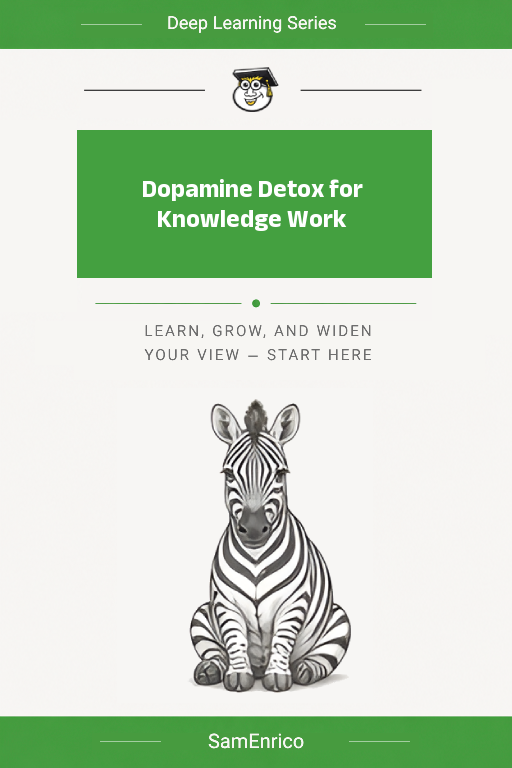
Non-FictionMental WealthNeurochemistry
Dopamine Detox for Knowledge Work eBook
Reduce high frequency rewards from email pings and
by Fries Tad
Reduce high frequency rewards from email pings and likes to restore baseline motivation for deep tasks.
Formats
Free sample
Chapter 1: The Broken Keyboard...--–- You sit down at 9:00 AM to write one email. By 11:00 AM, you have sent three emails, checked Twitter eleven times, watched a “five-minute” You Tube video about a topic you do not care about, rearranged three folders in your document management system, replied to two Slack messages that could have waited, and closed seventeen browser tabs. Your actual work—the one thing you were hired to do, the deep cognitive task that requires your full attention—is untouched. And you feel something strange. You feel exhausted.
Not from work. From the effort of not working.This is the paradox of the modern knowledge worker. You have never had more access to information, more powerful tools, or more flexibility in where and when you work. And yet, you have never struggled more to do the one thing that justifies your salary: sustained, focused, deep thinking. The very tools designed to make you more productive have become the primary obstacle to your productivity.
Your keyboard is not broken. But the environment around it is.The Great Paradox Let us name this contradiction clearly. The average knowledge worker—whether you are a software engineer, a writer, a data analyst, a designer, a marketer, or an executive—has access to the sum total of human knowledge in their pocket. You can learn any skill, access any document, communicate with any colleague, and analyze any dataset. This should be a golden age of productivity.
Instead, you are drowning.According to a 2021 study by Rescue Time, the average knowledge worker checks email or messaging apps every six minutes. That is ten times per hour. Seventy times per day. Over the course of a year, that is more than twenty-five thousand interruptions. Each interruption is small.
Each one feels insignificant. But the cumulative effect is not small at all. It is a fundamental restructuring of your brain’s motivational systems.The problem is not that you are lazy. The problem is not that you lack willpower. The problem is not even that you are “bad at focusing.” The problem is structural.
You are trying to do deep, cognitively demanding work in an environment that has been engineered to prevent exactly that. And you have been told, incorrectly, that the solution is to try harder.The Neurological Trap To understand why you feel exhausted despite doing so little, you need to understand a simple but powerful mechanism: context switching. Every time you switch your attention from one task to another, your brain does not simply move cleanly from A to B. It leaves behind a residue. This is called attention residue, a term coined by Professor Sophie Leroy at the University of Washington.When you check your email “for just a second” while writing a report, your brain does not fully let go of the report.
A ghost of it lingers in your working memory. Then, when you return to the report, a ghost of the email lingers. You are never fully present in either task. Research by Gloria Mark at the University of California, Irvine, found that after an interruption, it takes an average of twenty-three minutes and fifteen seconds to return to a task with the same depth of focus. Twenty-three minutes.
For a two-second interruption.Now multiply that by seventy interruptions per day. Seventy times twenty-three minutes is more than twenty-six hours. You do not have twenty-six hours in a day. The math does not work. Which means that by midday, you are not doing deep work at all.
You are doing something else entirely. You are managing distraction. You are constantly recovering, constantly ramping up, constantly getting almost to the edge of focus before another ping pulls you away.This is not a failure of character. This is physics. Your brain has a limited attentional budget, and interruptions tax that budget whether you want them to or not.High Dopamine vs.
Low Dopamine: A Critical Distinction Before we go further, we need to establish a distinction that will run through every chapter of this book. Not all stress is bad. Not all rewards are equal. The knowledge worker’s environment is flooded with one specific kind of stimulus: high-frequency, low-effort, unpredictable rewards. Notifications.
Pings. Likes. The red badge on your Slack icon. The sound of an email arriving. The momentary relief of seeing that someone replied.These are what we will call High Dopamine / Bad Stress.
They are bad not because dopamine is evil—dopamine is simply a neurotransmitter involved in motivation and anticipation. They are bad because they are too frequent and too easy. They tip your brain’s pleasure-pain seesaw toward the high side, which forces an equal and opposite crash into the low side. That crash feels like fatigue, irritability, and a vague sense that you are not doing enough.In contrast, there is Low Dopamine / Good Stress. This is the feeling of wrestling with a hard problem.
Learning a new skill. Debugging a complex piece of code. Writing a difficult paragraph. Designing a system from scratch. These activities also release dopamine, but on a different schedule.
The reward is delayed. The effort is high. The frequency is low. And crucially, the satisfaction lasts.Here is the cruel irony: your brain cannot tell the difference between these two sources of dopamine in the moment. It only knows that dopamine is being released.
When you flood it with high-frequency rewards, it downregulates its own receptors to compensate. This is homeostasis, the brain’s drive for balance. The result is that low-frequency rewards—the deep work that actually matters—no longer feel rewarding at all. They feel boring. Painful.
Impossible.You are not bad at deep work. Your baseline has been set to the hyper-stimulation of Twitter, Slack, and email.The Twenty-Three-Minute Lie We have all told ourselves the same lie. “I will just check this really quickly.” “It will only take a second.” “I can multitask—I am good at it.”You are not good at it. No one is. The research on multitasking is among the most replicable in all of psychology: human beings cannot do two cognitively demanding tasks at the same time.
What you are actually doing is task switching. And task switching has a cost. That cost is twenty-three minutes per switch.Let me make this concrete. Imagine you have a four-hour block of time to complete a deep work task. If you check email just four times during that block—once per hour—you will lose nearly an hour and a half to context switching.
Four checks. Ninety-two minutes. You have just lost nearly forty percent of your deep work capacity to four two-second interruptions.Now consider your actual day. You check email more than four times. You also check Slack.
You also check your phone. You also glance at the news. You also respond to a text message. By the time you have done all of these “quick checks,” you are no longer doing deep work at all. You are doing interruption management disguised as productivity.The Productivity Porn Trap There is another layer to this problem, one that feels especially seductive.
Let us call it productivity porn. Productivity porn is any activity that feels productive but produces no actual output. It…
This is the end of the free sample. Get the eBook to keep going. Buy now
About this book
Details
- Author
- Fries Tad
- Publisher
- SamEnrico
- Language
- English
- Genre
- Non-Fiction, Mental Wealth, Neurochemistry
- Released
- 2026-05-30
- Pages (approx.)
- 145
- Available as
- eBook, Audiobook

Read better in the ZLOADR app
Your eBooks on your phone or tablet. Sign in with your SamEnrico account and start reading.
More by Fries Tad
 Money and Marriage ArgumentsFries Tad$11.99
 HGH and IGF1 RatioFries Tad$11.99
 Bupropion GuideFries Tad$11.99
 Failure Velocity MetricFries Tad$11.99
 Chair Ritual for ForgivenessFries Tad$11.99
 Cognitive Restructuring Trauma AngerFries Tad$11.99
 Czikszentmihalyi Flow GuideFries Tad$11.99
 Outsourcing for SolopreneursFries Tad$11.99
 The Golden Lie: Doping in Ancient Olympia and the Birth of Sports ScandalFries Tad$11.99
 Anansi Weaves the Sky: The Spider’s Greatest TrickFries Tad$11.99
 The Essential Guide to BopFries Tad$11.99
 Rapa Turnip: Turnip Greens & RootsFries Tad$11.99
You may also like
 Hong Kong Handover 1997Dunn Johnnie$11.99
 Zumba For Postnatal Recovery CourseNeal Christian$11.99
 Zumba for BeginnersLadner Nikia$11.99
 YouTube Comment Mining GuideHumes Pandora$12.99
 Worry Box MeditationCarlin Rudy$11.99
 Workplace Stress MeditationNguyen Lynn$11.99
 Workplace Stress and Sleep RepairHawley Ivory$11.99
 Workplace Perfectionism CureDelaney Jeffry$11.99
 Workplace Injustice Anger GuideWallen Isabelle$11.99
 Work Addiction and Burnout LinkGreenwood Ester$11.99
 Women in Yoga and WellnessBeattie Galina$11.99
 Women in Stand Up ComedyChun Evangeline$11.99