
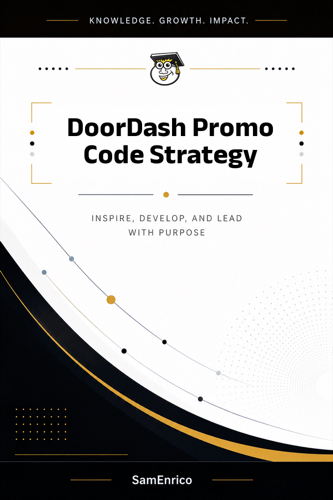
Non-FictionBusiness BriefPromo Optimization
DoorDash Promo Code Strategy eBook
Use customer promo codes to increase order volume.
Use customer promo codes to increase order volume.
Formats
Free sample
Chapter 1: The Math of Hunger...--You are not lazy. You are not bad with money. And you are definitely not alone.If you have ever opened the Door Dash app, built a cart that made your mouth water, proceeded to checkout, and then stared at a final total that was nearly double the restaurant’s menu price—only to sigh, click “Place Order” anyway, and tell yourself that convenience costs money—this chapter is for you.The problem is not your self-control. The problem is not that delivery is inherently expensive. The problem is that you have been playing a game whose rules you did not even know existed.
Door Dash has spent hundreds of millions of dollars engineering an experience that feels effortless while extracting every possible dollar from your wallet. And the cruelest trick? They have convinced you that the inflated price you see at checkout is simply the cost of doing business in the modern world.It is not.This chapter will deconstruct the hidden mathematics of a typical Door Dash order, expose the psychological traps that keep you overpaying, and introduce the single most important concept in this entire book: Incremental Economics. By the time you finish reading, you will never look at a delivery fee the same way again. More importantly, you will understand that you have not been saving money—you have simply been losing less.
And that is about to change.The $15 Meal That Costs $32Let us start with a simple experiment. Walk into your local burger joint. Order a cheeseburger, fries, and a medium soda. The menu says $14.95. You pay, you eat, you leave.
Total cost including tax: roughly $16.50.Now open Door Dash. Find that same restaurant. Add that same cheeseburger, fries, and soda to your cart. Before you even get to checkout, look closely at the item prices.In many cases, the burger alone is now $16.99. The fries are $5.49 instead of $3.99.
The soda is $3.29 instead of $2.49. This is not a glitch. This is menu price inflation, and it is Door Dash’s first invisible tax. Restaurants raise their prices on delivery apps to offset the 15–30% commission Door Dash charges them. You pay that markup, not the restaurant.So your $14.95 meal is now $25.77 before any fees.Now add the service fee.
Typically 10–15% of the subtotal. On $25.77, that is another $2.58 to $3.87. Add the delivery fee. That varies wildly—from $1.99 to $7.99 depending on distance, time of day, and how many drivers are available. Let us call it $4.99.
Add the small cart fee. If your order is under $15 (which it never is after markup, but Door Dash uses the pre-markup subtotal for this threshold in some markets), you might see an additional $2–3. And finally, add the tip. The app suggests 15%, 20%, or 25% of the post-fee, pre-tip total. On $35.63, 20% is $7.13.Let us add it all up:Component Cost In‑store menu price$14.95Door Dash menu markup+$10.82Service fee (15%)+$3.87Delivery fee+$4.99Tip (20%)+$7.13TOTAL$41.76You just paid $41.76 for a $14.95 meal.
That is a 179% markup.And here is the part that should make you angry: Door Dash knows exactly what they are doing. The menu markup is hidden because you are not comparing side‑by‑side. The fees are added one at a time so no single fee looks outrageous. The tip suggestion is calculated on the inflated total, not the original meal cost. Every design choice is optimized to make you say “well, it’s not that much more” while you click “Place Order.”The Myth of the One-Time Code Now, you might be thinking: “But I use promo codes.
I always search for ‘Door Dash promo code’ before I order. I am smarter than that.”Let me stop you right there.The random Google search for a promo code is the single most ineffective savings strategy in existence. Here is why.When you type “Door Dash promo code December 2025” into Google, you are competing against millions of other users doing the exact same thing. The first page of results is dominated by affiliate marketing sites that exist not to help you save money but to earn a commission when you click through and order. These sites scrape codes from forums, publish them without verifying expiration dates, and rarely update them.
By the time a code appears on page one of Google, it has already been shared on Reddit, Twitter, and Discord. It has been used thousands of times. And Door Dash’s terms almost always limit promo codes to a certain number of redemptions, a specific geographic region, or a narrow time window.The result? You copy a code like “DASH30,” paste it into the app, and see that dreaded red message: “Invalid or expired promo code.”You try another. Same result.You try a third, and it works—but it is only $5 off a $25 order.
You just spent ten minutes of your life to save five dollars. And you feel like you won.This is the myth of the one‑time code: the belief that savings come from finding a magical string of letters and numbers that unlocks a discount. In reality, that approach fails 95% of the time because you are always behind the curve. The people who actually save money on Door Dash do not hunt for codes. They build systems that generate discounts automatically, consistently, and predictably.
They understand that a promo code is not a treasure to be found. It is a lever to be pulled as part of a larger machine.The Psychology of Convenience Fees Why do we keep overpaying? The answer lies in behavioral economics.Anchoring: When you see a $25 subtotal in your cart, that number becomes your anchor. Adding a $5 delivery fee feels annoying but not catastrophic. Adding a $7 tip feels generous but reasonable.
By the time you reach $41, you have already mentally committed to the $25 anchor, so the additional $16 feels like a smaller relative increase than it actually is. Door Dash knows this. That is why they show you the subtotal first, then add fees one by one, rather than presenting the final total upfront.Sunk cost fallacy: You spent eight minutes building your cart. You decided what you wanted. You imagined eating it.
Closing the app now feels like wasting those eight minutes. So you order, even though the rational choice would be to walk to the restaurant or cook at home.The convenience premium: Humans consistently overvalue immediate gratification and undervalue delayed savings. Paying $41 now to eat in 35 minutes feels better than paying $15 now but having to drive 10 minutes and wait another 10. That 20‑minute difference is worth $26 to your hungry brain. And Door Dash has built an entire business model on that irrational calculation.Social proof: When the app shows you that “35 people ordered from this restaurant in the last hour,” you feel safer spending more.
If everyone else is doing it, it cannot be that wasteful. Except everyone else is also overpaying.These psychological traps are not character flaws. They are predictable, studied, and exploited by every major delivery platform. The first step to beating them is simply naming them.Incremental Economics: The Only Framework That Matters Here is the concept that will change everything.Most people think about Door Dash orders in terms of absolute cost: “I spent…
This is the end of the free sample. Get the eBook to keep going. Buy now
About this book
Details
- Author
- Downing Dinah
- Publisher
- SamEnrico
- Language
- English
- Genre
- Non-Fiction, Business Brief, Promo Optimization
- Released
- 2026-06-07
- Pages (approx.)
- 146
- Available as
- eBook, Audiobook

Read better in the ZLOADR app
Your eBooks on your phone or tablet. Sign in with your SamEnrico account and start reading.
More by Downing Dinah
 Distraction Proof Writing SprintDowning Dinah$11.99
 Evening Goal ReflectionDowning Dinah$11.99
 Growth Hormone and AutophagyDowning Dinah$11.99
 The Layered Induction MethodDowning Dinah$11.99
 Losing a Father Grief GuideDowning Dinah$11.99
 Yahoo Three Billion Account DisasterDowning Dinah$11.99
 Meth Irritability RecoveryDowning Dinah$11.99
 The Wendigo's Hollow: Hunger in the Northern WildsDowning Dinah$11.99
 The Great Escape of Casanova: Love, Lies, and a Prison Break in 18th-Century VeniceDowning Dinah$11.99
 A Collector's Handbook to the Opel Commodore (1967-72)Downing Dinah$11.99
 Growing AgeratumDowning Dinah$11.99
 Friday B2B Networking GuideDowning Dinah$12.99
You may also like
 Hong Kong Handover 1997Dunn Johnnie$11.99
 Zumba For Postnatal Recovery CourseNeal Christian$11.99
 Zumba for BeginnersLadner Nikia$11.99
 YouTube Comment Mining GuideHumes Pandora$12.99
 Worry Box MeditationCarlin Rudy$11.99
 Workplace Stress MeditationNguyen Lynn$11.99
 Workplace Stress and Sleep RepairHawley Ivory$11.99
 Workplace Perfectionism CureDelaney Jeffry$11.99
 Workplace Injustice Anger GuideWallen Isabelle$11.99
 Work Addiction and Burnout LinkGreenwood Ester$11.99
 Women in Yoga and WellnessBeattie Galina$11.99
 Women in Stand Up ComedyChun Evangeline$11.99