
Non-FictionBusiness BriefPromotions
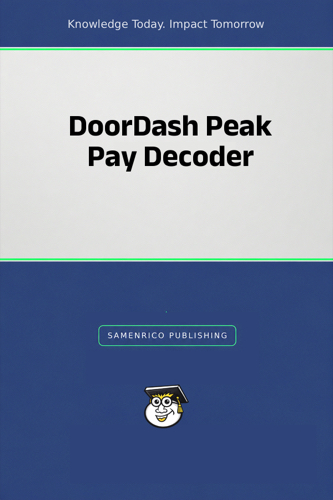
DoorDash Peak Pay Decoder eBook
Predicts when peak pay promotions will actually in
Predicts when peak pay promotions will actually increase net hourly earnings.
Formats
Free sample
Chapter 1: The Red Mirage--The notification buzzes on your phone at 11:47 AM on a sunny Saturday. "Peak Pay: +$3.00 per order in the Downtown zone until 1:30 PM." Your heart rate ticks up. You have been waiting for this. You tap "Dash Now," drive twelve minutes to the red zone on the map, and pull into the Chipotle parking lot. There are already seven other cars with phone mounts on their windshields.
You recognize a few faces. You wave. They do not wave back. They are staring at their screens, waiting.Forty-five minutes later, you have completed exactly one delivery. A $6.50 order for 4.2 miles.
With the $3 bonus, that is $9.50. Subtract $2.75 for gas and depreciation, and you have earned $6.75 for forty-five minutes of your Saturday afternoon. That is $9.00 per hour before you pay for your own lunch, your car payment, or your next oil change. The other seven drivers in the Chipotle parking lot had similar stories. One of them, a veteran named Marcus who has been dashing since 2019, tells you he made $14 in the last hour.
"Peak Pay days are weird," he says, shrugging. "Sometimes it is great. Sometimes it is like this."You drove home frustrated, wondering what you did wrong. You followed the rules. You went where the map was red.
You showed up when Door Dash offered you more money. So why did you earn less than minimum wage?This chapter will answer that question. It will dismantle the single most dangerous belief in the gig economy: that the red zone on your map is an opportunity. In fact, for most Dashers, most of the time, the red zone is a trap. It is a beautifully designed, psychologically irresistible trap that benefits Door Dash far more than it benefits you.
Understanding why this is true is the foundation of everything else in this book. Master this chapter, and you will never again sit in a crowded parking lot wondering where all the orders went.The Psychology of the Red Zone Door Dash's heat map is not designed to help you. It is designed to balance supply and demand across the platform. When you see a zone colored gray, that means Door Dash has roughly the number of drivers it needs. When you see a zone colored pink or red, that means Door Dash has more orders than drivers at this exact moment, and the company wants to correct that imbalance as quickly as possible.
The heat map is a lagging indicator. It tells you where demand has been, not where profitability will be over the next hour.But your brain does not process it that way. Your brain sees red and thinks opportunity. Your brain sees a bonus and thinks more money. This is not a character flaw.
It is a predictable cognitive bias called salience bias. We overvalue information that is vivid, immediate, and easy to see, like a bright red zone on a map, and undervalue information that is diffuse, statistical, and harder to visualize, like the number of other drivers who are also seeing that same red zone at the same time.Here is what happens in the first ten minutes after a Peak Pay announcement, broken down minute by minute.Minute zero: Door Dash posts a $2 or $3 Peak Pay window starting in fifteen minutes. The zone is currently yellow or light red. Demand is moderately high. Supply is moderately low.
The algorithm has predicted a supply gap thirty minutes from now.Minutes one through three: Five hundred Dashers within a ten-mile radius receive the notification. Two hundred of them are already dashing nearby. One hundred of them are at home, eating lunch, but they see the notification and decide to log on early.Minutes four through six: The first wave of Dashers arrives in the zone. The zone begins shifting from yellow to bright red on the map because driver supply is increasing rapidly. But the heat map does not distinguish between orders and drivers.
It only shows activity. More drivers means more activity, which makes the zone look even busier, which attracts more drivers.Minutes seven through ten: The zone is now oversaturated. There are more drivers than orders. The Peak Pay window has not even started yet. The Dashers who were already active are completing their orders and then facing long waits.
The Dashers who logged on from home are now sitting in parking lots, refreshing their screens.Minutes ten through fifteen: The Peak Pay window begins. The zone is now a deep, dark red. It looks like the most profitable place on Earth. In reality, the average wait between offers is now twelve to eighteen minutes. The $3 bonus is eaten entirely by idle time.This is the Red Mirage.
The redder the zone looks, the more drivers are already there. And the more drivers are already there, the lower your chances of getting a steady stream of offers.Driver Density: The Hidden Variable Most Dashers track three variables: time of day, day of week, and bonus amount. These are easy to see. But the most important variable, driver density, is invisible in the app. Door Dash does not show you how many other Dashers are in your zone.
It does not show you how many offers per hour drivers are receiving. It shows you only the output of supply and demand, which is the color of the zone, not the inputs.Driver density is simply the number of active Dashers divided by the number of available orders in a given zone at a given time. When driver density is low, meaning fewer drivers than orders, you receive offers constantly, you can be selective, and you rarely wait between pickups. When driver density is high, meaning more drivers than orders, you wait. You decline offers only to see them disappear.
You refresh your screen and see nothing.The relationship between driver density and Peak Pay is counterintuitive. Peak Pay attracts drivers more powerfully than it attracts orders. A $3 bonus might increase the number of orders in a zone by ten to fifteen percent. Customers order slightly more often when they know drivers are incentivized, though most customers have no idea Peak Pay exists. But that same $3 bonus can increase the number of drivers in a zone by two hundred to three hundred percent.Let me say that again because it is the most important sentence in this book.
A Peak Pay announcement can triple the number of drivers in a zone within fifteen minutes. Orders do not triple. They barely increase. The result is a dramatic spike in driver density, which means fewer offers per driver, which means lower net hourly earnings despite the bonus.This is not a bug. This is a feature of Door Dash's platform design.
Door Dash wants to clear its order backlog as quickly as possible to maintain customer satisfaction. The fastest way to clear a backlog is to flood the zone with drivers. Peak Pay is the tool Door Dash uses to create that flood. The company is not trying to make you rich. It is trying to solve its own supply problem at the lowest possible cost.
And flooding a zone with $2 or $3 bonuses is much cheaper than raising base pay permanently for all drivers.Utilization…
This is the end of the free sample. Get the eBook to keep going. Buy now
About this book
Details
- Author
- Armstrong Lindsay
- Publisher
- SamEnrico
- Language
- English
- Genre
- Non-Fiction, Business Brief, Promotions
- Released
- 2026-06-10
- Pages (approx.)
- 146
- Available as
- eBook, Audiobook

Read better in the ZLOADR app
Your eBooks on your phone or tablet. Sign in with your SamEnrico account and start reading.
More by Armstrong Lindsay
 Feynman Woman in PhysicsArmstrong Lindsay$11.99
 The Model Overdose ConfessionArmstrong Lindsay$11.99
 The Recovery Capital CourseArmstrong Lindsay$11.99
 Remote Fundraising CommunicationArmstrong Lindsay$11.99
 Growth Hormone Myths DebunkedArmstrong Lindsay$11.99
 Blood Moon Standstill: The 2019 Hong Kong SiegeArmstrong Lindsay$11.99
 The Complicated Parent GriefArmstrong Lindsay$11.99
 Cannabis and MemoryArmstrong Lindsay$11.99
 Visualization Protocol For TalksArmstrong Lindsay$11.99
 The Last Oracle of Delphi: Prophecy, Power, and the Fall of a Divine InstitutionArmstrong Lindsay$11.99
 The Linguistic Architects of Timbuktu: Decoding the World's WisdomArmstrong Lindsay$11.99
 Understanding Bacterial GastroenteritisArmstrong Lindsay$17.99
You may also like
 Hong Kong Handover 1997Dunn Johnnie$11.99
 Zumba For Postnatal Recovery CourseNeal Christian$11.99
 Zumba for BeginnersLadner Nikia$11.99
 YouTube Comment Mining GuideHumes Pandora$12.99
 Worry Box MeditationCarlin Rudy$11.99
 Workplace Stress MeditationNguyen Lynn$11.99
 Workplace Stress and Sleep RepairHawley Ivory$11.99
 Workplace Perfectionism CureDelaney Jeffry$11.99
 Workplace Injustice Anger GuideWallen Isabelle$11.99
 Work Addiction and Burnout LinkGreenwood Ester$11.99
 Women in Yoga and WellnessBeattie Galina$11.99
 Women in Stand Up ComedyChun Evangeline$11.99