
Non-FictionBusiness BriefPhilanthropy Planning
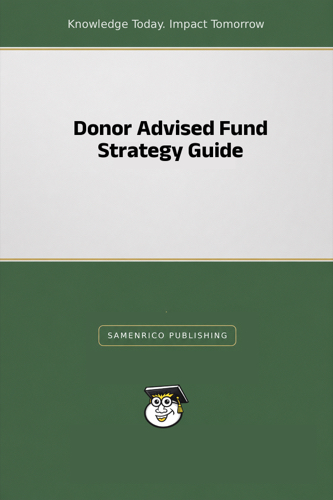
Donor Advised Fund Strategy Guide eBook
Bundle charitable gifts into a donor advised fund
by Bolin Meryl
Bundle charitable gifts into a donor advised fund for flexible tax timing and simplified giving.
Formats
Free sample
Chapter 1: The Twelve-Thousand-Dollar Mistake--–- Eleanor Whitaker had always considered herself a generous person. Every December, like clockwork, she sat at her kitchen table with a stack of end-of-year fundraising letters and wrote checks. $500 to the local food bank. $1,000 to her alma mater. $250 to the public radio station.
$2,000 to her church. Another $1,250 spread across a half-dozen smaller causes she cared about. By the time she finished, she had donated roughly $5,000 to charity—the same amount she had given every year for the past decade.Eleanor felt good about this ritual. She was doing her part. She was supporting causes that mattered.
And because she always donated before December 31, she assumed she was being tax-smart as well. After all, wasn't charitable giving supposed to be tax-deductible?Here is what Eleanor did not know. And here is what this chapter will reveal, possibly saving you thousands of dollars before you read another page.Every single one of Eleanor's $5,000 in annual donations provided her with exactly zero dollars in tax savings. Not a penny. Not a dime.
For ten consecutive years, she had been deducting nothing from her taxes while believing she was being financially responsible. The mistake cost her somewhere between $12,000 and $22,000 in unnecessary taxes over that decade, depending on her marginal tax rate.Eleanor is not alone. She is not an exception. She is the rule. Roughly ninety percent of American taxpayers who make charitable donations are making the exact same mistake.
This chapter will show you why, how to calculate exactly how much it has cost you, and—most importantly—the simple strategic shift that turns your giving from a tax nothing-burger into a powerful wealth-building tool.The Standard Deduction: The Invisible Thief of Small Donations To understand Eleanor’s mistake, we need to understand a seemingly boring but critically important piece of the tax code: the standard deduction.The standard deduction is essentially the government saying, "We will not tax the first X dollars of your income, no matter what." For tax year 2025, the standard deduction is approximately $15,000 for single filers and $30,000 for married couples filing jointly. These numbers adjust slightly each year for inflation, but the magnitude remains the same: somewhere in the range of $15,000 to $30,000 per household.Here is what most people misunderstand. You do not get to take the standard deduction and deduct your charitable donations. You get one or the other. You either take the standard deduction—a flat amount that requires no receipts, no paperwork, and no documentation—or you "itemize" your deductions, which means you add up all your deductible expenses (charitable gifts, mortgage interest, state and local taxes, medical expenses) and deduct that total instead.For the vast majority of taxpayers, the standard deduction is larger than the total of all their itemizable expenses.
This is by design. The Tax Cuts and Jobs Act of 2017 nearly doubled the standard deduction specifically to simplify tax filing for most Americans. And it worked. Before 2017, roughly one-third of taxpayers itemized. Today, less than ten percent itemize.This means that ninety percent of taxpayers—including Eleanor—are taking the standard deduction every single year.
And if you take the standard deduction, your charitable donations provide zero tax benefit. They are simply swallowed up by the standard deduction, which you would have received anyway.Let me say that again because it is the single most important sentence in this book. If you take the standard deduction, none of your charitable donations reduce your taxes by a single dollar.This is not a flaw in the tax code. It is a feature. The government is not punishing you for giving to charity.
It is simply saying: we already gave you a large standard deduction that covers most people's expenses, so you do not need to track every small donation. But the consequence is that millions of generous Americans are leaving massive tax savings on the table without even knowing it.The Simple Math That Will Change How You Give Forever Let us return to Eleanor. In a typical year, Eleanor’s itemizable deductions look like this:Charitable donations: $5,000Mortgage interest: $8,000State and local taxes (capped at $10,000): $10,000Total itemized deductions: $23,000Eleanor is married filing jointly, so the standard deduction is roughly $30,000. Because $23,000 is less than $30,000, Eleanor takes the standard deduction. Her $5,000 in charitable donations provides no tax benefit whatsoever.Now consider Eleanor’s neighbor, David.
David is also generous. Over a three-year period, David donates exactly the same total amount as Eleanor: $15,000. But David donates differently. Instead of giving $5,000 every year, David gives $15,000 in year one and nothing in years two and three.In year one, David’s itemizable deductions look like this:Charitable donations: $15,000Mortgage interest: $8,000State and local taxes: $10,000Total itemized deductions: $33,000Because $33,000 exceeds the $30,000 standard deduction, David itemizes in year one. His $15,000 charitable donation is now fully deductible.
Assuming a 24% marginal tax rate, David saves $3,600 in taxes in year one that Eleanor never saves.In years two and three, David has no charitable donations. His itemizable deductions total $18,000 ($8,000 mortgage interest plus $10,000 state and local taxes), which is less than the $30,000 standard deduction. So David takes the standard deduction in those years, just like Eleanor.Over three years, Eleanor and David donated the exact same amount—$15,000—to the exact same charities. But David saved $3,600 in taxes that Eleanor did not. Over a decade, that difference grows to $12,000.
Over a lifetime of giving, it can easily exceed $50,000.This is the bunching strategy, also called bundling or the "lump sum" approach. Instead of donating a little bit every year, you bundle multiple years of giving into a single tax year. You jump over the standard deduction hurdle in that year, claim the full tax benefit, and then take the standard deduction in the surrounding years when you are not donating.The name of the game is not giving more. It is giving smarter. It is timing your giving so that your generosity actually reduces your tax bill instead of being invisibly absorbed by the standard deduction.The 0.5% Floor: A New Hurdle You Need to Know About Before we go further, we need to address an additional complexity that most books ignore.
The Secure Act 2.0 and subsequent legislation introduced a new limitation on charitable deductions known as the 0.5% AGI floor. We will explore this fully in Chapter 10, but you need to know about it now because it affects the bunching math.Here is what the floor means: you can only deduct charitable contributions that exceed one-half of one percent of your Adjusted Gross Income (AGI). For a donor with $200,000 AGI, that is $1,000. The first $1,000 of charitable donations each year is simply nondeductible, regardless of whether you itemize.This floor makes small annual donations even more inefficient than they already were. And it makes bunching even more powerful, because by bundling multiple years into one large contribution, you ensure that only a tiny fraction of your total giving gets caught by the floor.For our purposes in this chapter, you simply need to know that the floor exists.
We will come back to it in Chapter 10, and we will incorporate it into the detailed tax planning worksheets in Chapter 12. For now, the core insight remains: bunching your donations into…
This is the end of the free sample. Get the eBook to keep going. Buy now
About this book
Details
- Author
- Bolin Meryl
- Publisher
- SamEnrico
- Language
- English
- Genre
- Non-Fiction, Business Brief, Philanthropy Planning
- Released
- 2026-06-06
- Pages (approx.)
- 143
- Available as
- eBook, Audiobook

Read better in the ZLOADR app
Your eBooks on your phone or tablet. Sign in with your SamEnrico account and start reading.
More by Bolin Meryl
 Multitasking Memory AgingBolin Meryl$11.99
 IBS Master ReferenceBolin Meryl$11.99
 Smoking Cessation Support GroupsBolin Meryl$11.99
 Mobile Device Usage ReportBolin Meryl$11.99
 Gacy Chicago Community ImpactBolin Meryl$11.99
 Night Stalker Catholic School YearsBolin Meryl$11.99
 Folate Pregnancy GuideBolin Meryl$11.99
 The Salons of Reason: How Enlightenment Thinkers Built a New WorldBolin Meryl$11.99
 Tetsuo: The Iron Man That Shocked the WorldBolin Meryl$11.99
 A Collector's Handbook to the Citroën Light 20)Bolin Meryl$11.99
 How to Produce Gesture Control Input DevicesBolin Meryl$11.99
 Ransomware Third Party RiskBolin Meryl$12.99
You may also like
 Hong Kong Handover 1997Dunn Johnnie$11.99
 Zumba For Postnatal Recovery CourseNeal Christian$11.99
 Zumba for BeginnersLadner Nikia$11.99
 YouTube Comment Mining GuideHumes Pandora$12.99
 Worry Box MeditationCarlin Rudy$11.99
 Workplace Stress MeditationNguyen Lynn$11.99
 Workplace Stress and Sleep RepairHawley Ivory$11.99
 Workplace Perfectionism CureDelaney Jeffry$11.99
 Workplace Injustice Anger GuideWallen Isabelle$11.99
 Work Addiction and Burnout LinkGreenwood Ester$11.99
 Women in Yoga and WellnessBeattie Galina$11.99
 Women in Stand Up ComedyChun Evangeline$11.99