
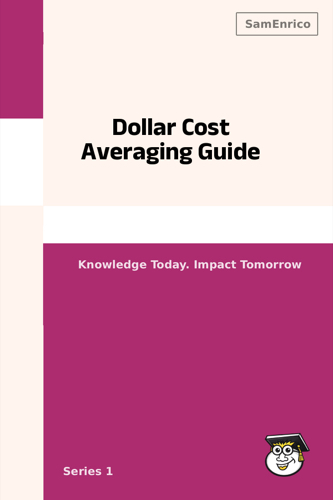
Non-FictionBusiness BriefInvestment Discipline
Dollar Cost Averaging Guide eBook
Teaches automatic monthly investments into index f
Teaches automatic monthly investments into index funds to smooth out market volatility.
Formats
Free sample
Chapter 1: The Cemetery of Geniuses--–- Isaac Newton, the greatest scientific mind of his generation, lost the equivalent of $3 million in today’s money trying to time the stock market. He bought high, watched prices soar, sold too early, watched them soar further, bought back at the peak, and then watched the South Sea Bubble collapse around him. His final verdict? “I can calculate the motions of heavenly bodies, but not the madness of people.”That was 1720. Nearly three centuries later, the same madness persists—only now it wears a hoodie and trades on Robinhood.Every single day, millions of intelligent, hardworking, perfectly rational people open their brokerage apps and make the same catastrophic error.
They check prices. They feel something—excitement when green, dread when red. They make a move. They sell something that just dropped. They buy something that just soared.
And then, like Newton, they wonder why the universe refuses to obey their predictions.This chapter is not about dollar cost averaging. Not yet. Before you can understand why DCA works, you need to understand why everything else fails. You need to walk through the cemetery of geniuses—the Nobel laureates, the hedge fund wizards, the mathematical prodigies—who all believed they were smarter than the market. They were wrong.
And if you believe you are smarter than them, you will join them in the cemetery.The purpose of this chapter is to humble you. Not to shame you. To free you.Because once you accept that you cannot predict the market, you stop trying. And once you stop trying, you can start winning.The Most Expensive Sentence in Human History Let us begin with a sentence. It is a sentence you have said to yourself, probably within the last year.
It is a sentence that has destroyed more wealth than every stock market crash combined.Here it is: “This time is different.”Every bubble, every crash, every panic begins with those four words. In 1929, investors said “this time is different” because of the new era of electrification and mass production. In 1999, they said it because of the internet. In 2007, they said it because of financial engineering. In 2021, they said it because of meme stocks and crypto and SPACs and NFTs.It was never different.Markets crash.
Markets recover. The pattern is so reliable that it should be boring. But it is not boring, because each crash feels uniquely terrifying. The 2008 crash felt like the end of capitalism. The 2020 crash felt like the end of human contact.
The next crash will feel like something else—some new catastrophe that has not yet been invented.The geniuses in the cemetery all believed that their era was unique. That the old rules no longer applied. That they had found the cheat code.They were wrong.The Nobel Prize Curse If intelligence were the key to investment success, Nobel laureates would dominate the Forbes list. They do not. In fact, winning a Nobel Prize in Economics appears to be a curse for investment performance.Consider the case of Myron Scholes and Robert C.
Merton. In 1997, they won the Nobel Prize for their work on options pricing—a mathematical breakthrough that fundamentally changed modern finance. Their hedge fund, Long-Term Capital Management (LTCM), was staffed with more Ph Ds than most small colleges. They had two Nobel laureates. They had quantitative models that predicted market movements with what appeared to be scientific precision.In 1998, LTCM collapsed so spectacularly that the Federal Reserve had to orchestrate a bailout to prevent a global financial meltdown.
The geniuses had borrowed $100 for every $1 they actually owned. When the Russian government defaulted on its debt—an event their models said would happen once every 10,000 years—LTCM evaporated. The Nobel laureates lost everything. Their investors lost everything.The lesson is not that they were stupid. They were brilliant.
The lesson is that brilliance is not a hedge against market uncertainty. In fact, it can be a liability. The smarter you are, the more likely you are to believe that your models have captured reality. They never have. Reality is always messier, weirder, and more unpredictable than any equation.This is known as the expert problem.
Studies consistently show that financial experts make worse predictions than simple averages. In one famous study, psychologist Philip Tetlock tracked the predictions of 284 political and economic experts over 20 years. Their average accuracy was barely better than random chance. And the more famous the expert, the worse their accuracy—because fame encouraged overconfidence.You are not smarter than the market. Neither are the experts.
Neither are the Nobel laureates. Accepting this is not surrender. It is liberation.The Retail Investor Autopsy Perhaps you are thinking: “I’m not trying to beat the market. I just want to buy low and sell high. That’s not complicated.”You are correct that the instruction is not complicated.
The execution is impossible.Let us examine the actual performance of real human investors. Every year, the investment firm Dalbar publishes a study comparing the returns of the average investor to the returns of the stock market itself. The results are devastating. Over the 30-year period ending in 2022, the S&P 500 returned an average of 9.96% per year. The average equity fund investor earned just 5.29% per year.That gap—4.67% per year, compounded over three decades—represents hundreds of thousands of dollars left on the table.
The average investor did not lose money. They simply made far less than they should have, because they bought high and sold low.How does this happen? Let us walk through the typical cycle.Stage 1: Disinterest. The market goes up for years. The investor does not pay attention.
They are busy with work, family, life.Stage 2: Interest. The market has been up for so long that it becomes impossible to ignore. The investor’s coworker bought a new car. The investor’s brother-in-law retired early. The news is full of stories about ordinary people becoming millionaires.Stage 3: Entry.
The investor finally buys. They have waited for a “dip” that never came, so they buy near the peak. They feel smart. They are part of the club now.Stage 4: Euphoria. Prices continue to rise.
The investor’s portfolio grows faster than their salary. They check their app every hour. They tell their friends. They start researching “hot stocks” and “next big things.”Stage 5: Denial. The market turns.
At first, it is just a “correction.” The investor tells themselves they are in it for the long term. They do not sell.Stage 6: Fear. The correction becomes a crash. The investor’s gains have vanished. Now their original investment is shrinking.
They check their app constantly, each time feeling a small electric shock of pain.Stage 7: Panic. The news is apocalyptic. Experts say it will get worse. The investor cannot sleep. They sell everything, just to make the pain stop.Stage 8: Regret.
The market bottoms days or weeks after they sold. It begins to recover. The investor watches from the sidelines, unable to get back in. They wait for “confirmation” that the recovery is real. By the time they buy again, they are near the next peak.This is not a failure of intelligence.
It is a failure of design. The human brain was not built for investing. It was built for survival on…
This is the end of the free sample. Get the eBook to keep going. Buy now
About this book
Details
- Author
- Winstead Lady
- Publisher
- SamEnrico
- Language
- English
- Genre
- Non-Fiction, Business Brief, Investment Discipline
- Released
- 2026-06-10
- Pages (approx.)
- 144
- Available as
- eBook, Audiobook

Read better in the ZLOADR app
Your eBooks on your phone or tablet. Sign in with your SamEnrico account and start reading.
More by Winstead Lady
 Manhattan Project VeteransWinstead Lady$11.99
 Hybrid Meeting Equity GuideWinstead Lady$11.99
 Child CPR Modifications ManualWinstead Lady$11.99
 The Battle of Telamon: Rome’s First Great TriumphWinstead Lady$11.99
 How to Produce BitumenWinstead Lady$11.99
 UK Business Credit ReferenceWinstead Lady$12.99
 How to Start a Beverage Bottling on a Fee or Contract Basis Business (Beginners Guide)Winstead Lady$11.99
 Assistant Center ManagerWinstead Lady$11.99
You may also like
 Hong Kong Handover 1997Dunn Johnnie$11.99
 Zumba For Postnatal Recovery CourseNeal Christian$11.99
 Zumba for BeginnersLadner Nikia$11.99
 YouTube Comment Mining GuideHumes Pandora$12.99
 Worry Box MeditationCarlin Rudy$11.99
 Workplace Stress MeditationNguyen Lynn$11.99
 Workplace Stress and Sleep RepairHawley Ivory$11.99
 Workplace Perfectionism CureDelaney Jeffry$11.99
 Workplace Injustice Anger GuideWallen Isabelle$11.99
 Work Addiction and Burnout LinkGreenwood Ester$11.99
 Women in Yoga and WellnessBeattie Galina$11.99
 Women in Stand Up ComedyChun Evangeline$11.99