
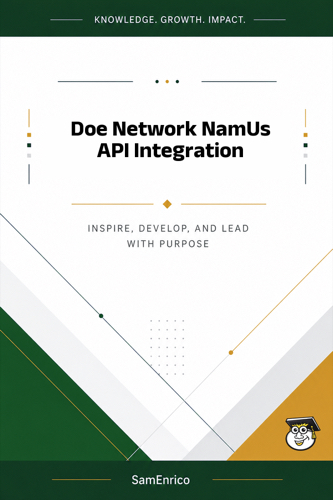
Doe Network NamUs API Integration eBook
Use data APIs to cross-reference missing and unide
Use data APIs to cross-reference missing and unidentified databases automatically.
Formats
Free sample
Chapter 1: The Volunteer's Last Weekend--The spreadsheet had 4,872 rows, and Marie had been staring at it for eleven hours.She rubbed her eyes, took another sip of cold coffee, and scrolled past another row of dentals. “Upper right canine missing. Lower left second molar filled. Amalgam present.” She compared it to the unidentified decedent’s chart — “Upper right canine missing. No other dental work.” Close.
So close. But the amalgam was wrong. The decedent had no fillings. The missing person had three. Marie highlighted the row yellow instead of green — a near miss, not a match — and moved on.It was 2:47 AM on a Sunday.
She had been doing this since Friday evening.Marie was not a detective. She was not a forensic odontologist. She was a high school biology teacher from Ohio who had joined the Doe Network volunteer corps three years ago after reading a story about a Jane Doe identified after thirty-seven years. That story had moved her — not just the identification, but the volunteer who had spent eight hundred hours on that one case. Marie thought: I have weekends.
I have attention to detail. I can do that.Three years later, she had helped identify exactly one person. A John Doe found in 1992, matched to a missing person report from 1991. The match came from a tattoo — a faded dragon on the left shoulder — that Marie had spotted at 1 AM on a Tuesday, cross-referencing images across two browser windows, no automation, no help, just her eyes and a growing sense that the system was broken.The identification brought closure to a family in Oregon. The mother had cried on the phone.
Marie had cried too. It was the best day of her volunteer life.But the other 4,871 rows? Those were still waiting.The 40,000There are, at any given moment, approximately 40,000 unidentified persons in the United States. They are called Jane Does and John Does. Some have been nameless for decades.
Some are found within days but never matched. Some have DNA profiles in CODIS. Some have dental charts. Some have nothing but a t-shirt and a vague location.The National Missing and Unidentified Persons System — Nam Us — holds records for roughly 15,000 active missing persons and 4,000 unidentified decedents at any given time. The Doe Network, a volunteer-run organization founded in 1999, holds records for thousands more, many of which overlap with Nam Us but many of which do not.
The two systems do not talk to each other. Not really. Not in real time. Not in a way that scales.This is the problem that this book exists to solve.But before we write a single line of code — before we discuss APIs, authentication, web scraping, fuzzy matching algorithms, or probability decay — we need to understand something fundamental. We need to understand the human cost of manual cross-referencing.
We need to understand why a biology teacher from Ohio spends her weekends squinting at dental charts. And we need to understand why automation, done right, is not a replacement for Marie. It is an act of respect for her time.This chapter is not about technology. It is about the world that technology must serve.The Birth of a Volunteer The modern web sleuth movement did not begin with Nam Us. It began with a murdered woman found in 1967, a volunteer named Todd Matthews, and a website called the Doe Network.Here is the story, because it matters to everything that follows.In 1967, the body of a young woman was found wrapped in a tent and a blanket near Lexington, Kentucky.
She became known as “Tent Girl.” For thirty years, she remained unidentified. Her case file sat in a drawer. Her dental charts yellowed. Her family — if she had one — never came forward.In 1998, Todd Matthews, a factory worker from Tennessee, married into the family of the deputy coroner who had originally investigated the Tent Girl case. Matthews became obsessed.
He built a rudimentary website. He scanned newspaper clippings. He posted her details to early online forums. And he cross-referenced — manually, painstakingly — every missing person report he could find.In 1998, he found a match. A woman named Barbara Ann Hackmann Taylor had disappeared from Virginia in 1967 under mysterious circumstances.
The timeline matched. The geography matched. The dental charts — what little existed — aligned. Matthews contacted law enforcement. DNA confirmed it.
Tent Girl had a name.That identification changed everything.Matthews went on to co-found the Doe Network, a volunteer organization dedicated to matching missing and unidentified persons using the power of distributed human attention. The model was simple: volunteers would be assigned cases, would search through publicly available records, and would flag potential matches for law enforcement review. No automation. No APIs. Just people.
Just weekends. Just coffee.The Doe Network has since helped identify hundreds of people. It has given names back to the nameless. It has closed cases that law enforcement had long abandoned. But it has never escaped its founding limitation: the work is manual, and the scale is overwhelming.The Limits of Manual Matching Let us quantify the problem, because quantification is the first step toward automation.Nam Us currently contains approximately 15,000 active missing person records and 4,000 unidentified decedent records.
A full cross-reference — comparing every missing person to every unidentified person — requires 60 million pairwise comparisons. That is 60,000,000 times a volunteer must ask: Could this missing person be this Jane Doe?But that is not the whole problem. Each comparison is not a simple yes or no. Each comparison requires examining multiple data fields: age range, height, weight, hair color, eye color, scars and tattoos, dental charts, DNA status, geographic proximity, circumstances of disappearance, clothing and jewelry descriptions. A thorough manual comparison of a single pair might take five minutes.
That includes pulling up both records, scanning the narratives, comparing the photos, cross-referencing dental notations, and noting potential discrepancies.Five minutes per pair. Sixty million pairs. That is 300 million minutes. That is 5 million hours. That is 570 years of continuous work.No volunteer corps can do that.In practice, volunteers use heuristics to reduce the search space.
They filter by state. They filter by estimated age range. They focus on cases with distinctive tattoos or unique clothing. These heuristics are sensible, but they are also blind. A body found in Ohio might be a missing person from California — a long-distance hitchhiker, a runaway, a victim of foul play transported across state lines.
The state filter would miss that match entirely. A distinctive tattoo might be faded, misdescribed, or entirely absent from one of the two records. The heuristic would fail.Marie, our biology teacher from Ohio, knows this. She has learned, through painful experience, that the obvious filters are not always correct. She has learned that matches can hide in unexpected places.
She has learned that the only way to be certain is to check — to check everything, every time, until her eyes blur and her coffee grows cold.She has also learned that she cannot do it alone.Two Systems, One Language Before we can automate, we must understand the two systems we are trying to connect.Nam Us — the National Missing and Unidentified Persons System — was launched in 2007 by the U.S. Department of Justice. It is a…
This is the end of the free sample. Get the eBook to keep going. Buy now
About this book
Details
- Author
- Abernathy Modesta
- Publisher
- SamEnrico
- Language
- English
- Genre
- Non-Fiction, True Crime, Data Science
- Released
- 2026-06-07
- Pages (approx.)
- 145
- Available as
- eBook, Audiobook

Read better in the ZLOADR app
Your eBooks on your phone or tablet. Sign in with your SamEnrico account and start reading.
More by Abernathy Modesta
 Garage Startup Immigrant StoryAbernathy Modesta$11.99
 Upwork Payment Protection ClaimsAbernathy Modesta$11.99
 Self Compassion ResilienceAbernathy Modesta$11.99
 The Hand Stick InductionAbernathy Modesta$11.99
 Vaginal Birth RecoveryAbernathy Modesta$11.99
 Processing Nightmares From SurgeryAbernathy Modesta$11.99
 Feedback for PresentersAbernathy Modesta$11.99
 The Visionaries of Stone and Light: How Western Architects Defied GravityAbernathy Modesta$11.99
 Rana Pratap: The Last Rajput Stand at HaldighatiAbernathy Modesta$11.99
 How to Produce Nut ButtersAbernathy Modesta$11.99
 How to Produce ArchesAbernathy Modesta$11.99
 Growing Cassia (Shower Tree)Abernathy Modesta$11.99