
Non-FictionTrue CrimeCollaboration
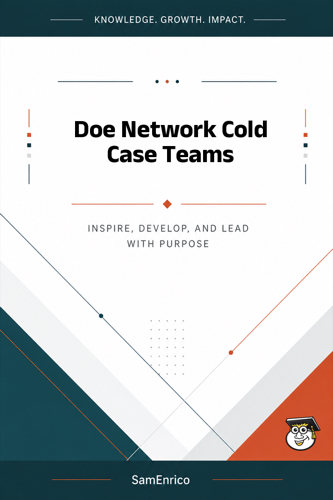
Doe Network Cold Case Teams eBook
Form virtual teams to review unsolved unidentified
Form virtual teams to review unsolved unidentified remains across jurisdictions.
Formats
Free sample
Chapter 1: The Silent Mass Disaster...–- On any given day, somewhere in the United States, a medical examiner closes a cold storage drawer on a body that has no name. The file on the desk beside it contains everything known about this person: height, weight, estimated age, dental charts, perhaps a photograph of a distinctive tattoo or a piece of jewelry found with the remains. What the file does not contain is a name. No one has reported this person missing—or if someone has, the report sits in a different county, a different state, in a database that does not talk to the database where this Doe resides. This is not an anomaly.
This is the routine reality of the unidentified remains crisis in America, a slow-motion disaster that has unfolded over decades without a national emergency declaration, without a coordinated response, and without the public awareness that such a catastrophe would normally command.The scale of the problem is almost impossible to grasp intuitively. The National Institute of Justice estimates that at any given moment, approximately 40,000 sets of unidentified human remains are held in medical examiner offices, coroner facilities, and unmarked graves across the country. Each year, roughly 4,000 new unidentified remains are discovered—bodies found in wooded areas, pulled from rivers, excavated from construction sites, or recovered from house fires and car accidents where identification is impossible through conventional means. And each year, only a fraction of these are ever identified. The rest accumulate, year after year, decade after decade, filling freezers and filing cabinets with the silent testimony of lives that ended without recognition.But these statistics, however staggering, fail to capture the human reality behind the numbers.
Every unidentified set of remains was once a person with a name, a family, a history. Someone who laughed at jokes, worried about money, fell in love, made mistakes, and dreamed of a future that never arrived. The transition from that living, breathing human being to a case number in a coroner's file represents not just a biological death but a social and legal one—a vanishing so complete that even death could not restore their identity. The Jane Doe found in a drainage ditch in 1998 is not an abstraction. She is someone's daughter, possibly someone's mother, certainly someone's friend.
The John Doe pulled from the Mississippi River in 2005 is not a puzzle to be solved for entertainment. He is a person whose loved ones have spent two decades wondering, hoping, and grieving without the basic human certainty of knowing what happened.The Jurisdictional Puzzle To understand why this crisis persists despite modern technology and dedicated professionals, one must first understand the fragmented landscape of American death investigation. Unlike most developed nations, the United States has no national coroner system, no unified database of missing persons that automatically cross-references unidentified remains, and no mandatory reporting requirements that force jurisdictions to share information with one another. Instead, the country operates under a patchwork of approximately 2,400 independent medical examiner and coroner offices, each with its own procedures, its own resources, its own backlog, and its own priorities.Consider a hypothetical case that illustrates the problem in concrete terms. A young woman vanishes from Albuquerque, New Mexico, in 2017.
Her family reports her missing to the Albuquerque Police Department, which enters her information into the National Crime Information Center (NCIC) database. Meanwhile, six months later and four hundred miles away, a rancher in rural Colorado discovers skeletal remains on his property. The local coroner—a part-time elected official with no medical training, as is still legal in many states—collects the bones and stores them in a box. He files a report with his county sheriff, but because the remains show no obvious signs of homicide, the case receives low priority. The coroner does not enter the remains into Nam US, the National Missing and Unidentified Persons System, because he has never heard of it.
The NCIC entry for the missing Albuquerque woman sits in a federal database that the Colorado coroner cannot access without going through law enforcement. No one connects the two records. The young woman remains missing. The remains remain unidentified. The family remains in limbo.This is not a hypothetical scenario designed to illustrate a rare failure.
This is the standard operating procedure of a system that was never designed to handle cross-jurisdictional identification at scale. The United States has more than 18,000 law enforcement agencies, each with its own jurisdiction, its own records systems, and its own protocols for handling missing persons and unidentified remains. A body found in one county, a missing person reported in another, and dental records stored in a third may never converge because no single entity has both the authority and the incentive to force the comparison. The jurisdictional silos that protect local control also ensure that information remains trapped exactly where it is least useful.The Data Gap Even when well-intentioned professionals attempt to share information, the technical infrastructure often fails them. Nam US, created by the National Institute of Justice in 2007 and now managed by the University of North Texas, is the closest thing the country has to a national clearinghouse for unidentified remains.
The system is powerful when properly used—it allows law enforcement and coroners to search for potential matches between missing persons reports and unidentified remains records, and it has facilitated thousands of identifications since its launch. But Nam US suffers from two critical limitations.First, entry into Nam US is largely voluntary. Despite federal grants and training programs, many coroners and medical examiners still do not routinely upload their unidentified remains cases to the system. A 2018 audit found that thousands of unidentified remains in local custody had never been entered into any national database, effectively invisible to any investigator outside the local jurisdiction. Second, the data that does make it into Nam US is often incomplete or inconsistent.
One coroner might measure a femur and enter a precise estimate of height; another might guess. One detective might upload dental x-rays; another might note only that teeth are present. These inconsistencies mean that even when records exist in the same database, matching algorithms may fail to connect them because the data formats do not align.The result is a paradoxical situation: there is no shortage of data about missing persons and unidentified remains. In fact, there is an overwhelming abundance of data. But the data lives in incompatible systems, uses inconsistent standards, and lacks any mechanism for automated cross-referencing.
The problem is not that the information does not exist. The problem is that no one has connected the dots.The Birth of a Grassroots Solution It was into this fractured landscape that a small group of internet users began, in the late 1990s, to do something remarkable. They started comparing missing persons listings against unidentified remains records manually—case by case, detail by detail, across jurisdictions that no official agency had ever connected. These early volunteers were not law enforcement officers, not forensic scientists, not professional investigators. They were ordinary citizens with extraordinary persistence, driven by a simple conviction: that no one should remain nameless in death simply because the system failed them.What began as scattered efforts on true crime forums…
This is the end of the free sample. Get the eBook to keep going. Buy now
About this book
Details
- Author
- Hope Strickland
- Publisher
- SamEnrico
- Language
- English
- Genre
- Non-Fiction, True Crime, Collaboration
- Released
- 2026-06-06
- Pages (approx.)
- 142
- Available as
- eBook, Audiobook

Read better in the ZLOADR app
Your eBooks on your phone or tablet. Sign in with your SamEnrico account and start reading.
More by Hope Strickland
 Remote Work Cheat SheetHope Strickland$11.99
 Comparison to Other HeistsHope Strickland$11.99
 Twitch Subscriber Spending ControlHope Strickland$11.99
 Lying Down Body Scan ScriptHope Strickland$11.99
 Infant Nonverbal Cues GuideHope Strickland$11.99
 Utility Shutoff PreventionHope Strickland$11.99
 Napping Master GuideHope Strickland$11.99
 The Last Broadcast: The Night the BBC Defied a DictatorHope Strickland$11.99
 The Fur Trader's Heart: Love and Empire on the Canadian FrontierHope Strickland$11.99
 How to Produce Nail SuppliesHope Strickland$11.99
 How to Produce an Access Control Card ReaderHope Strickland$11.99
 Growing Calamagrostis (Reed Grass, Smallweed)Hope Strickland$11.99
You may also like
 Hong Kong Handover 1997Dunn Johnnie$11.99
 Zumba For Postnatal Recovery CourseNeal Christian$11.99
 Zumba for BeginnersLadner Nikia$11.99
 YouTube Comment Mining GuideHumes Pandora$12.99
 Worry Box MeditationCarlin Rudy$11.99
 Workplace Stress MeditationNguyen Lynn$11.99
 Workplace Stress and Sleep RepairHawley Ivory$11.99
 Workplace Perfectionism CureDelaney Jeffry$11.99
 Workplace Injustice Anger GuideWallen Isabelle$11.99
 Work Addiction and Burnout LinkGreenwood Ester$11.99
 Women in Yoga and WellnessBeattie Galina$11.99
 Women in Stand Up ComedyChun Evangeline$11.99