
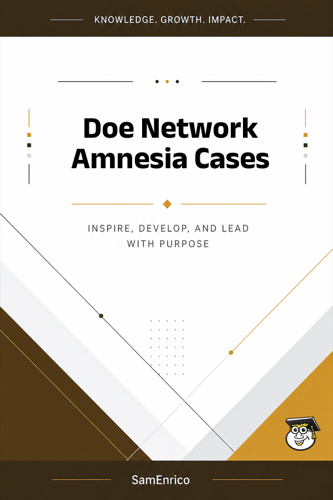
Doe Network Amnesia Cases eBook
Help living unidentified individuals with memory l
Help living unidentified individuals with memory loss reclaim their identities.
Formats
Free sample
Chapter 1: The Forgotten Among Us--–- In September 1981, a woman was found naked, filthy, and near death in a shallow grave at Birch State Park in Fort Lauderdale, Florida. She had been buried alive—covered with dirt and leaves, left to suffocate in the dark. By the time a park ranger heard her faint moans and dug her out, she was hypothermic, dehydrated, and drifting in and out of consciousness. She had no identification. She had no wallet, no purse, no jewelry, no phone.
She had nothing except the clothes she had not been wearing when she was found and a body that bore the scars of a life she could not remember.When she woke in the hospital, the nurses asked her name. She stared back at them with empty eyes. "I don't know," she said. They asked where she was from. "I don't know." They asked how she had gotten into that shallow grave.
"I don't remember." They asked if anyone was looking for her. She began to cry—not because she knew the answer was yes, but because she realized with dawning horror that she did not know the answer at all. She did not know if anyone in the world loved her. She did not know if she had children, parents, a husband, a best friend. She did not know if she had ever celebrated a birthday, fallen in love, graduated from school, or held a job.
She did not know if she was someone worth looking for.The police named her "Jane Doe." It is a placeholder, a bureaucratic acknowledgment of failure. Jane Doe is what we call the nameless when we have given up on finding their real names. But this Jane Doe was not dead. She was alive. And she was asking—not with words, because she had learned that words would not help, but with the silence of a person who has been erased from her own life—for someone to find out who she was.She appeared on "Good Morning America" on October 19, 1981.
The cameras showed a woman in her late twenties or early thirties, with brown hair and a face that looked haunted but hopeful. She sat next to her psychiatrist, Dr. Jesse Kaye, who explained her condition to the nation. She had no memory of her past, he said. She could not say where she was born, what her name was, or how she had ended up in that shallow grave.
But if she never recovered those memories, he added, "there's the potential for the development of a totally new personality." She could become someone else entirely. She could build a new self from the rubble of the old one.The nation watched. The phones rang. But no one recognized her. No one called with her name.
No one came forward to claim her. The segment ended. The cameras moved on to the next story. And Jane Doe of Birch State Park faded back into the anonymous wards of the psychiatric hospital where she had been placed, waiting for a past that never arrived.She has never been identified.To this day, more than four decades later, she remains nameless. She is a ghost who walks among the living—a woman who exists but has no history, a person who breathes but has no name, a soul who matters but has no one to matter to.
Her case file sits in a drawer somewhere, gathering dust. Her photograph has been scanned into databases that no one checks. Her DNA profile has been compared to thousands of missing persons reports and has never found a match. She is, in the most literal sense, forgotten.But she is not alone. She is one of hundreds—perhaps thousands—of living unidentified individuals in the United States alone.
They are found in hospitals, psychiatric facilities, homeless shelters, and on the streets. They have no memory of who they are. They cannot tell you their names, their birthdays, or where they came from. Some have been wandering for days. Others have been institutionalized for decades, known only as "Jane Doe" or "John Doe," their real names lost to brain injury, dementia, psychiatric illness, or the mysterious erasure of psychogenic amnesia.
They are the forgotten among us. And this book is for them.The Population We Never See Most people have heard of "John Doe" and "Jane Doe"—the placeholder names given to unidentified corpses. These are the bodies found in alleys, rivers, and shallow graves, the victims of accidents, homicides, and natural causes whose identities cannot be determined. There is an entire infrastructure dedicated to identifying the dead: forensic anthropologists, DNA databases, dental records, fingerprint analysis. Organizations like Nam Us (the National Missing and Unidentified Persons System) exist to match the missing with the dead.But there is no comparable infrastructure for the living unidentified.
When a person is found alive but cannot state their name, they fall through the cracks of a system that was not designed for them. They are not dead, so they do not qualify for the forensic resources allocated to unidentified decedents. They are not missing (they have been found), so they do not receive the attention given to active missing persons cases. They are not criminals (usually), so they do not generate the investigative urgency of a wanted fugitive. They are simply...
there. Bodies that need housing, meals, and medical care, but not names.The statistics are maddeningly imprecise because no one tracks these cases systematically. The National Missing and Unidentified Persons System (Nam Us) primarily catalogs unidentified remains, not living individuals. State-level missing persons clearinghouses are designed to locate people who have vanished, not to identify people who have been found. Hospitals and psychiatric facilities are not required to report living unidentified individuals to any central database.
As a result, we do not know exactly how many people are living without names in America today. Estimates from investigative journalists and Doe Network volunteers suggest hundreds, possibly more than a thousand, spread across the country in long-term care facilities, psychiatric wards, and homeless shelters.Some have been there for years. Some for decades. They are the elderly man in a Bronx nursing home who cannot remember his childhood. He has been there since 1998.
The staff calls him "Mr. Smith." He does not know that is not his name. He does not know that there might be a family somewhere wondering what happened to him. He does not know that he is missing from someone's life.They are the middle-aged woman in a Chicago psychiatric hospital who was found wandering a highway in 2005. She was disoriented, malnourished, and unable to speak coherently.
Over time, her speech returned—but not her memory. She can tell you about the weather, about politics, about the books she reads. She cannot tell you her mother's name. She was someone's daughter. Someone gave birth to her, named her, raised her.
That someone may still be alive, still wondering, still waiting. But they will never find her because she does not know how to be found.They are the young man found on a park bench in Seattle, unconscious, with no identification and no memory of…
This is the end of the free sample. Get the eBook to keep going. Buy now
About this book
Details
- Author
- Taggart Carmon
- Publisher
- SamEnrico
- Language
- English
- Genre
- Non-Fiction, True Crime, Amnesia
- Released
- 2026-06-05
- Pages (approx.)
- 126
- Available as
- eBook, Audiobook

Read better in the ZLOADR app
Your eBooks on your phone or tablet. Sign in with your SamEnrico account and start reading.
More by Taggart Carmon
 South African IT Consultant In UKTaggart Carmon$11.99
 Time Blocking for TickTick UsersTaggart Carmon$11.99
 Siberian Winter Survival TripTaggart Carmon$11.99
 Online Anger Thought RecordsTaggart Carmon$11.99
 Body Scan for Better BreathingTaggart Carmon$11.99
 Atomic Habits For Habit AuditTaggart Carmon$11.99
 Lifestyle Over DietTaggart Carmon$11.99
 Cú Chulainn’s Forgotten Oath: The Blood-Sworn Warrior of UlsterTaggart Carmon$11.99
 Shadows Over Peking: The Boxer Uprising and the Birth of Modern EspionageTaggart Carmon$11.99
 How to Produce Network CabinetsTaggart Carmon$11.99
 A Collector's Handbook to the Singer 2-litreTaggart Carmon$11.99
 Ghana Dropshipping Taxation GuideTaggart Carmon$12.99
You may also like
 Hong Kong Handover 1997Dunn Johnnie$11.99
 Zumba For Postnatal Recovery CourseNeal Christian$11.99
 Zumba for BeginnersLadner Nikia$11.99
 YouTube Comment Mining GuideHumes Pandora$12.99
 Worry Box MeditationCarlin Rudy$11.99
 Workplace Stress MeditationNguyen Lynn$11.99
 Workplace Stress and Sleep RepairHawley Ivory$11.99
 Workplace Perfectionism CureDelaney Jeffry$11.99
 Workplace Injustice Anger GuideWallen Isabelle$11.99
 Work Addiction and Burnout LinkGreenwood Ester$11.99
 Women in Yoga and WellnessBeattie Galina$11.99
 Women in Stand Up ComedyChun Evangeline$11.99