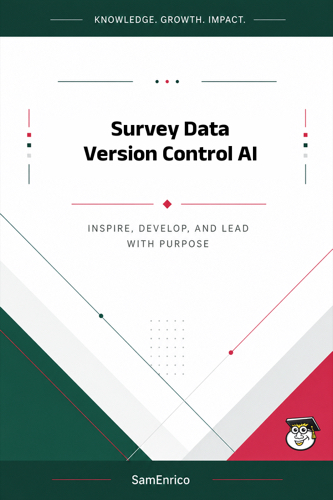
Documentation Version Control eBook
Use AI to track and summarize changes between tech
Use AI to track and summarize changes between technical documentation versions.
Formats
Free sample
Chapter 1: The $1.7 Million Comma--–- Every documentation meeting starts the same way. Someone pulls up a Git log. Someone else says, "The docs are in version control, so we're fine." Everyone nods. The meeting ends. And somewhere, right now, a customer is about to get the wrong answer because of that nod.This is not a book about Git.
This is not a book about technical writing best practices. This is a book about a specific, expensive, and largely invisible problem that is getting worse every day as companies rush to deploy AI assistants on top of documentation that was never designed to be read by machines.The problem is this: your documentation is versioned. But your version control system is lying to you about what actually changed.Let me prove it to you.The Comma That Changed Everything In 2021, a fintech startup I'll call Pay Flow (not their real name, but the story is real) maintained API documentation in a standard Git repository. Their docs were "version controlled." They had a CHANGELOG.md. They even had a policy that every code PR required a corresponding docs PR.Then a developer changed one line in authentication.md.The original line read: "The timeout parameter is optional, default 30 seconds."The new line read: "The timeout parameter is optional – default 30 seconds."That is the entire change.
A comma became an em dash. Every diff tool in existence showed this as a one-character modification. The developer wrote a commit message: "fix: formatting in auth docs." The PR was approved in thirty seconds. The change merged.Three days later, a Pay Flow customer integrating their payment system noticed that transactions were timing out after exactly 30 seconds – but their integration was supposed to use a custom 90-second timeout they'd configured. They opened a support ticket.
The support agent checked the documentation. It said the parameter was optional. The agent told the customer, "The parameter works. Check your implementation."The customer spent forty-seven engineering hours debugging their code. They found no bug.
They escalated to Pay Flow's Tier 3 support. A senior engineer finally discovered the truth: the parameter had never been optional. The comma had been a typo. The original author meant to write "The timeout parameter is optional? Default 30 seconds" – a question they'd intended to resolve later.
When the developer changed the comma to an em dash, they inadvertently made the statement definitive. The documentation now claimed something that was false, and the support agent relied on that false claim.The cost: $1.7 million in waived fees, customer compensation, and reputational damage.Git didn't flag the change as significant. No diff tool highlighted it. No CI check caught it. Because line-level version control cannot distinguish between a comma and a contradiction.The 58% Number That Should Terrify You The Pay Flow story is bad.
What's coming is worse.Between January and March of 2024, a team of researchers (including engineers from three Fortune 500 companies who agreed to share anonymized data) tested the accuracy of standard Retrieval-Augmented Generation systems on versioned documentation. They built a simple RAG chatbot, the kind that thousands of companies are deploying right now. They pointed it at documentation repositories with multiple versions – v1.0 through v3.5 of API docs, software user guides, and internal knowledge bases.Then they asked version-specific questions."What was the maximum file upload size in v1.2?""Which authentication methods were supported in the February 2023 release?""Which parameters did the /user/create endpoint accept in v2.0?"The RAG systems had access to all versions of the documentation. They could see every file, every commit, every historical change.The results were devastating.Across three enterprise documentation sets (financial services API, healthcare Saa S platform, and e-commerce checkout system), the RAG systems answered correctly only 58% of the time. That is not a typo.
Fifty-eight percent. Which means that nearly half the time – 42% – they gave answers that were wrong, misleading, or dangerously conflated.Here is what "wrong" looks like in practice:Version conflation: A user asks about v2.3. The RAG system retrieves chunks from v1.0, v2.3, and v3.5 (which hasn't been released yet). It generates an answer that combines all three: "The endpoint accepts parameters X, Y, and Z." But v2.3 didn't support Z. That was added in v3.5.
The user's integration fails.Temporal hallucinations: A user asks, "When was the /delete endpoint deprecated?" The RAG system sees a deprecation notice in v2.8 and an actual removal in v3.2. It invents a date in between: "Deprecated in v3.0." There is no v3.0. The system hallucinated.Silent contradictions: The documentation for v2.1 says "rate limiting is 1000 requests per hour." The documentation for v2.4 says "rate limiting is 5000 requests per hour." The RAG system retrieves both but doesn't know which applies to the user's version. It picks arbitrarily. Sometimes it's right.
Sometimes it's wrong. The user has no way to know.Fifty-eight percent accuracy is not a bug. It is a structural feature of putting old-fashioned version control in front of modern AI systems. The two were never designed to work together.Why Git Is Lying to You Right Now Git is an extraordinary tool. It has changed how software is built.
But Git was designed for source code, and source code has properties that documentation does not.Source code is executed. If you change a line of code and it's wrong, the program crashes or fails tests. There is immediate, unambiguous feedback. Documentation is read. If you change a line of documentation and it's wrong, a human being – or an AI – might believe it for months before discovering the error.
There is no compiler for prose.Here are three specific ways Git lies to you about your documentation. I want you to check your own repositories after reading this chapter. You will find every single one.Lie #1: The Binary Blind Spot Open a Git repository that contains PDF files, Word documents, Power Point decks, or images. Run git log on one of those files. Then run git diff between two versions.What do you see?You see "Binary files differ" or "file changed." That is all.
Git cannot tell you what changed inside a PDF. It cannot tell you that a diagram was updated, that a chart's numbers changed, that a screenshot shows a different UI. It can only tell you that something changed – and that something is completely opaque to automation.This matters because documentation is increasingly binary. API blueprints are PDFs. Architecture diagrams are PNGs.
Training materials are Power Point decks. Your version control system treats all of them as black boxes. When a compliance auditor asks, "What changed in the security architecture diagram between Q1 and Q2?" your answer is, "Something changed. We're not sure what."Lie #2: The Semantic Noise Problem Consider two changes to a documentation file.Change A: Change the word "deprecated" to "removed" in an API reference.Change B: Change a comma to a period in a tutorial introduction.Git shows both changes identically: a one-line modification. The diff output for Change A might be:- This feature is deprecated.+ This feature is removed.The diff output for Change B might be:- Click submit, then wait.+ Click submit.
Then wait.To a line-level diff, these are the same. To a reader, they are catastrophically different. Change A tells thousands…
This is the end of the free sample. Get the eBook to keep going. Buy now
About this book
Details
- Author
- Hardman Rochel
- Publisher
- SamEnrico
- Language
- English
- Genre
- Non-Fiction, AI Operator, Version Control
- Released
- 2026-06-01
- Pages (approx.)
- 145
- Available as
- eBook, Audiobook

Read better in the ZLOADR app
Your eBooks on your phone or tablet. Sign in with your SamEnrico account and start reading.
More by Hardman Rochel
 Loving Kindness for LGBTQ+ FolksHardman Rochel$11.99
 Macedonian Australian Return To Ohrid GuideHardman Rochel$11.99
 Anapanasati For Migraine GuideHardman Rochel$11.99
 Congo Crisis Lumumba AssassinationHardman Rochel$11.99
 The Self Doubt Exposure Therapy GuideHardman Rochel$11.99
 The Phantom of the Champs-Élysées: The Unsolved Murder of French Actress Simone GenetHardman Rochel$11.99
 How to Become a Lace-paper-machine OperatorHardman Rochel$11.99
 HCM Implementation ConsultantHardman Rochel$11.99
 Toyota Lean Manufacturing GuideHardman Rochel$12.99