
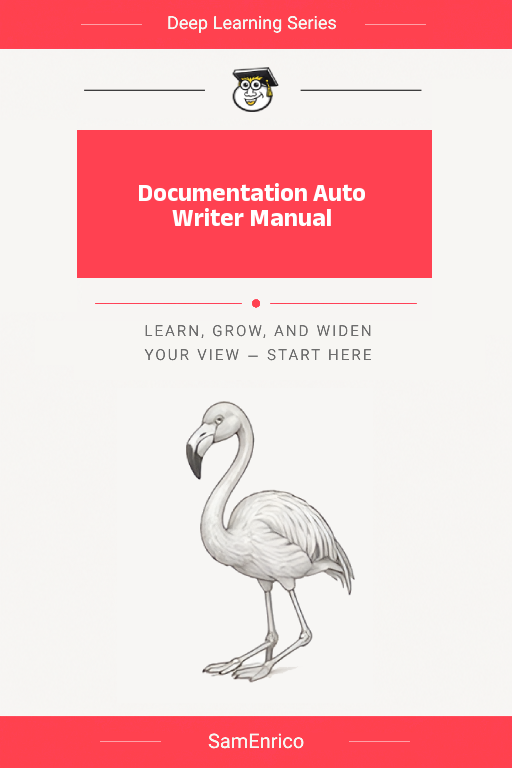
Non-FictionAI OperatorSoftware CraftDocs Guide
Documentation Auto Writer Manual Audiobook
Generate docstrings, READMEs, and inline comments
Generate docstrings, READMEs, and inline comments from code using AI context understanding. Includes parameter descriptions, usage examples, and API reference extraction prompts.
Formats
Free sample
Chapter 1: The 2 AM Confession...--It starts with a confession. Not the kind you whisper in a darkened room, but the kind that scrolls across a Slack channel at 2:17 AM on a Tuesday. The kind that every engineer has typed, read back, and felt a dull ache of recognition."I know the docs are wrong. I just don't have time to fix them. The code ships tomorrow."You have sent this message. Or you have received it. Or you have been the user on the other end, staring at an API response that contradicts everything the README promised, muttering words your mother would not approve of.This chapter is not about documentation as a nice-to-have. It is not about best practices that you will bookmark and ignore. It is about the gap between what your code does and what people think it does—and the slow, expensive, embarrassing cost of leaving that gap unfilled.Let me tell you about a fintech startup called Verix. Not their real name, but their real story. In 2023, they lost a $2.1 million client because their API documentation claimed that a POST /payment/authorize endpoint returned a status field with values approved, declined, or pending. What the code actually returned, after a silent refactor six months earlier, was authorized, rejected, or processing. The client's integration script looked for approved. It never found it. Transactions failed silently for eleven days before anyone noticed. The client left. The post-mortem had 47 bullet points. None of them said "we didn't have enough documentation." All of them implied it.This is not a horror story. It is a Tuesday.The Three Lies We Tell Ourselves About Documentation Before we fix the problem, we have to name the lies that keep us stuck. You have told yourself these lies. I have told myself these lies. They are seductive because they contain a grain of truth wrapped in a blanket of exhaustion.Lie #1: "The Code Is the Documentation"This is the battle cry of the minimalist. The argument goes: if your code is clean, well-named, and properly structured, anyone can read it and understand what it does. Therefore, you do not need separate documentation.Here is why this is a lie: code tells you what happens. It does not tell you why a particular decision was made, which edge cases were intentionally ignored, how two services are supposed to interact across version boundaries, or what the author was thinking…
This is the end of the free sample. Get the Audiobook to keep going. Buy now
About this book
Details
- Author
- Mundy Bernardo
- Publisher
- SamEnrico
- Language
- English
- Genre
- Non-Fiction, AI Operator, Software Craft, Docs Guide
- Released
- 2026-06-01
- Pages (approx.)
- 137
- Available as
- eBook, Audiobook

Listen in the VoxFlicks app
Audiobooks and audio dramas wherever you go. Sign in with your SamEnrico account and press play.
More by Mundy Bernardo
 MBSR For Financial Anxiety WorkbookMundy Bernardo$11.99
 Burnout Prevention for Accountants HandbookMundy Bernardo$11.99
 Workplace Stress for AccountantsMundy Bernardo$11.99
 Ezekiel Visionary ProphetMundy Bernardo$11.99
 The Self Esteem for New Mothers GuideMundy Bernardo$11.99
 The Dragon’s Bride: A Flame-Bound HeartMundy Bernardo$11.99
 Understanding Kocher–debré–semelaigne SyndromeMundy Bernardo$17.99
 SaaS in Retail GuideMundy Bernardo$12.99
 How to Start a Hobby in Shooting rifles - pistols - and shotgunsMundy Bernardo$11.99
 Aircraft EngineerMundy Bernardo$11.99
You may also like
 Hong Kong Handover 1997Dunn Johnnie$11.99
 Zumba For Postnatal Recovery CourseNeal Christian$11.99
 Zumba for BeginnersLadner Nikia$11.99
 YouTube Comment Mining GuideHumes Pandora$12.99
 Worry Box MeditationCarlin Rudy$11.99
 Workplace Stress MeditationNguyen Lynn$11.99
 Workplace Stress and Sleep RepairHawley Ivory$11.99
 Workplace Perfectionism CureDelaney Jeffry$11.99
 Workplace Injustice Anger GuideWallen Isabelle$11.99
 Work Addiction and Burnout LinkGreenwood Ester$11.99
 Women in Yoga and WellnessBeattie Galina$11.99
 Women in Stand Up ComedyChun Evangeline$11.99