
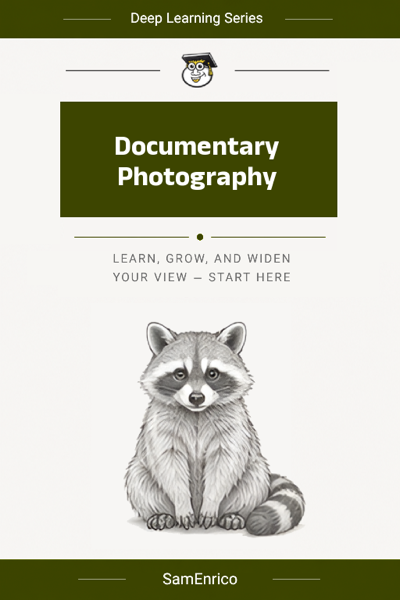
Non-FictionInformativeEducational
Documentary Photography eBook
A Coursebook on Documentary Photography
A Coursebook on Documentary Photography
Formats
Free sample
Chapter 1: The Frame Lies...--– The first lie you will learn in this book is that a camera tells the truth. You have heard it a thousand times—"the camera never lies," "a photograph is proof," "seeing is believing." These phrases are not just misleading; they are the opposite of what documentary photography actually is. Every time you lift a camera to your eye, you begin a process of exclusion, emphasis, and interpretation. You choose what stays in the frame and what gets left out. You decide when to press the shutter and when to wait.
You select which lens renders the scene wide or tight, which aperture throws the background into soft oblivion or sharpens every branch and brick, which moment of a thousand passing seconds becomes permanent. None of these choices are neutral. None of them are "truth" in any simple sense. And yet, documentary photography remains one of the most powerful tools for social witness, historical memory, and human connection that has ever been invented. The paradox is not a problem to solve.
It is the engine of the entire medium.This chapter dismantles the comfortable assumption that a documentary photograph is an objective slice of reality. It does so not to discourage you, but to wake you up. By the time you finish these pages, you will understand why documentary is not a mirror but a point of view—an argument about how the world is or should be. You will learn to ask the single most important question before you ever touch a shutter button: "What is my bias, and how will it shape this story?" And you will begin a practice—the Listening Exercise—that will transform how you see long before you ever look through a viewfinder.The Invention of a Word: "Documentary" and Its Baggage In 1926, the Scottish filmmaker John Grierson wrote a review of Robert Flaherty's film Moana in the New York Sun. Searching for a word to describe Flaherty's approach—somewhere between journalism and art, between fact and interpretation—Grierson landed on "documentary." He called it "the creative treatment of actuality." That phrase is worth sitting with.
Creative treatment and actuality in the same sentence. Grierson was not confused. He was precise. He understood that documentary was never about simply pointing a camera at something real and walking away. It was about shaping reality into a form that could be seen, felt, and understood by an audience.
The creativity was not a corruption of truth. It was the vehicle for truth.Crucially, Grierson was speaking about film, not photography. This distinction matters more than most photography books acknowledge. Film has always been understood as a constructed medium—editing, sound design, voiceover, multiple cameras. No one watches a documentary film and believes they are seeing unmediated reality.
But photography carries a different cultural weight. The single image, frozen in time, feels more like evidence. It feels like proof. A photograph can be entered into a court of law. A photograph can win a Pulitzer Prize.
A photograph can start a war or end one, or at least shift public opinion enough that politicians feel the pressure to act. This evidentiary power is both the glory and the danger of documentary photography. The glory is that it matters. The danger is that we forget the creative treatment that brought it into being.So let us establish the foundational paradox of this entire book: Documentary photography is the most truthful form of lying you will ever practice. You will not fake events.
You will not stage moments and pretend they are spontaneous. You will not move objects or remove trash cans or add tears where none fell. Those are forms of deception, and they have no place in ethical documentary work. But you will frame. You will crop.
You will wait for the right light. You will choose black and white or color. You will decide which face among a crowd becomes the face of the story. These are creative treatments of actuality. They are not lies.
They are interpretations. And the difference between interpretation and deception is the difference between documentary and fraud.What This Book Is Not Before we go any further, let us be clear about what this book is not. It is not a camera manual. You will not find detailed instructions for every button on your Sony, Canon, Nikon, Fuji, or Leica. There are hundreds of excellent books for that, and you should own one.
This book assumes you have a camera—any camera, including your phone—and that you know how to make it expose an image reasonably well. If you do not yet know the difference between aperture and shutter speed, take a weekend to learn. Then come back. The technical skills matter, but they are not the heart of documentary work.This book is also not a history of photography, though you will meet the essential figures—Jacob Riis, Lewis Hine, Dorothea Lange, Walker Evans, Robert Frank, Nan Goldin, and others. It is not a grant-writing guide, though you will learn how to write a project statement.
It is not a photobook design manual, though you will learn how to sequence images. It is, instead, a coursebook on thinking—on seeing the world with intention, on understanding your relationship to the people you photograph, on making images that outlast the scroll of an Instagram feed. It is about the relationship between the photographer and the subject, between the frame and what lies beyond it, between your biases and the story you are trying to tell.The Listening Exercise: Where You Begin Most photography books start with a camera. This one starts with your mouth closed and your ears open. Before you read another chapter, you are going to begin a two-week exercise that will become the foundation of everything that follows.
It is called the Listening Exercise, and it is deceptively simple: for fourteen days, you will not take a single photograph of the community or subject you hope to document.Instead, you will go to that place—a barbershop, a farmer's market, a church, a laundromat, a factory floor, a street corner, a community center, a playground, a bus stop—and you will simply be there. You will sit. You will watch. You will take notes in a small notebook, but not about compositions or lighting. You will write down names, routines, jokes, complaints, silences, the way people greet each other, the way they say goodbye.
You will learn when business is slow and when it is frantic. You will learn who tells stories and who listens. You will learn what people are proud of and what they wish would change.On day fifteen, you may bring your camera. But by then, something will have shifted. You will no longer be a stranger with a lens.
You will be someone who has shown up, who has listened, who has earned the right to ask. And the people you photograph will sense that difference. They will not pose for you the way they would for a tourist or a journalist on a deadline. They will be themselves, because you have already seen them being themselves…
This is the end of the free sample. Get the eBook to keep going. Buy now
About this book
Details
- Author
- Cleary Cristie
- Publisher
- SamEnrico
- Language
- English
- Genre
- Non-Fiction, Informative, Educational
- Released
- 2026-05-06
- Pages (approx.)
- 137
- Available as
- eBook, Audiobook

Read better in the ZLOADR app
Your eBooks on your phone or tablet. Sign in with your SamEnrico account and start reading.
More by Cleary Cristie
 Internal Mobility BenchmarksCleary Cristie$11.99
 Mindful Stretching BreakCleary Cristie$11.99
 Smith Wigglesworth PentecostCleary Cristie$11.99
 The Mechanical Engineer InnovationCleary Cristie$11.99
 The Complicated Grief and Substance UseCleary Cristie$11.99
 The Hollow Hunger: The Last Survivors of the Dyatlov PassCleary Cristie$11.99
 Understanding Sudden Cardiac DeathCleary Cristie$17.99
 Purchase Price Allocation GuideCleary Cristie$12.99
 GRASP Certification ExportCleary Cristie$12.99
 How to Become a Squeegee TenderCleary Cristie$11.99
You may also like
 Hong Kong Handover 1997Dunn Johnnie$11.99
 Zumba For Postnatal Recovery CourseNeal Christian$11.99
 Zumba for BeginnersLadner Nikia$11.99
 YouTube Comment Mining GuideHumes Pandora$12.99
 Worry Box MeditationCarlin Rudy$11.99
 Workplace Stress MeditationNguyen Lynn$11.99
 Workplace Stress and Sleep RepairHawley Ivory$11.99
 Workplace Perfectionism CureDelaney Jeffry$11.99
 Workplace Injustice Anger GuideWallen Isabelle$11.99
 Work Addiction and Burnout LinkGreenwood Ester$11.99
 Women in Yoga and WellnessBeattie Galina$11.99
 Women in Stand Up ComedyChun Evangeline$11.99